
Have you ever wanted something badly, worked for it, and then received a disappointing “no”?
Maybe you applied for a job and someone else was selected. Maybe a relationship ended when you thought it would last. Perhaps a business idea failed, an important opportunity disappeared, or a goal you had been chasing suddenly became impossible.
In those moments, rejection can feel like a closed door.
It is natural to wonder, “Why did this happen to me?”
But sometimes, the answer becomes clearer with time.
A rejection that feels painful today may eventually lead you toward an opportunity you could not see before. A setback may force you to learn something new, change direction, meet different people, or discover abilities you never knew you had.
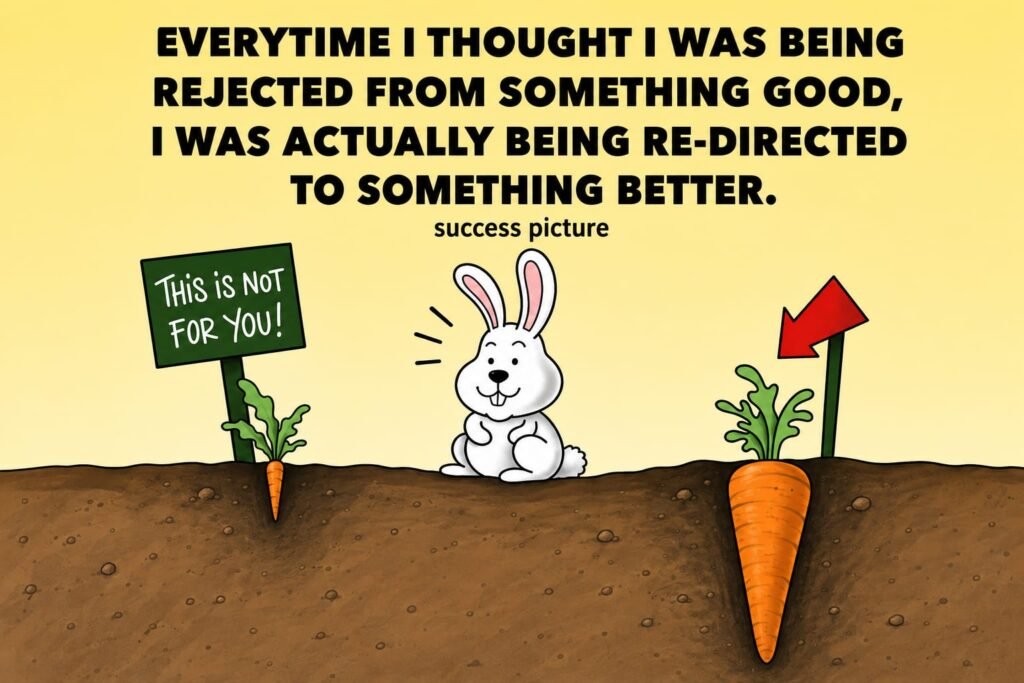
This is the idea behind rejection becoming redirection.
It does not mean every disappointment is secretly good or that difficult experiences should simply be ignored. Rejection can genuinely hurt. However, you can choose what you do next.
Instead of allowing one setback to define your future, you can use it as information, motivation, and a reason to explore a different path.
What Does “Rejection Becomes Redirection” Mean?
The phrase rejection becomes redirection describes the possibility that losing one opportunity can lead you toward another.
Imagine someone applying for their dream job. They prepare carefully, attend the interview, and believe they have a strong chance. Then they receive an email saying another candidate was selected.
At first, it feels like failure.
But perhaps the experience encourages that person to improve their skills. A few months later, they apply for another position that suits their strengths even better. This time, they are successful.
The first rejection did not guarantee the second opportunity.
What changed was the person’s response.
They did not allow disappointment to become the end of their story.
That is the important lesson.
A closed door does not automatically tell you where to go next, but it can encourage you to look for another door.
1. Rejection Does Not Define Your Worth
One of the biggest mistakes people make after rejection is connecting the outcome to their personal value.
If you are rejected for a job, you may think you are not talented enough.
If someone does not return your feelings, you may think you are not lovable.
If a business idea fails, you may believe you are incapable of success.
But an outcome and your personal worth are not the same thing.
A company can reject an applicant because another candidate has slightly different experience. A customer may reject a product because it does not fit their needs. A person may decide that a relationship is not right for them for reasons that have little to do with your value.
The lesson
A rejection is an event, not an identity.
You experienced rejection. You are not a rejected person.
That distinction can protect your confidence and help you continue moving forward.
2. Sometimes You Need a Different Direction
We often become attached to a particular version of success.
We imagine a specific job, relationship, city, business, or lifestyle.
When that exact plan does not happen, we may believe our future has disappeared.
But life rarely follows a perfectly straight line.
Consider someone who spends years preparing for one career but later discovers that another field suits their personality and strengths much better.
The original plan was not necessarily wasted.
The knowledge, discipline, relationships, and experience gained along the way may become useful in the new direction.
The lesson
Your destination may change without making your journey meaningless.
Sometimes you do not need to abandon your dreams. You simply need to discover a better route.
3. Rejection Can Reveal What You Really Want
A setback can force you to examine your goals.
Before rejection, you may have assumed that you wanted something because everyone around you expected it.
After losing it, you may discover that you were chasing approval rather than genuine fulfillment.
For example, someone might spend years trying to reach a prestigious position because they believe success means having an impressive title.
After being rejected from a promotion, they may realize that what they actually want is flexibility, creativity, meaningful work, or more time with family.
The disappointment becomes a moment of reflection.
The lesson
When something does not work out, ask yourself:
“Did I truly want this, or did I simply want to be chosen?”
The answer can change your direction.
4. Setbacks Can Make You Stronger
Strength is rarely developed when everything goes perfectly.
Challenges force you to adapt.
A failed project can teach planning.
A difficult interview can improve communication.
A missed opportunity can encourage preparation.
A business failure can reveal weaknesses in a strategy.
A personal disappointment can teach emotional resilience.
The experience may not be pleasant, but it can become valuable if you learn from it.
The lesson
You cannot control every setback, but you can control whether you learn from it.
5. The First Response Should Be Reflection, Not Panic
When rejection happens, emotions can be intense.
You may feel angry, embarrassed, disappointed, or confused.
There is nothing wrong with experiencing those emotions.
The important thing is not to make major decisions while overwhelmed.
Give yourself time to process what happened.
Then ask:
- What exactly happened?
- What was within my control?
- What was outside my control?
- What can I learn?
- What could I improve?
- What should I try next?
These questions turn emotional pain into useful information.
The lesson
Pause before reacting. Reflect before deciding.
TRY OUR FREE QUOTE GENERATOR
6. Learn the Difference Between Failure and Feedback
Not every rejection means you failed.
Sometimes it is simply feedback.
Imagine applying for ten jobs and receiving several rejections.
Instead of concluding, “Nobody wants me,” examine the pattern.
Perhaps your resume needs improvement.
Maybe your interview technique needs work.
Perhaps you are applying for roles that do not match your experience.
The rejection provides information that can improve your next attempt.
The lesson
Do not treat every “no” as a final judgment.
Sometimes it is simply information about what needs to change.
7. Do Not Let One “No” Become Your Permanent Story
One rejection can become psychologically powerful when you repeat it to yourself.
“I failed.”
“I always lose.”
“Nothing works for me.”
“I will never succeed.”
These statements transform one event into a permanent identity.
Instead, use more accurate language:
“This attempt did not work.”
“This opportunity was not right for me.”
“I need a different approach.”
“I can try again.”
Your language influences how you interpret your circumstances.
The lesson
Do not turn a temporary setback into a permanent belief about yourself.
8. Successful People Have Also Faced Rejection
When you look at successful people from a distance, their achievements can make their journeys appear effortless.
But many successful individuals have experienced failure, criticism, rejection, or major setbacks.
The important lesson is not that rejection guarantees success.
It does not.
The lesson is that rejection does not make success impossible.
People who continue learning, adapting, and trying new approaches can eventually create opportunities that were not visible during their earlier struggles.
The lesson
You do not need a perfect history to build a successful future.
9. A Closed Door Can Encourage Creativity
When your original plan stops working, you may have to become more creative.
Suppose you planned to start a business using one strategy, but customers do not respond.
You now have a choice.
You can quit.
Or you can investigate why the strategy failed and try something different.
Perhaps the target audience needs to change.
Perhaps the product needs improvement.
Perhaps your marketing message needs to be clearer.
Perhaps another business model would work better.
The obstacle forces you to think.
The lesson
Sometimes limitations encourage solutions that comfort never would have produced.
10. Rejection Can Introduce You to New Opportunities
When one path closes, your attention may shift.
You might meet new people.
Explore a different industry.
Learn a new skill.
Move to a new location.
Start a new project.
Discover an interest you previously ignored.
The opportunity may not appear immediately.
That is why patience matters.
Redirection is often a process rather than a sudden event.
The lesson
Do not expect the next opportunity to appear immediately after the previous one disappears.
Keep moving and stay open.
TRY OUR FREE QUOTE GENERATOR
11. Do Not Romanticize Every Rejection
There is an important balance here.
It is tempting to say, “Everything happens for a reason.”
Sometimes that statement can feel comforting, but life is more complicated.
Some setbacks are simply painful events.
You do not need to pretend that something bad was good.
Instead, focus on what you can control.
You can acknowledge the disappointment while still deciding to grow.
You can say:
“I did not want this to happen, but I will decide what I do next.”
That is a much healthier approach.
The lesson
You do not have to love the setback to learn from it.
12. Rejection Can Strengthen Self-Reliance
When everything works according to plan, it is easy to depend on external validation.
Rejection challenges that dependence.
You begin learning how to encourage yourself.
You learn that someone else saying “yes” is wonderful, but someone saying “no” does not have to destroy your confidence.
Over time, this can create emotional independence.
The lesson
Build a relationship with yourself that does not depend entirely on other people’s approval.
13. Keep Your Long-Term Goal Bigger Than One Opportunity
Imagine that your goal is to build a successful career.
One particular job is an opportunity, not the entire goal.
If you are rejected from that job, the goal still exists.
If your goal is to become financially independent, one failed project does not erase the objective.
If your goal is personal growth, one difficult period does not cancel your progress.
The lesson
Do not confuse the vehicle with the destination.
One opportunity is only one possible route toward a larger goal.
14. Persistence Does Not Mean Doing the Same Thing Forever
There is a difference between persistence and stubbornness.
Persistence means continuing to pursue something meaningful.
Stubbornness can mean repeating the same ineffective behavior without learning.
Imagine someone repeatedly applying for the same type of position with the same resume and the same interview approach.
Continuing to apply is not enough.
They may need to improve their skills, change their strategy, seek feedback, or explore related roles.
The lesson
Keep the ambition.
Improve the approach.
15. Use Rejection as a Chance to Upgrade Yourself
A setback can become a personal development project.
Ask yourself what would make you more prepared for the next opportunity.
Perhaps you need:
- Better communication skills
- More technical knowledge
- Stronger writing
- Better time management
- Greater confidence
- More experience
- A stronger professional network
- Improved decision-making
Instead of spending all your energy asking why someone rejected you, ask:
“What can I improve before the next opportunity arrives?”
That question puts you back in control.
TRY OUR FREE QUOTE GENERATOR
16. Your Timeline Does Not Have to Match Someone Else’s
Social media can make rejection feel even worse.
You may see someone else getting the job, launching the business, getting married, buying a home, or achieving a major goal while you are dealing with disappointment.
Remember that you are seeing selected moments of their lives.
Your journey has its own timeline.
Someone else reaching a milestone earlier does not mean you have missed your opportunity.
The lesson
Do not turn someone else’s progress into evidence that you are falling behind.
17. Rejection Can Teach You Patience
Some opportunities require preparation before they become possible.
A rejection may create time for you to develop.
You may need another year of experience.
You may need additional education.
You may need to understand yourself better.
You may need to become more financially stable.
Waiting can be frustrating, but preparation can make future opportunities easier to handle.
The lesson
Sometimes the delay is not the destination.
It is preparation.
18. Build a Habit of Looking for the Next Step
When disappointment happens, avoid asking only:
“Why did I lose this?”
Also ask:
“What is the next useful thing I can do?”
The next step might be very small.
Update your resume.
Send one application.
Study for thirty minutes.
Contact someone in your field.
Write a new business idea.
Go for a walk and clear your mind.
Make a plan for tomorrow.
Small actions restore momentum.
The lesson
You do not need to solve your entire future today.
You only need to identify the next useful step.
19. Sometimes the Better Opportunity Looks Different
People often expect redirection to produce something that looks exactly like the original dream—only better.
That may not happen.
The better opportunity could be completely different.
A person who planned to work for a large company might eventually build a small business.
Someone who wanted one career might discover another profession.
Someone who expected one relationship to last might eventually develop a healthier relationship with someone else.
The new path may initially feel unfamiliar.
The lesson
Do not reject a new opportunity simply because it does not resemble your original plan.
20. Give Yourself Permission to Begin Again
Starting again is not proof that you are weak.
It is proof that you are willing to continue.
You can begin again at twenty.
At thirty.
At forty.
At fifty.
At sixty.
There is no universal deadline for personal growth.
A setback may change your direction, but it does not have to end your journey.
The lesson
Beginning again is still beginning.
A Practical 7-Step Way to Turn Rejection Into Redirection
If you are currently dealing with a setback, try this simple process.
Step 1: Accept What Happened
Do not waste energy pretending the rejection did not hurt.
Acknowledge it.
Step 2: Give Yourself Time
Emotional recovery does not always happen immediately.
Give yourself space to think clearly.
Step 3: Separate Facts From Assumptions
The fact may be:
“I was not selected.”
The assumption might be:
“I am not good enough.”
Do not confuse the two.
Step 4: Identify the Lesson
Ask what the experience can teach you.
Step 5: Improve One Thing
Choose one skill, habit, or strategy to strengthen.
Step 6: Look for Alternative Paths
Explore other opportunities that can move you toward your larger goal.
Step 7: Take One New Action
Do something practical.
Send an application.
Learn a skill.
Make a call.
Start a project.
Take the next step.
What to Remember When You Feel Rejected
When rejection feels overwhelming, remember these simple ideas:
One “no” is not your entire story.
A setback does not erase your previous progress.
Your worth is not determined by one person’s decision.
A different path can still lead to a meaningful destination.
You can change your strategy without abandoning your dream.
Growth often begins when the original plan stops working.
Frequently Asked Questions
Is rejection always a sign that something better is coming?
No. There is no guarantee that every rejection will immediately lead to something better. The useful idea is that you can choose to respond to rejection in a way that creates new possibilities.
How do I stop taking rejection personally?
Start by separating the event from your identity. A specific rejection usually reflects a particular situation, decision, preference, timing, or set of circumstances. It does not automatically define your overall worth or ability.
Can rejection help personal growth?
Yes. Rejection can encourage reflection, resilience, skill development, adaptability, and clearer goals. The benefit comes from how you process and respond to the experience.
What should I do immediately after rejection?
Allow yourself to acknowledge the disappointment, avoid impulsive decisions, identify what you can learn, and decide on one practical next step.
How can I stay motivated after repeated rejection?
Focus on controllable actions. Improve your skills, change your strategy when necessary, track your progress, and keep your larger goal separate from any single opportunity.
Final Thoughts
Rejection can feel like a dead end.
But sometimes what looks like an ending is simply a change in direction.
The job you did not get may encourage you to develop a skill that leads somewhere else. The project that failed may teach you how to build a better one. The relationship that ended may give you time to understand yourself more deeply. The opportunity that disappeared may create space for something you never considered.
None of this means you should ignore disappointment.
Feel it.
Learn from it.
Then keep moving.
The most important question after rejection is not always “Why wasn’t I chosen?”
Sometimes the better question is:
“Where can I go from here?”
Your future is larger than one rejection.
Your potential is larger than one failure.
And your journey does not have to end simply because one path has closed.
Sometimes rejection closes a door. Sometimes it points you toward a different one.
Keep looking.
Keep learning.
Keep growing.
Your next chapter may begin where your previous plan ended.
SHARING IS CARING 💖