
How Japan rebuilt after World War II is one of the most remarkable stories of recovery, economic transformation, and long-term growth in modern history. When the war ended in 1945, Japan faced enormous destruction, shortages, damaged infrastructure, and an uncertain future.
Cities had been devastated. Industrial facilities and infrastructure had suffered enormous damage. Millions of people had been displaced or returned from overseas. Food shortages, inflation, unemployment, and disrupted trade created enormous pressure on ordinary families.
Japan was not simply trying to rebuild factories. It was trying to rebuild an entire society.
And yet, within a few decades, Japan had transformed itself into one of the world’s most important industrial economies.
Its companies became famous for automobiles, electronics, machinery, cameras, ships, and precision manufacturing. Japanese products began appearing in homes around the world. By the 1960s, the country had become a symbol of rapid economic development.
This remarkable transformation is often called the Japanese economic miracle.
But there was no single secret behind it.
Japan’s recovery came from a combination of difficult reforms, investment, education, industrial policy, technological learning, international trade, infrastructure development, private enterprise, and a willingness to improve over a long period.
The story is therefore more complicated—and more interesting—than the simple idea that Japan “worked hard and became successful.”
It was a long national rebuilding project involving governments, businesses, workers, families, educators, engineers, and entrepreneurs.
So how did Japan move from wartime destruction to global economic strength?
The story of how Japan rebuilt after World War II is ultimately a story of rebuilding institutions, industries, infrastructure, and confidence.
Let’s look at the story step by step.
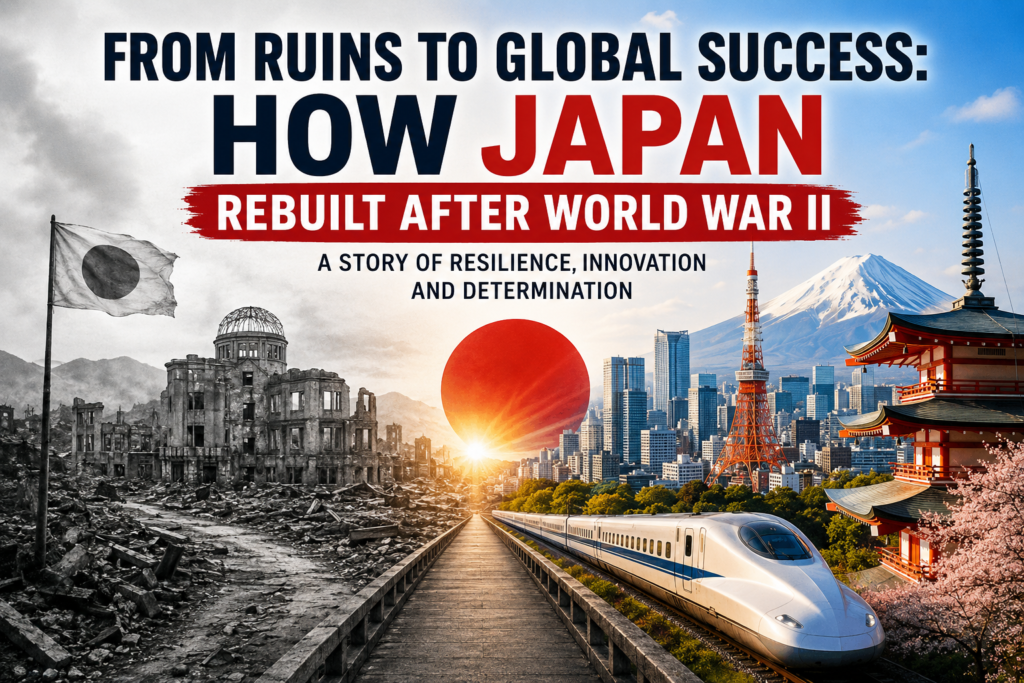
How Japan Rebuilt After World War II
The scale of Japan’s postwar problems was enormous.
The Japanese government’s historical account of the recovery describes the immediate postwar economy as being close to paralysis, with extensive damage to housing, factories, transportation facilities, roads and other infrastructure. Japan also had to absorb millions of people returning from overseas.
Japan’s Ministry of Foreign Affairs later described the industrial economy as being in extremely poor condition in the immediate aftermath of the war, with industrial production in 1946 only around 30% of its prewar benchmark.
Imagine trying to rebuild an economy under those conditions.
Factories needed repair.
Transportation systems needed restoration.
People needed food and housing.
Businesses needed capital.
The country needed access to international markets.
And the government needed to create enough stability for normal economic activity to return.
The first stage was therefore not about becoming a global economic leader.
It was about survival and reconstruction.
The First Step Was Stabilization
One important lesson from Japan’s recovery is that economic growth cannot happen easily without basic stability.
The immediate postwar period was marked by shortages and inflation.
Japan initially used extensive controls to manage the crisis. But economic policy later shifted toward stabilization and a more market-oriented system.
A major turning point came with the Dodge Line, associated with American economist Joseph Dodge in 1949. The program sought to stabilize Japan’s finances and currency and reduce inflationary pressures.
Japan’s Ministry of Foreign Affairs notes that the yen was fixed at 360 to the U.S. dollar in 1949 as part of the stabilization effort, helping establish a more predictable economic environment.
This was not a glamorous part of the Japanese success story.
There were difficult consequences.
But stability mattered.
Businesses need predictable conditions to invest. Families need reasonable economic stability to plan. Investors need confidence. Manufacturers need functioning markets.
Before Japan could accelerate, it had to create a foundation on which acceleration was possible.
Land Reform Changed the Economic Structure
Another important postwar change was land reform.
During the occupation period, Japan underwent significant institutional reforms, including changes to land ownership, labor laws and competition policy.
Land reform reduced the concentration of agricultural land ownership and changed relationships between landowners and tenant farmers.
This mattered because economic development is not only about factories and machines.
It is also about institutions.
Who owns assets?
Who has opportunities?
How are markets organized?
How do workers participate in the economy?
How can businesses compete?
Postwar reforms helped reshape the economic environment in which Japan would later grow.
The Transformation of Industry
Once basic stability began improving, Japan needed to rebuild productive capacity.
The country concentrated heavily on industries such as:
- Steel
- Coal
- Electricity
- Chemicals
- Machinery
- Transportation
- Manufacturing
The goal was not simply to restore old factories.
Japan increasingly invested in newer equipment and production methods.
This became one of the most important characteristics of the country’s recovery.
Japan had lost enormous amounts of physical capital during the war, but rebuilding also created an opportunity: factories could be modernized rather than simply restored exactly as they had been.
Historical accounts of Japan’s development note the importance of investment in industrial capacity and infrastructure during the early postwar period.
This created an important cycle:
Investment → better equipment → higher productivity → greater production → more income → more investment.
The cycle became increasingly powerful.
Education Was One of Japan’s Long-Term Advantages
If factories were the physical foundation of recovery, people were the human foundation.
Japan already had a relatively strong educational tradition before World War II, and postwar education remained important to economic development.
An OECD survey from the 1960s highlighted Japan’s education levels as one factor associated with the country’s productive workforce.
This matters because modern manufacturing requires more than physical labor.
Workers need to understand machinery.
Engineers need mathematics and science.
Managers need organizational skills.
Technicians need to solve problems.
Companies need people who can learn new production methods.
Japan’s ability to develop and use human capital became increasingly valuable as its economy moved toward more sophisticated manufacturing.
The larger lesson
A country can build factories quickly.
Building a highly capable workforce takes much longer.
Japan’s postwar experience demonstrates why investment in education can have effects that last for generations.
The Korean War Gave Japan an Unexpected Economic Boost
One of the most surprising parts of Japan’s recovery came from an event that Japan itself did not cause.
The Korean War began in 1950.
Because of Japan’s geographic position and industrial capacity, the country became an important base for procurement and repair activities connected to the conflict.
Japanese government historical accounts describe the Korean War as providing substantial procurement and repair orders that helped trigger Japan’s first major postwar boom.
This created demand for Japanese businesses.
Factories received orders.
Workers received employment.
Companies earned revenue.
Investment increased.
The immediate boom did not explain Japan’s entire long-term success, but it gave the recovering economy an important push at a critical moment.
This is a useful reminder that economic development is influenced by circumstances as well as planning.
Japan benefited from an external opportunity—but it was able to take advantage of that opportunity because it had industrial capabilities that could respond.
MITI and Japan’s Industrial Strategy
In 1949, Japan established the Ministry of International Trade and Industry, commonly known as MITI. It later became part of the institutional history that led to today’s Ministry of Economy, Trade and Industry.
MITI became closely associated with Japan’s postwar industrial policy.
Its role is sometimes simplified into the story that the Japanese government simply chose winning industries and ordered companies to succeed.
Reality was more complicated.
Government policy interacted with private businesses, banks, industrial associations, workers, international markets, and changing technologies.
Researchers continue to debate exactly how much credit should go to government industrial policy versus private investment and market forces. For example, economic histories emphasize both policy intervention and the importance of private saving, investment, and market incentives.
The important point is that Japan developed institutions capable of thinking about industrial competitiveness over the long term.
That included:
- Supporting industrial development
- Encouraging technology adoption
- Promoting exports
- Coordinating economic policy
- Helping Japanese companies adapt to international competition
Japan’s success was therefore not simply “government versus business.”
It was an interaction between the two.
Japan Did Not Invent Every Technology It Used
One of the most valuable lessons from Japan’s recovery is that innovation does not always mean inventing everything from scratch.
Japan became extremely effective at learning, adapting, improving, and commercializing technology.
Japanese companies entered into technical cooperation arrangements with foreign firms and adopted overseas technologies while adapting production methods to Japanese conditions.
An OECD assessment from 1964 specifically noted the importance of imported techniques and technical cooperation in Japan’s industrial modernization.
This is a powerful lesson for businesses and individuals.
You do not always have to invent something completely new.
Sometimes you can take an existing idea and make it:
- More reliable
- More affordable
- More efficient
- Easier to use
- Better designed
- More consistent
That approach became extremely important to Japanese manufacturing.
Manufacturing Became the Engine of Growth
Understanding how Japan rebuilt after World War II also requires looking beyond economic growth and examining how manufacturing became a foundation for the country’s transformation.
Manufacturing played a central role in Japan’s rise.
Research published in 2026 continues to identify manufacturing as a particularly important driver of Japan’s historical catch-up with Western economies.
Japan gradually developed strong capabilities in industries such as:
- Automobiles
- Electronics
- Machinery
- Shipbuilding
- Steel
- Consumer products
- Precision equipment
Japanese companies increasingly competed internationally on quality, reliability, efficiency, and price.
This was crucial because Japan had limited natural resources compared with many larger industrial economies.
It therefore had strong incentives to import raw materials and export higher-value manufactured products.
Japan’s Ministry of Foreign Affairs has described this basic economic challenge: the country needed imported resources and therefore needed manufactured exports capable of generating the foreign currency required to pay for those imports.
The World Began to Notice Japanese Quality
At first, “Made in Japan” did not automatically mean premium quality in the minds of consumers everywhere.
That changed over time.
Japanese manufacturers became increasingly associated with reliability, precision, efficiency, and attention to production quality.
Companies learned to reduce waste, improve processes, identify defects, and continuously refine manufacturing.
This became particularly influential in automobile and electronics production.
The idea of continuous improvement became closely associated with Japanese management and manufacturing culture.
But it is important not to reduce this achievement to a stereotype about Japanese workers.
Quality systems were supported by organizational structures, engineering, supplier relationships, investment, management practices, and long-term learning.
It was a system—not a magical personality trait.
Continuous Improvement Became a Competitive Advantage
One of the most useful ideas associated with Japanese manufacturing is kaizen, commonly translated as continuous improvement.
The basic idea is simple:
Instead of assuming that a process is already perfect, look for small ways to improve it.
A worker might identify unnecessary movement.
An engineer might reduce production time.
A manager might improve communication.
A factory might reduce material waste.
A company might redesign a component to make it more reliable.
Individually, each improvement may appear small.
Collectively, thousands of improvements can transform an organization.
This connects directly with the philosophy behind Success Picture:
Big results can come from small improvements repeated consistently.
Saving and Investment Helped Create Momentum
Japan’s rapid growth was also supported by high levels of saving and investment.
The OECD’s 1964 survey emphasized the relationship between rising investment and productivity growth. It noted that investment helped expand industrial productivity and that Japanese firms increasingly focused capital spending on innovation and adapting production methods.
This created another reinforcing cycle.
People saved.
Financial institutions provided capital.
Companies invested.
Factories became more productive.
Output increased.
Income increased.
More investment followed.
Economic growth became self-reinforcing.
The important point is that success did not come simply from working harder.
Capital had to be invested productively.
Infrastructure Helped Connect the Economy
Economic development requires infrastructure.
Factories need electricity.
Businesses need roads and railways.
Workers need transportation.
Companies need ports.
Goods need to reach customers.
Japan invested heavily in infrastructure as its economy expanded.
The 1964 Tokyo Olympics became a symbolic moment for the country’s transformation.
That same year, the Tokaido Shinkansen began operation, connecting Tokyo and Osaka with high-speed rail.
The Shinkansen became an international symbol of Japanese engineering and modernization.
It also demonstrated something important: infrastructure can be both a practical economic tool and a statement of national confidence.
Japan was no longer simply rebuilding.
It was demonstrating what it could build.
Japan Became More Connected to World Trade
Japan’s economic growth increasingly depended on international trade.
After the difficult early postwar period, Japan worked toward reintegration into international economic institutions and markets.
The country joined the General Agreement on Tariffs and Trade in 1955 and later became an important participant in global trade.
Its export industries expanded dramatically.
The country’s economic model increasingly relied on turning imported resources into manufactured products that could compete in international markets.
This was especially important for a country with limited domestic supplies of many raw materials.
The lesson
Japan did not try to become successful in isolation.
It learned how to compete with the world.
The Automobile Industry Changed Japan’s Global Image
Few industries illustrate Japan’s transformation better than automobiles.
Japanese manufacturers gradually became major global competitors.
They focused on reliability, production efficiency, fuel economy, engineering, and quality.
By the 1970s, Japanese automobiles had become increasingly important in international markets.
The oil shocks of the 1970s created additional demand for fuel-efficient vehicles, strengthening the position of Japanese automakers in several markets.
This shows how preparation and changing circumstances can intersect.
Japanese companies had already developed manufacturing capabilities.
Then global conditions created a new advantage for some of those capabilities.
Electronics Became Another Major Success Story
Japan also became a major force in consumer electronics.
Televisions, cameras, radios, calculators, audio equipment, and other electronic products helped Japanese companies build international brands.
The country did not simply copy foreign products forever.
Japanese companies increasingly developed their own designs, manufacturing systems, and technologies.
OECD analysis from the 1980s shows how Japanese productivity performance in electrical machinery became an important source of comparative advantage, with automation and technological change playing major roles.
This was another example of Japan’s broader strategy:
Learn → improve → manufacture efficiently → compete globally.
Japan’s Rise Was Not Perfect
It is important not to turn Japan’s recovery into a fairy tale.
Rapid economic growth brought serious problems.
Industrial pollution became severe in several areas.
Urbanization created pressure on housing and infrastructure.
Long working hours and intense workplace expectations became subjects of criticism.
Economic growth also produced environmental and social costs.
Later, Japan experienced the enormous asset-price bubble of the late 1980s, followed by a long period of economic weakness after the bubble burst.
So Japan’s story should not be presented as:
“Japan did everything right.”
That would be historically inaccurate.
A better lesson is:
Japan demonstrated how a country can achieve extraordinary progress while still facing new problems created by that progress.
The Japanese Economic Miracle Was Not Caused by One Secret
When people ask, “What was Japan’s secret?” they often want one simple answer.
There wasn’t one.
Japan’s postwar rise resulted from several forces working together:
1. Economic stabilization
Stable economic conditions created a foundation for investment.
2. Institutional reforms
Postwar reforms changed land ownership, labor relations, competition, and economic institutions.
3. Education
A relatively well-educated population provided valuable human capital.
4. Investment
Companies invested heavily in equipment, infrastructure, and productive capacity.
5. Technology
Japan adopted foreign technologies and progressively improved them.
6. Manufacturing
Industrial production became a major source of productivity and exports.
7. International trade
Japanese companies increasingly competed in global markets.
8. Infrastructure
Transportation, electricity, communications, and industrial facilities supported expansion.
9. Government policy
Institutions such as MITI helped shape industrial and trade policy.
10. Private enterprise
Businesses, entrepreneurs, engineers, and workers turned opportunities into actual products and services.
11. Long-term thinking
Many investments required years before producing their full benefits.
12. Continuous improvement
Companies constantly looked for ways to improve quality and efficiency.
The miracle was therefore not one miracle.
It was a system of mutually reinforcing improvements.
What the World Can Learn From Japan’s Recovery
Japan’s postwar history offers lessons that extend beyond economics.
Lesson 1: Rebuilding Starts With Reality
Japan did not have the luxury of pretending its problems did not exist.
The damage was enormous.
Recovery began by recognizing reality.
For individuals and businesses, the same principle applies.
You cannot improve what you refuse to acknowledge.
Lesson 2: Small Improvements Can Become Massive
A single improvement may seem insignificant.
Thousands of improvements are different.
This is why continuous improvement is so powerful.
You do not need to transform everything overnight.
Improve one process.
Then another.
Then another.
Lesson 3: Education Creates Long-Term Power
Buildings can be destroyed.
Machines can become outdated.
But knowledge can be passed from one generation to another.
Investment in education therefore creates long-lasting national capacity.
Lesson 4: Learn Before You Invent
Japan’s experience demonstrates that countries and companies can gain tremendous value by learning from technologies developed elsewhere.
The important question is not always:
“Did we invent it?”
Sometimes it is:
“Can we make it better?”
Lesson 5: Quality Builds Trust
A company that consistently produces reliable products can earn something more valuable than a single sale.
It can earn a reputation.
That reputation can create repeat customers and international opportunities.
Lesson 6: Infrastructure Matters
Talent and ambition need systems that allow them to produce results.
Good transportation, electricity, communication networks, education systems, and financial institutions can dramatically increase economic productivity.
Lesson 7: Global Competition Can Improve Companies
International competition can be difficult.
But it can also force businesses to improve.
Companies that want to survive globally have strong incentives to become more efficient, innovative, and customer-focused.
Lesson 8: Success Takes Time
Japan’s transformation did not happen overnight.
The country rebuilt in stages.
Recovery came first.
Rapid growth followed.
Industrial leadership developed over time.
This is an important lesson for anyone expecting instant results.
Long-term success is usually built long before it becomes visible.
A Simple Timeline of Japan’s Postwar Transformation
1945
World War II ends. Japan faces severe destruction, shortages, and economic disruption.
1946–1948
Japan begins major reconstruction and institutional reforms.
1949
The Dodge stabilization program begins, while MITI is established.
1950
The Korean War creates major procurement demand for Japanese businesses.
1950s
Industrial reconstruction accelerates. Investment, productivity, and manufacturing expand.
1955
Japan joins GATT and becomes increasingly integrated into international trade.
1960s
Rapid economic growth continues, with manufacturing and infrastructure expanding strongly.
1964
Tokyo hosts the Olympics and the Tokaido Shinkansen begins service.
1970s
Japan becomes an increasingly important exporter of automobiles, electronics, machinery, and other manufactured products.
1980s
Japanese companies become major global competitors in automobiles, electronics, machinery, and technology.
This timeline demonstrates that the transformation was gradual.
There was no single day when Japan suddenly became successful.
Why Japan’s Story Still Matters Today
Japan’s postwar recovery remains relevant because modern countries face many of the same fundamental questions.
How do you rebuild after a crisis?
How do you develop human capital?
How do you increase productivity?
How do you compete internationally?
How do you encourage innovation?
How do you turn limited resources into greater value?
Japan’s historical experience does not provide a perfect formula that every country can simply copy.
Every country has different institutions, demographics, resources, culture, geography, and economic conditions.
But the underlying principles remain useful.
Invest in people.
Improve infrastructure.
Encourage productive investment.
Learn from the world.
Build competitive industries.
Improve continuously.
Think beyond the next year.
Japan’s Story Is Also a Story About Resilience
Perhaps the most powerful part of Japan’s postwar story is not the economic statistics.
It is the human dimension.
Millions of ordinary people had to rebuild their lives.
Workers returned to damaged factories.
Families rebuilt homes.
Students entered schools.
Engineers repaired machines.
Business owners restarted companies.
Communities rebuilt infrastructure.
Over time, these individual efforts became something much larger.
A nation’s economic transformation is ultimately made up of millions of human decisions.
That is why Japan’s recovery can be understood not only as an economic story, but also as a story of resilience, learning, adaptation, and long-term effort.
🛠️ Explore More Success Picture Tools
Create Your Own Success Quote
Inspired by Japan’s journey from destruction to global success? Create a personalized motivational quote with our Free Quote Generator and turn your favorite words into an inspiring message.
👉 Visit our Free Quote Generator
Write, Plan & Create With Workpad
Have an idea for your next project, blog post, goal, or personal growth plan? Use Success Picture Workpad to organize your thoughts and turn ideas into action.
👉 Visit Success Picture Workpad
Explore Our Image Tools
Need to resize, compress, convert, or edit an image for your blog or social media? Explore our collection of free image tools designed to make everyday image tasks easier.
👉 Explore Success Picture Image Tools
Final Thoughts: From Ruins to Possibility
The experience of how Japan rebuilt after World War II shows that lasting transformation rarely comes from one decision; it develops through many improvements working together over time.
Japan’s journey after World War II is one of the most remarkable transformations in modern economic history.
The country emerged from the war facing destruction, shortages, inflation, disrupted trade, and an uncertain future.
Yet over the following decades, Japan rebuilt its industrial base, strengthened its institutions, invested in education and infrastructure, adopted and improved technologies, developed globally competitive manufacturing industries, and became a major participant in the world economy. Economic historians and international organizations have documented the central roles of investment, manufacturing, productivity, technology, trade, and institutional change in this transformation.
But perhaps the greatest lesson is simpler.
Japan did not rebuild its future in one giant step.
It rebuilt it through thousands of decisions.
One factory repaired.
One student educated.
One machine improved.
One product redesigned.
One process made more efficient.
One business expanded.
One export shipped.
One problem solved.
Then another.
And another.
That is how national transformation can happen.
It is also how personal transformation happens.
You may not be able to change everything today.
But you can improve one thing.
You can learn one skill.
You can make one better decision.
You can start one project.
You can solve one problem.
You can take one step forward.
Great transformations often begin with small actions repeated for a very long time.
Japan’s story is therefore more than a story about economic recovery.
It is a reminder that destruction does not necessarily have the final word.
With the right combination of people, institutions, knowledge, investment, adaptation, and persistence, a difficult starting point can become the beginning of something remarkable.
Frequently Asked Questions
How did Japan recover so quickly after World War II?
Japan’s recovery resulted from several factors working together, including economic stabilization, postwar institutional reforms, investment, education, industrial development, technological adoption, infrastructure, international trade, and private-sector activity. The Korean War also provided an important early demand boost.
What was the Japanese economic miracle?
The term generally refers to Japan’s exceptionally rapid economic growth during the postwar decades, particularly from the 1950s through the 1970s. During this period, Japan transformed into a major industrial economy.
What role did MITI play in Japan’s economic growth?
MITI, established in 1949, was an important institution in Japan’s postwar industrial and trade policy. It worked within a broader economic system involving government, businesses, financial institutions, and international markets.
Did the United States help Japan rebuild?
Yes. The U.S.-led occupation brought major institutional and economic changes, while Japan’s relationship with the United States also became important to its postwar security and economic environment. The Korean War created additional demand for Japanese production. However, Japan’s later growth cannot accurately be attributed to one external source; it resulted from many interacting domestic and international factors.
Was Japan’s recovery only about hard work?
No. Hard work alone does not explain the transformation. Education, capital investment, technology, industrial policy, infrastructure, international trade, institutions, productivity growth, and favorable external conditions were all important.
What can entrepreneurs learn from Japan’s recovery?
Entrepreneurs can learn the value of continuous improvement, investment in skills, quality control, customer focus, technological learning, efficient production, long-term thinking, and the willingness to adapt when circumstances change.