
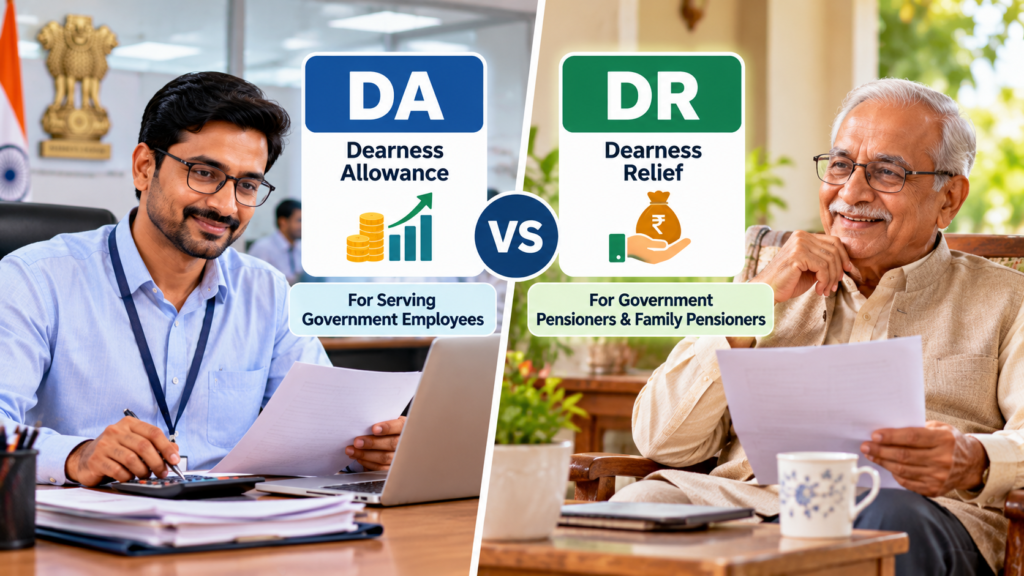
DA vs DR is an important topic for Central Government employees, retired government employees, and pensioners in India. Both Dearness Allowance (DA) and Dearness Relief (DR) are intended to help people manage the impact of rising prices on their income. However, they apply to different groups of people.
Dearness Allowance is generally paid to eligible serving employees, while Dearness Relief is provided to eligible pensioners and family pensioners under applicable government rules. Although the purpose of both is similar, their eligibility, payment process, and calculation base differ.
If you are wondering whether DA and DR are the same, who receives each benefit, how the amount is calculated, or what the latest Central Government rates mean for your monthly income, this guide explains the differences in simple language.
Important update: The Government of India announced a 2% increase in DA for Central Government employees and DR for pensioners, effective from 1 January 2026. The revised rate increased from 58% to 60% of basic pay or the applicable basic pension. You can verify the announcement through the official Press Information Bureau (PIB) and check the relevant government orders before relying on a rate for a particular employee or pensioner.
What Is DA (Dearness Allowance)?
Dearness Allowance, commonly called DA, is an allowance paid to eligible employees to help offset the effect of inflation on their purchasing power.
When the prices of everyday essentials such as food, transport, electricity, medicines, and housing-related expenses increase, the same salary may not cover as much as it did previously. DA is designed to provide some relief from these rising living costs.
In India, Central Government DA rates are revised through official government orders. The calculation and applicable rules depend on the employee’s pay structure and the relevant government instructions.
Who receives DA?
DA is generally applicable to eligible serving employees, including:
- Central Government employees covered by the relevant DA rules.
- Eligible employees working in specified Central Government departments and establishments.
- Employees of certain government bodies or organisations where the applicable rules provide for DA.
- State Government employees when their respective state government adopts or announces DA revisions under its rules.
Remember: DA rates and eligibility are not automatically identical across all government departments, public sector organisations, state governments, and other employers. Always check the order applicable to your employment.
What Is DR (Dearness Relief)?
Dearness Relief, commonly called DR, is a benefit intended to help eligible pensioners manage the impact of inflation after retirement.
Once an employee retires, their regular salary generally stops and pension becomes an important source of income, subject to the applicable pension scheme and rules. As living costs rise, the purchasing power of a fixed pension may decline. DR is intended to help offset that effect.
The Central Government announces DR revisions for eligible pensioners and family pensioners through official orders. The exact applicability depends on the pensioner’s category and the rules governing their pension.
Who receives DR?
DR may be payable to eligible categories such as:
- Retired Central Government employees receiving a qualifying pension.
- Eligible family pensioners receiving family pension after the death of a pensioner or employee.
- Other pensioner categories specifically covered by the relevant government orders, including certain defence and railway pensioners.
The precise rules may differ by pension category. Not every retired person automatically qualifies for Central Government DR. People receiving pensions from state governments, private employers, or other pension arrangements should check the rules of their own pension authority.
DA vs DR: Key Differences
The main difference between DA and DR is the group of people they are intended to benefit. DA is associated with eligible serving employees, whereas DR is associated with eligible pensioners and family pensioners.
| Basis | Dearness Allowance (DA) | Dearness Relief (DR) |
|---|---|---|
| Full form | Dearness Allowance | Dearness Relief |
| Main purpose | Help serving employees manage inflation | Help eligible pensioners manage inflation |
| Primary beneficiaries | Eligible serving employees | Eligible pensioners and family pensioners |
| Calculation base | Applicable basic pay | Applicable basic pension or family pension |
| Payment | Usually included in salary payments | Usually included with pension payments |
| Rate revisions | Announced under applicable employee rules | Announced under applicable pensioner rules |
| Eligibility | Depends on employment category and relevant rules | Depends on pension category and relevant rules |
| After retirement | DA generally ends as an employee benefit when service ends, subject to applicable rules | DR may become payable on an eligible pension under the relevant rules |
| Government orders | Employee-specific DA orders | Pensioner-specific DR orders |
Although DA and DR serve a similar purpose, they are separate benefits administered under their respective rules.
Latest DA and DR Rates in 2026
For Central Government employees and pensioners covered by the relevant orders, the officially announced revision effective from 1 January 2026 increased the rate by 2 percentage points.
The rate moved from 58% to 60% of the applicable basic pay or basic pension.
| Details | Rate |
|---|---|
| Previous rate | 58% |
| Increase | 2 percentage points |
| Revised rate | 60% |
| Effective date | 1 January 2026 |
| DA calculation base | Applicable basic pay |
| DR calculation base | Applicable basic pension |
The Union Cabinet announcement was issued on 18 April 2026. The Department of Expenditure published the relevant DA order on 22 April 2026.
Official references:
- PIB announcement on DA and DR
- Department of Expenditure – official DA orders
- Department of Pension and Pensioners’ Welfare
Please note: The 60% figure relates to the cited Central Government revision effective from 1 January 2026. Check for any later official order before publishing or using this figure as the current rate. State Government employees and pensioners may have different applicable rates and effective dates.
How Is DA Calculated?
For a simplified calculation, DA is calculated as a percentage of the employee’s applicable basic pay.
Formula:
DA amount = Applicable basic pay × DA rate ÷ 100
Suppose an eligible Central Government employee has a basic pay of ₹40,000 and the applicable DA rate is 60%.
DA = ₹40,000 × 60 ÷ 100
Monthly DA = ₹24,000
This is the DA component only. It does not mean the employee’s entire monthly salary is ₹24,000. Basic pay, other eligible allowances, deductions, and other salary components are handled separately under the applicable rules.
Another DA calculation example
Suppose an employee’s basic pay is ₹50,000.
| Calculation | Amount |
|---|---|
| Basic pay | ₹50,000 |
| DA rate used in this example | 60% |
| DA amount | ₹30,000 |
If the rate were 58%, the DA amount would be ₹29,000. The difference between the two examples is ₹1,000 per month.
These examples illustrate the arithmetic only. Use the rate applicable to your employment category and the official order covering your pay.
How Is DR Calculated?
DR is calculated as a percentage of the applicable basic pension or family pension, subject to the rules governing the pensioner’s category.
Formula:
DR amount = Applicable basic pension × DR rate ÷ 100
Suppose an eligible pensioner has an applicable basic pension of ₹25,000 and the DR rate is 60%.
DR = ₹25,000 × 60 ÷ 100
Monthly DR = ₹15,000
This amount represents the DR component in the simplified example. The total pension payment may also include other applicable components, adjustments, deductions, or benefits according to the pensioner’s circumstances and rules.
Another DR calculation example
Suppose a pensioner’s applicable basic pension is ₹30,000.
| Calculation | Amount |
|---|---|
| Basic pension | ₹30,000 |
| DR rate used in this example | 60% |
| DR amount | ₹18,000 |
At a rate of 58%, the amount would be ₹17,400. The difference is ₹600 per month.
Actual pension calculations can be affected by pension revisions, the applicable definition of basic pension, and category-specific rules. Use your pension payment statement and the relevant official order to confirm your entitlement.
Is DA the Same as DR?
No. DA and DR are not the same benefit, although both are designed to help eligible beneficiaries manage rising prices.
The easiest way to understand the difference is:
- DA is generally for eligible serving employees.
- DR is generally for eligible pensioners and family pensioners.
Both are expressed as a percentage, and the rates announced for Central Government employees and pensioners have often been aligned. However, this does not mean the two benefits are interchangeable or that every person receives both.
For example, a serving employee may receive DA on applicable basic pay. A retired employee who qualifies for pension-related relief may receive DR on applicable basic pension under the pension rules.
Why Are DA and DR Revised?
DA and DR are intended to help offset the effect of inflation. When the general price level rises, people may need more money to purchase the same goods and services.
The Central Government revises DA and DR under the applicable arrangements and official orders. For Central Government employees covered by the 7th Central Pay Commission framework, revisions have been based on the accepted formula associated with the relevant pay commission recommendations.
Revisions are commonly announced in instalments during the year, but readers should not assume a particular date or percentage until an official announcement is published.
The final rate, effective date, beneficiary categories, and payment instructions should be checked in the relevant government order rather than relying solely on social media posts or unofficial reports.
What Happens to DA When an Employee Retires?
Retirement changes the nature of the benefits an employee may receive.
DA is generally an employee allowance linked to serving employment and applicable basic pay. After retirement, the employee’s salary arrangement ends, and pension becomes relevant if the person qualifies for pension benefits.
An eligible pensioner may receive DR under the pension rules. However, the exact treatment depends on the person’s pension scheme, retirement circumstances, and applicable government instructions.
It is important not to assume that an employee’s last DA amount automatically continues as DR at the same amount. The pension calculation and the applicable DR rate must be considered separately.
For pension-related rules and official clarifications, visit the Department of Pension and Pensioners’ Welfare.
Do State Government Employees and Pensioners Get DA and DR?
Many state governments provide DA to eligible serving employees and DR to eligible pensioners. However, state governments issue their own orders, and the rates, effective dates, payment arrangements, and conditions may differ from those announced for Central Government beneficiaries.
For this reason, a Central Government DA or DR announcement should not automatically be treated as applicable to every state employee or pensioner.
If you work for a state government, check:
- Your state’s finance department website.
- The latest official DA or DR government order.
- The effective date stated in the order.
- Whether the order covers your employment or pension category.
- Any instructions issued by your department, treasury, or pension-disbursing authority.
The same caution applies to employees of public sector undertakings, autonomous bodies, and other organisations, where separate rules or adoption orders may apply.
Are DA and DR Paid Every Month?
DA is generally paid as part of the salary of eligible employees, while DR is generally included in the pension payment of eligible pensioners. The actual payment schedule and adjustments depend on the applicable rules and the instructions issued by the relevant authority.
When a revised rate is made effective from an earlier date, the order may provide for arrears or other adjustments. However, arrears should not be assumed automatically in every situation. The order’s effective date, payment instructions, beneficiary category, and individual eligibility determine how the revision is implemented.
If your salary or pension statement does not reflect an announced revision, check the relevant order and contact your department’s accounts office, pension-disbursing authority, or bank as appropriate.
Can an Employee Receive Both DA and DR?
DA and DR are associated with different beneficiary situations: DA with eligible serving employment and DR with eligible pension status.
A person should not assume that both are payable simultaneously merely because they are a serving or retired government employee. Whether a particular person can receive a salary-related benefit and a pension-related benefit at the same time depends on the applicable employment, pension, re-employment, and government rules.
If you have been re-employed after retirement or receive a special category of pension, consult the specific government instructions that apply to your case. The general explanation in this article cannot determine an individual’s entitlement.
How to Check the Latest DA and DR Government Orders
To avoid confusion about rates and effective dates, use official sources.
1. Check the latest DA order
Visit the Department of Expenditure website. Look for the order titled along the lines of “Revision of rates of Dearness Allowance to Central Government employees.” Confirm the date, effective date, rate, and employee categories covered.
2. Check the DR order for pensioners
Visit the Department of Pension and Pensioners’ Welfare. Search for the relevant Dearness Relief order for Central Government pensioners or family pensioners.
3. Verify the Cabinet announcement
The Press Information Bureau publishes official announcements about Cabinet decisions, including DA and DR revisions.
4. Check state-specific orders
If you are a state government employee or pensioner, visit your state’s official finance department website. Confirm that the order applies to your state and beneficiary category.
5. Review your salary or pension statement
Compare the applicable rate with the amount shown on your salary slip or pension payment statement. If something appears incorrect, ask the relevant department or pension authority to clarify it.
Frequently Asked Questions (FAQs)
1. What is the full form of DA?
DA stands for Dearness Allowance. It is an allowance paid to eligible employees to help offset the effect of inflation on purchasing power.
2. What is the full form of DR?
DR stands for Dearness Relief. It is intended to help eligible pensioners and family pensioners manage the impact of rising prices.
3. What is the main difference between DA and DR?
DA is generally paid to eligible serving employees and is calculated using applicable basic pay. DR is generally paid to eligible pensioners and family pensioners and is calculated using applicable basic pension.
4. What is the Central Government DA rate effective from 1 January 2026?
The official revision announced in April 2026 raised the rate from 58% to 60% of applicable basic pay, effective from 1 January 2026. Check the Department of Expenditure for any subsequent order before relying on this figure as the latest rate.
5. What is the Central Government DR rate effective from 1 January 2026?
The Cabinet announced a corresponding increase in DR from 58% to 60% of applicable basic pension, effective from 1 January 2026. Pensioners should check the relevant DR order for the exact category-specific rules and any subsequent revision.
6. Are DA and DR calculated on gross salary or gross pension?
The simplified calculation uses applicable basic pay for DA and applicable basic pension for DR, rather than simply applying the percentage to the entire gross salary or pension payment. The exact calculation depends on the relevant rules.
7. Do family pensioners receive DR?
Eligible family pensioners may receive DR under the applicable pension rules and government orders. Eligibility and calculation should be checked against the rules governing the particular family pension.
8. Do state government employees receive the same DA rate as Central Government employees?
Not necessarily. State governments issue their own orders, and the applicable rate and effective date may differ. Employees should check their state’s official notifications.
9. Is DA automatically converted into DR after retirement?
DA and DR are separate benefits. Retirement changes the basis of the benefit, and DR entitlement depends on the pensioner’s eligibility and applicable rules. The DA amount received before retirement should not simply be assumed to continue unchanged.
10. Are DA and DR revisions always announced twice a year?
Central Government revisions have commonly followed a biannual pattern, but readers should rely on official orders for actual announcements, rates, and effective dates rather than assuming a particular revision will occur on a specific date.
11. Are DA and DR taxable?
Tax treatment depends on the applicable income-tax law and the individual’s circumstances. Employees and pensioners should consult the current Income Tax Department guidance or a qualified tax professional for their specific situation.
12. Where can I check official DA and DR updates?
For DA, visit the Department of Expenditure. For pensioner-related DR orders, visit the Department of Pension and Pensioners’ Welfare. The PIB website is also useful for official Cabinet announcements.
Conclusion
The difference between DA and DR is straightforward once you understand who receives each benefit. Dearness Allowance is generally intended for eligible serving employees, while Dearness Relief is intended for eligible pensioners and family pensioners.
Both benefits help offset the effect of inflation, but they are governed by separate rules and may have different eligibility conditions and payment procedures. The Central Government’s 2026 revision cited in this article raised both rates to 60%, effective from 1 January 2026, for the categories covered by the relevant orders.
If you are checking your own salary or pension, always verify the latest official notification and confirm that it applies to your employment or pension category. This is the safest way to understand the rate, effective date, and amount you may be entitled to receive.
Disclaimer: This article is for general informational purposes only and is not an official government notification or individual financial or legal advice. Rates and eligibility can change. Always consult the applicable official order and your department or pension authority before making decisions based on DA or DR information.
SHARING IS CARING 💖