
Form 16 is one of the most important tax documents for salaried employees in India. If you work for a company, private organisation, government department, or another employer that deducts tax from your salary, you may receive Form 16 after the end of the financial year.
Many employees look for Form 16 when they want to file their Income Tax Return (ITR), apply for a loan, or check how much tax their employer has deducted. However, not everyone knows what the document contains, how to get it, or what to do if it is missing.
In this guide, you will learn what Form 16 is, how to download it, what Part A and Part B mean, who is eligible to receive it, and how to use it while preparing your income tax return.
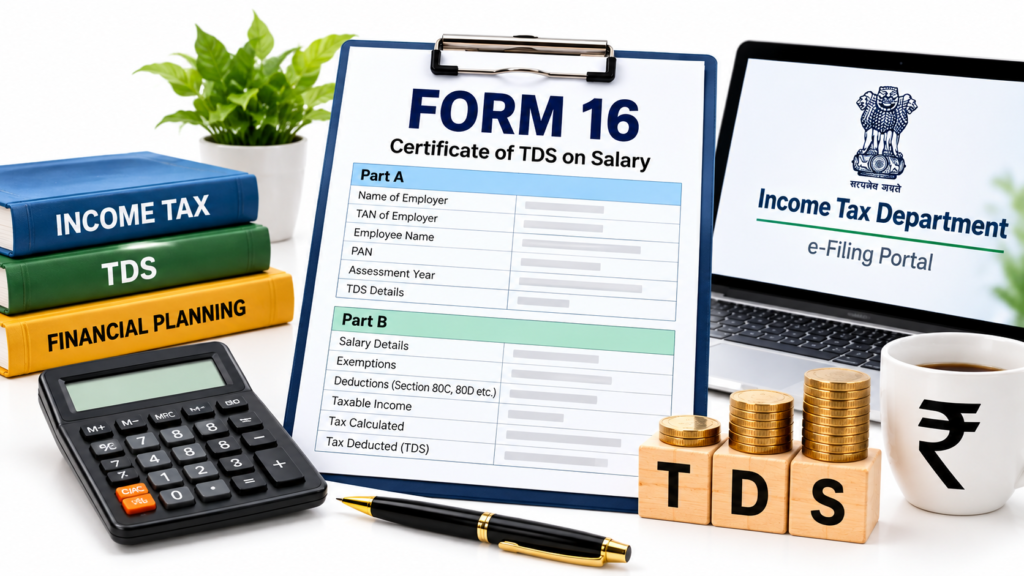
What Is Form 16?
Form 16 is a certificate related to Tax Deducted at Source (TDS) on salary. It is generally issued by an employer to an employee and provides details of salary paid, eligible deductions or exemptions, and tax deducted from the employee’s salary during the relevant period.
In simple words, Form 16 helps you understand how your salary income and salary TDS have been reported by your employer. It is also an important document when preparing your Income Tax Return.
For example, suppose your employer deducts income tax from your monthly salary and deposits it with the government. Form 16 provides a summary of the salary and tax details reported for the relevant financial year.
The Income Tax Department identifies Form 16 as a certificate of tax deducted from salary. It is different from Form 16A, which relates to TDS on income other than salary.
Why Is Form 16 Important?
Form 16 can make tax-related tasks easier because it brings several salary and TDS details together in one document.
Here are some common uses of Form 16:
- Filing an Income Tax Return: It helps you prepare your return by providing salary and tax deduction information.
- Checking TDS details: You can review the tax shown as deducted by your employer.
- Verifying salary information: It helps you compare reported salary figures with your payslips and other records.
- Supporting financial applications: Banks and lenders may request Form 16 as one of several documents when assessing a loan application.
- Maintaining tax records: Keeping the certificate can help you refer to past salary and tax information when needed.
Remember that Form 16 is a supporting document. You should not assume that receiving it automatically means your tax return is complete or that you do not need to report other income.
Who Is Eligible to Receive Form 16?
Form 16 is generally issued to salaried employees by their employer when the relevant salary TDS certificate is required under applicable tax rules.
Whether you receive it depends on your employment and tax-deduction circumstances.
1. Salaried employees whose employer deducts TDS
If your employer deducts tax from your salary, you should generally receive the relevant salary TDS certificate from the employer in accordance with applicable rules.
2. Employees who changed jobs during the financial year
If you worked for two or more employers during the same financial year, each employer may issue a separate Form 16 for the salary paid during your employment with that organisation.
When filing your ITR, remember to account for salary from all employers, not just your current employer.
3. Employees whose salary did not attract TDS
If no tax was deducted from your salary, you may not receive Form 16 in the usual circumstances. However, the absence of Form 16 does not automatically mean you have no income tax return filing obligation. Your total income, applicable tax rules, and other filing conditions determine your obligations.
If you are unsure, ask your employer’s payroll team for clarification and review the official Income Tax Department guidance.
What Are Part A and Part B of Form 16?
Form 16 is commonly discussed in two parts: Part A and Part B. Each provides different information about your salary and tax.
Part A of Form 16
Part A mainly contains information about the employer, employee, and tax deducted and deposited during the relevant period. Depending on the certificate and applicable format, it may include details such as:
- Employer’s name and address
- Employer’s Tax Deduction and Collection Account Number (TAN)
- Employee’s name and PAN
- Relevant financial year or period
- Summary of tax deducted and deposited
- Details relating to the TDS statement and certificate
Check these details carefully. An incorrect PAN, employer detail, or tax figure may need correction by the employer.
Part B of Form 16
Part B provides a salary and tax computation summary. It may include information such as:
- Salary paid and salary components
- Exemptions, where applicable
- Deductions considered for tax calculation
- Income under the salary head
- Taxable income computation
- Tax calculated and tax deducted, as applicable
The exact details depend on the relevant financial year and the format applicable to your certificate.
Important: Do not rely only on the final tax figure. Review the salary details, deductions, exemptions, and TDS information before using Form 16 to prepare your return.
How to Download Form 16 Online in India
Employees generally obtain Form 16 from their employer. Many organisations provide it through an employee self-service portal, payroll software, or the HR department.
If you are an employee, follow these steps:
Step 1: Contact your employer or HR department
Ask your HR, payroll, or finance team when Form 16 will be available for the relevant financial year.
Step 2: Log in to your employee portal
If your organisation has an employee portal, log in using your authorised credentials. Look for sections such as Payroll, Tax Documents, Salary Documents, or Form 16.
Step 3: Select the correct financial year
Choose the financial year for which you need the certificate. Check the year carefully so that you do not download a document for the wrong period.
Step 4: Download the PDF
If Form 16 is available, select the download option and save the PDF securely on your device. Some employers may require you to verify your identity or use a password to open the file.
Step 5: Check the certificate
Open the document and verify your name, PAN, employer details, salary figures, and tax deduction information.
Step 6: Contact payroll if the document is missing
If you cannot find Form 16, contact your employer’s HR or payroll team. If you changed jobs during the year, contact the relevant previous employer as well.
Can you download Form 16 directly from the Income Tax portal?
Employees should not assume that their personal e-Filing account provides a ready-to-download employer-issued Form 16. In the usual process, the employee obtains the certificate from the employer.
The TRACES portal has services for authorised deductors to generate and download TDS certificates. The Income Tax e-Filing portal also provides services for checking tax-related information. These services are not the same as downloading an employer-issued certificate from an employee account.
Official websites:
- Income Tax e-Filing portal: https://www.incometax.gov.in/
- Income Tax Department: https://www.incometaxindia.gov.in/
- TRACES: https://www.tdscpc.gov.in/
Always use official websites and avoid sharing your PAN, login password, OTP, or other sensitive information with unauthorised people.
What Is the Due Date for Form 16?
The applicable due date depends on the tax rules governing the relevant period.
Under the salary TDS rules commonly applied to Form 16 under the Income-tax Act, 1961, the certificate is generally required to be issued by 15 June of the financial year immediately following the financial year in which the income was paid and tax deducted, subject to applicable provisions and changes in law.
For example, for salary and TDS relating to Financial Year 2025–26, the general date under that framework would be 15 June 2026.
Important update for readers: India’s income-tax framework changed in 2026, including the introduction of the Income-tax Act, 2025 and new forms under the applicable rules. For a current-year article, verify the certificate name, format, and deadline against the official portal for the relevant tax year before publishing or acting on the information.
Do not confuse the certificate’s issue date with the due date for filing your Income Tax Return. They are separate deadlines.
Form 16 vs Form 16A: What Is the Difference?
Form 16 and Form 16A are both associated with tax deducted at source, but they apply to different types of income.
| Feature | Form 16 | Form 16A |
|---|---|---|
| Main purpose | TDS on salary | TDS on income other than salary |
| Common issuer | Employer | Relevant deductor or payer |
| Common recipient | Salaried employee | Person receiving the payment |
| Frequency | Generally annual | Generally quarterly |
| Examples | Salary income | Certain interest, professional fees, or other payments subject to TDS |
For example, your employer may provide Form 16 for salary TDS, while a bank may issue Form 16A for certain interest income on which TDS has been deducted.
The correct certificate depends on the nature of the payment and the applicable tax rules.
How to Use Form 16 While Filing Your ITR
Form 16 can help you prepare your return, but it should be checked against your other financial records.
Follow this basic checklist:
- Collect all salary certificates: If you changed jobs during the year, obtain the relevant certificates from each employer.
- Check salary figures: Compare the figures with your payslips and salary records.
- Review deductions and exemptions: Confirm that the amounts shown are consistent with your records and the applicable tax regime.
- Check TDS information: Compare the tax deducted with Form 26AS and other available tax records.
- Review other income: Include applicable interest income, rental income, capital gains, or other taxable income that may not appear in Form 16.
- Choose the appropriate ITR form: The correct return depends on your income sources and circumstances.
- Review before submission: Check the completed return for missing income, incorrect figures, and mismatched tax credits.
You can access the official Income Tax e-Filing portal at https://www.incometax.gov.in/ to use the available return-filing and tax-information services.
Why should you check Form 26AS and AIS?
Form 16 reflects information reported by your employer. Form 26AS and the Annual Information Statement (AIS) can help you review tax credits and other reported financial information.
If figures do not match, investigate the difference instead of copying the same number into your return without checking. You may need to contact your employer, bank, or another deductor to correct an error.
What Should You Do If Your Employer Does Not Provide Form 16?
Not receiving Form 16 can be frustrating, especially when you want to file your ITR. Start by checking the reason rather than assuming something is wrong.
- Contact HR or payroll: Ask whether the certificate has been issued and how to access it.
- Confirm your details: Check that your PAN and employment information were recorded correctly.
- Request a correction if needed: If salary or TDS information is wrong, ask the employer to review the relevant filings and certificate.
- Gather alternative records: Keep payslips, bank statements, salary records, and available tax information for preparing your return.
- Check official tax records: Use the Income Tax Department’s authorised services to review available information.
- Do not ignore filing obligations: If you are required to file an ITR, the absence of Form 16 does not automatically remove that requirement.
If the issue remains unresolved or your tax situation is complicated, consider consulting a qualified tax professional.
Is Form 16 Mandatory for Filing an ITR?
Form 16 is useful, but it is not a universal requirement for every person who files an Income Tax Return.
If you are a salaried employee, it can make reporting salary and checking TDS easier. However, your filing obligation depends on the applicable law and your circumstances, not solely on whether your employer has issued Form 16.
If you do not have the certificate, you may still be able to prepare your return using payslips, salary statements, bank records, Form 26AS, AIS, and other relevant documents. Make sure all taxable income and eligible tax credits are reported correctly.
Common Mistakes to Avoid When Using Form 16
Before relying on Form 16, avoid these common mistakes:
- Assuming Form 16 includes every source of income.
- Forgetting salary received from a previous employer.
- Ignoring interest income or capital gains.
- Entering deductions without checking eligibility.
- Failing to compare TDS figures with available tax records.
- Selecting the wrong financial year.
- Treating the Form 16 issue date as the ITR filing deadline.
- Sharing the certificate publicly or sending it to unverified websites.
Form 16 contains personal and financial information. Store it securely and share it only when there is a legitimate need.
Frequently Asked Questions About Form 16
1. What is Form 16 used for?
Form 16 is a salary TDS certificate that helps an employee review salary, deductions or exemptions, and tax deducted by the employer. It is commonly used while preparing an Income Tax Return.
2. Who issues Form 16?
The employer issues Form 16 to the employee in accordance with the applicable tax rules.
3. Can I download Form 16 without contacting my employer?
You may be able to download it from your employer’s payroll or employee portal. If it is unavailable, contact HR or payroll. Do not assume the certificate is available as a direct download in every employee’s Income Tax e-Filing account.
4. What is the difference between Part A and Part B of Form 16?
Part A generally contains employer, employee, and TDS details. Part B generally summarises salary, applicable exemptions and deductions, and the tax computation.
5. Is Form 16 compulsory for filing an ITR?
Not in every case. It is useful for salaried taxpayers, but the requirement to file an ITR depends on the applicable law and individual circumstances.
6. Can I file an ITR if I do not have Form 16?
You may still be able to file using salary records, payslips, bank statements, and available tax information. Make sure your income and tax credits are reported accurately.
7. What if I worked for two companies in one financial year?
You should collect the relevant salary and tax information from both employers and report your total income correctly in your return.
8. What is Form 16A?
Form 16A is a TDS certificate for applicable income other than salary. It is different from Form 16, which relates to salary TDS.
9. Is Form 16 proof that I do not owe any more tax?
No. Your final tax position depends on your total taxable income, eligible deductions, tax regime, tax credits, and other relevant factors. Additional tax may be payable, or a refund may be due.
10. Where can I find official tax information?
Visit the official Income Tax e-Filing portal at https://www.incometax.gov.in/ or the Income Tax Department’s website at https://www.incometaxindia.gov.in/.
Final Thoughts
Form 16 is an important document for salaried employees in India because it helps them understand salary-related tax deductions and prepare their Income Tax Return. Knowing the difference between Part A and Part B, how to obtain the certificate, and how to check its figures can make tax season less confusing.
Before filing your return, review Form 16 alongside your other income records and the tax information available through official government services. If something does not match, ask the relevant employer or deductor to clarify it.
Disclaimer: This article is for general educational purposes and is not personalised tax, legal, or financial advice. Income-tax forms, deadlines, and procedures may change. Verify the rules applicable to your tax year through official government sources or consult a qualified tax professional.
SHARING IS CARING 💖