
Buying a car is an exciting milestone. For many people, it represents years of hard work, greater convenience, and the freedom to travel whenever they want. But before booking your dream car, there is one important financial decision to make: should you buy the car on a loan and pay monthly EMIs, or use your savings to pay the full amount in cash?
Both options have advantages and disadvantages. A car loan allows you to spread the cost over several years, while a full cash payment helps you avoid loan interest. However, using all your savings for a car can leave you financially unprepared for emergencies.
So, which option is better for car buyers in India?
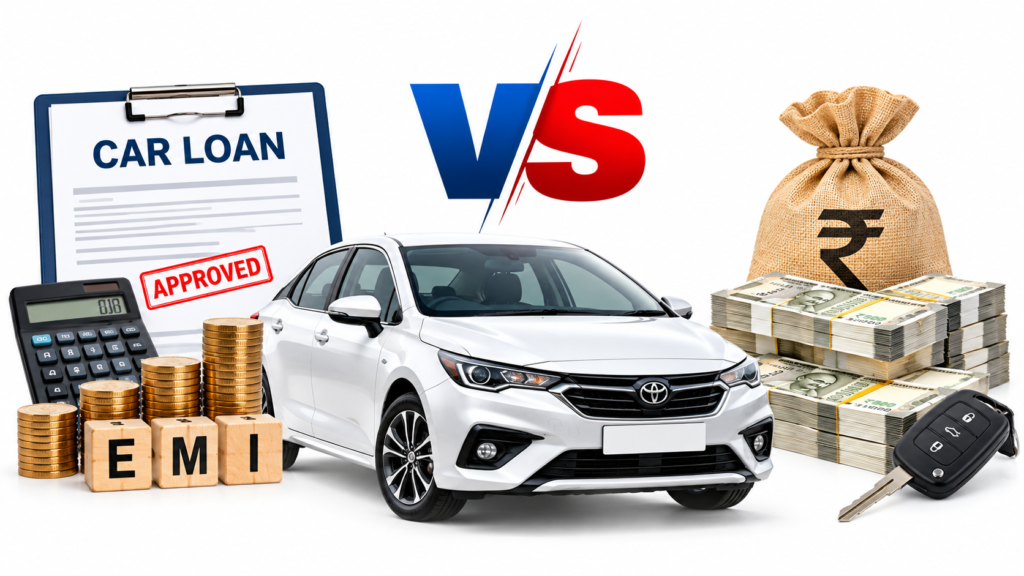
The answer depends on your income, savings, loan interest rate, financial goals, and the amount you can comfortably afford. In this guide, we will compare buying a car on loan versus paying the full amount upfront, with practical examples to help you make an informed decision.
Car Loan vs Full Cash Payment: Quick Comparison
| Factor | Buying on a car loan | Paying full cash |
|---|---|---|
| Initial payment | Down payment plus applicable charges | Full car price plus applicable charges |
| Monthly EMI | Required during the loan tenure | No car-loan EMI |
| Interest cost | Yes, according to the loan terms | No car-loan interest |
| Emergency savings | More savings may remain initially | Savings can fall significantly |
| Financial flexibility | Depends on EMI and other commitments | No car-loan obligation after purchase |
| Ownership | Subject to the lender’s hypothecation until released | No loan hypothecation |
| Best suited for | Buyers who want to spread payments | Buyers with sufficient savings after the purchase |
The best option is not simply the one with the lowest monthly payment. It is the one that fits your overall financial situation without creating unnecessary financial pressure.
1. What Does Buying a Car on Loan Mean?
When you buy a car on loan, a bank or financial institution finances part or all of the eligible purchase cost. You repay the borrowed amount in monthly instalments, commonly known as EMIs, over an agreed period.
Your EMI generally includes two components:
- Principal: The amount you borrowed.
- Interest: The cost charged by the lender for providing the loan.
You may also have to pay processing fees and other applicable charges. The amount you can borrow, the interest rate, and the repayment period depend on the lender’s eligibility criteria and loan terms.
Example of buying a car on loan
Suppose you want to purchase a car priced at ₹10 lakh and decide to make a down payment of ₹2 lakh.
Your loan calculation could look like this:
- Car price: ₹10,00,000
- Down payment: ₹2,00,000
- Loan amount: ₹8,00,000
- Illustrative annual interest rate: 9%
- Loan tenure: 5 years
At these illustrative terms, your EMI would be approximately ₹16,607 per month.
Over five years, you would pay approximately ₹9.96 lakh in EMIs. Adding the ₹2 lakh down payment brings your total car-price-related outflow to around ₹11.96 lakh.
That means the interest would be approximately ₹1.96 lakh over five years, excluding processing fees and other charges.
Actual figures will vary according to the lender’s interest rate, loan structure, fees, and repayment terms.
Advantages of buying a car on loan
1. You do not need to pay the full price immediately.
You can purchase the car with a down payment and keep some of your money available for other needs.
2. You can preserve emergency savings.
If you have ₹12 lakh in savings and purchase a ₹10 lakh car entirely in cash, a large part of your savings will disappear. Financing part of the purchase may help you retain a larger cash reserve.
3. You can spread the expense over time.
Monthly EMIs can make a vehicle more accessible, provided the repayment amount fits comfortably within your budget.
4. You may be able to keep money invested.
If you have a suitable investment that earns more after tax than the effective cost of borrowing, financing may be worth considering. However, investment returns are uncertain, while loan repayments are contractual obligations.
Disadvantages of buying a car on loan
1. You pay interest.
The loan increases the total amount you spend on the car. The longer the repayment period, the more interest you may pay, depending on the loan terms.
2. You have a monthly financial commitment.
Your EMI continues even if your income falls, you change jobs, or an unexpected expense arises.
3. You may face additional charges.
Processing fees, applicable taxes, and other charges can increase the effective cost of borrowing.
4. The vehicle is subject to the lender’s rights.
A financed vehicle is generally recorded as hypothecated to the lender until the loan is repaid and the hypothecation is removed through the required procedure.
2. What Does Buying a Car With Full Cash Payment Mean?
Buying a car with full cash payment means paying the entire purchase amount from your available funds without taking a car loan.
In everyday conversation, “cash payment” often means paying from savings through a bank transfer, cheque, or another accepted payment method—not necessarily using physical currency.
For example, if your car costs ₹10 lakh and you pay the entire amount upfront, you do not have a car-loan EMI or car-loan interest to pay.
You will still need to budget for insurance, fuel, servicing, repairs, registration-related expenses, and other ownership costs.
Advantages of paying the full amount
1. You avoid car-loan interest.
You do not pay interest on money borrowed for the car because you have not borrowed it.
2. There is no car-loan EMI.
Your monthly income is not committed to repaying a car loan. This can make your monthly budget easier to manage.
3. You avoid loan-related charges.
You do not have to pay car-loan processing fees or other charges specific to that loan.
4. You have greater flexibility in your monthly budget.
Without a car-loan EMI, you can direct more of your income towards household expenses, savings, investments, or other financial goals.
5. There is no loan hypothecation to remove.
Because you did not finance the purchase with a car loan, there is no car-loan hypothecation to clear after repayment.
Disadvantages of paying the full amount
1. Your savings may decrease sharply.
This is the biggest concern for many buyers. Spending most of your available savings on a depreciating asset can leave you unprepared for a medical emergency, job loss, home repair, or other unexpected expense.
2. You may miss other financial opportunities.
Money used to buy a car cannot simultaneously be used for another purpose. However, the potential return you give up is not guaranteed, and it should not automatically be assumed that investing is better than avoiding loan interest.
3. You lose immediate liquidity.
A car is not always easy to sell quickly at a price that recovers what you paid. If you need money urgently, you may not be able to recover the full purchase amount.
Paying in full can be an excellent choice when you have sufficient savings, but it should not come at the cost of financial security.
3. Car Loan vs Cash Payment: A Real-Number Example
Let’s compare the two options using a hypothetical car priced at ₹10 lakh.
Illustrative Car Price: ₹10,00,000
Full Cash Payment: ₹10,00,000 Paid upfront.
Loan Option: ₹11,96,000 Approximate total cost, including the down payment and EMIs.
Example calculation: ₹8 lakh loan at 9% annual interest for 5 years, with a ₹2 lakh down payment. Figures are rounded and exclude loan fees and other vehicle ownership costs.
In this example, paying in full costs approximately ₹1.96 lakh less than the loan option in terms of the car price and loan repayments.
But there is an important consideration: this calculation does not account for the value of keeping money available or any investment return you might earn on the money not used for the full cash payment.
If paying cash leaves you with almost no savings, the lower purchase cost may not be worth the financial risk. A car loan may be reasonable if it allows you to retain an adequate emergency fund and the EMI is comfortably affordable.
4. Should You Use Your Savings to Buy a Car or Take a Loan?
This is where the decision becomes more personal.
Suppose you have ₹15 lakh in savings and want to buy a car worth ₹10 lakh. Paying in full would leave you with ₹5 lakh before accounting for other upcoming expenses.
Whether that is sensible depends on your monthly household expenses, job stability, other financial commitments, and how much emergency money you need.
Now suppose you have ₹11 lakh in savings and want the same car. Paying the entire price would leave you with only ₹1 lakh.
In that situation, financing part of the purchase may be worth considering if it helps you preserve enough money for emergencies and the monthly EMI fits your budget.
Before deciding, ask yourself these questions:
- Will I still have enough emergency savings after purchasing the car?
- Can I pay the EMI comfortably even if my expenses increase?
- Do I have other loans or major financial commitments?
- Is the interest rate reasonable compared with the benefits of retaining my savings?
- Am I buying a car I can afford, or stretching my budget for a more expensive model?
Your answers can be more important than choosing between cash and a loan in isolation.
5. Is It Better to Invest Your Money Instead of Paying Cash?
Some people prefer to take a car loan and invest the money they would otherwise spend on the car. The idea is that their investments may earn a return while they repay the loan.
This approach can work in certain circumstances, but it is not guaranteed to save money.
For example, if your loan has an effective annual cost of 9%, an investment that earns 6% after tax would not normally compensate you for the borrowing cost on a comparable basis. An investment earning 12% after tax might appear more attractive, but market-linked returns can fluctuate and are not guaranteed.
When comparing the two options, consider:
- The effective loan interest rate, including relevant fees
- The investment’s expected return after tax and expenses
- Investment risk and the possibility of losses
- The period for which you can remain invested
- Your emergency fund and other financial goals
Avoid taking a loan solely because someone promises high investment returns. Paying cash to avoid interest is a more predictable financial benefit than relying on uncertain investment gains.
6. What Is the Best Car Loan Tenure?
Car loans are commonly offered over different repayment periods. Your lender will provide the available options based on your eligibility and its terms.
A longer tenure generally lowers the EMI for a given loan amount and interest rate, but it usually increases the total interest paid. A shorter tenure generally means a higher EMI but less interest over the life of the loan.
Consider this simplified comparison for the same loan amount and interest rate:
| Factor | Shorter tenure | Longer tenure |
|---|---|---|
| Monthly EMI | Usually higher | Usually lower |
| Total interest | Usually lower | Usually higher |
| Monthly budget pressure | Greater | Lower |
| Time spent repaying | Shorter | Longer |
Do not choose a longer tenure only to make an expensive car appear affordable. Compare the total repayment amount, not just the EMI displayed in an advertisement.
Also review prepayment and foreclosure conditions before signing the agreement.
7. How Much Down Payment Should You Make?
A larger down payment reduces the amount you borrow. If the interest rate and tenure remain the same, borrowing less generally reduces both your EMI and total interest cost.
However, making the largest possible down payment is not always the best decision.
For example, if paying an additional ₹1 lakh upfront leaves you without enough money for emergencies, a smaller down payment may be more appropriate.
Choose a down payment that balances three priorities:
- Keeping the loan amount manageable
- Maintaining sufficient emergency savings
- Ensuring that the EMI fits your monthly budget
Compare offers from multiple lenders and check the effective cost of the loan before deciding.
8. Other Costs to Consider Before Buying a Car
Whether you pay cash or take a loan, the purchase price is only one part of owning a car.
Remember to budget for:
- Insurance premiums
- Fuel or charging expenses
- Regular servicing
- Tyres, batteries, and replacement parts
- Repairs and unexpected maintenance
- Parking and tolls
- Registration and other applicable charges
- Depreciation in the vehicle’s value
A car loan does not make these costs disappear, and paying cash does not eliminate them either.
Before buying, calculate the total cost of ownership and check whether your income can comfortably support the car for several years.
9. Can You Get a Tax Benefit on a Car Loan in India?
For most individuals buying a car for personal use, car-loan interest is generally not deductible simply because they have taken a loan.
Different considerations may apply when a vehicle is genuinely used for business or professional purposes and the relevant tax requirements are satisfied. The treatment depends on the taxpayer’s circumstances, records, applicable tax provisions, and the nature of the expense.
Do not assume that buying a car on loan automatically creates a tax benefit. If you are purchasing a vehicle for business use, consult a qualified tax professional about the applicable rules.
10. Which Option Is Better for Different Types of Buyers?
Paying cash may suit you if:
- You have enough savings to pay for the car and retain an adequate emergency fund.
- You want to avoid interest and loan-related charges.
- You prefer not to have a monthly car-loan commitment.
- You have other financial priorities that are already well funded.
Taking a loan may suit you if:
- Paying in full would leave you with too little emergency money.
- You have stable income and can comfortably afford the EMI.
- You have compared loan offers and understand the total cost.
- Retaining some savings is important for your other financial commitments.
Consider a partial loan if:
You have enough savings for a substantial down payment but prefer not to use all your available money. Financing part of the purchase may help balance the interest cost against the need for liquidity.
There is no universal answer. A financially sensible car purchase is one that meets your transport needs without putting your other goals at risk.
Frequently Asked Questions (FAQs)
1. Is it better to buy a car on loan or pay full cash in India?
Paying cash generally avoids loan interest and processing fees. A loan may be more suitable if paying the full price would leave you without sufficient emergency savings. Compare the total borrowing cost with your financial needs before deciding.
2. How much money can I save by buying a car in cash?
Your savings depend on the amount you would otherwise borrow, the interest rate, the loan tenure, and the applicable fees. In the ₹10 lakh example above, the illustrative interest cost is approximately ₹1.96 lakh on an ₹8 lakh loan over five years at 9% annual interest.
3. Is taking a car loan a good idea if I have enough money in my bank account?
Not necessarily. If paying cash leaves you with sufficient savings, it may be sensible to avoid borrowing. However, if using your savings would reduce your financial security, a partial loan may be worth considering.
4. Does a longer car loan tenure save money?
It usually lowers the monthly EMI but increases the total interest paid, assuming the same loan amount and interest rate. Compare the total repayment amount before choosing a tenure.
5. Should I use my investments to buy a car?
It depends on the investment, taxes, risk, and your financial goals. Avoiding loan interest offers a more predictable benefit than relying on uncertain investment returns. Do not sell long-term investments without considering the wider financial consequences.
6. Can I make a down payment and finance the remaining amount?
Yes, subject to the lender’s terms and eligibility requirements. A larger down payment generally reduces the loan amount, EMI, and total interest, but you should retain enough money for emergencies.
7. Can I claim tax deductions on a personal car loan?
Personal car-loan interest is generally not deductible solely because you borrowed money to buy a private-use car. Business or professional use may be treated differently under the applicable tax rules.
8. Should I buy an expensive car if the EMI is affordable?
Not necessarily. Consider the total purchase cost, interest, insurance, fuel, maintenance, depreciation, and your other financial goals. An affordable EMI does not automatically mean the vehicle is affordable overall.
Conclusion: Car Loan vs Full Cash Payment
Buying a car on loan and paying the full amount in cash can both be sensible choices, depending on your financial situation.
A full cash payment helps you avoid loan interest and monthly EMIs. A car loan allows you to spread the expense and may help preserve savings for emergencies. However, financing a car increases its total cost, while using too much cash can leave you financially vulnerable.
Before making a decision, compare the total loan repayment with the cash price, calculate your ongoing ownership costs, and make sure you retain an appropriate emergency fund.
The best option is the one that lets you buy a suitable car without sacrificing your financial security or long-term goals.
SHARING IS CARING 💖