Introduction
Big success rarely happens in a single day.
Most of the achievements we admire are the result of hundreds or even thousands of small decisions made over time. A person learns one new skill, saves a little money, exercises regularly, reads a few pages, improves a weakness, or simply chooses to try again after failure.
At first, these actions may seem insignificant. But when repeated consistently, they can create remarkable results.
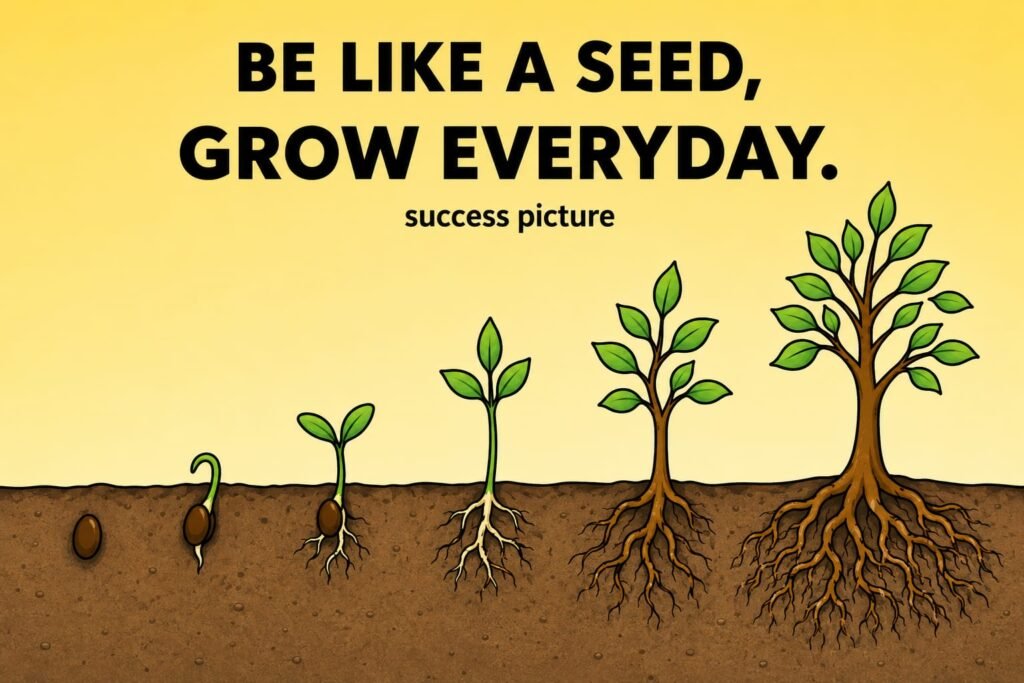
Think about a tiny seed. When it is placed in the soil, there is nothing impressive to see. It does not immediately become a tree. It needs water, sunlight, nutrients, time, and patience. Day after day, growth happens quietly beneath the surface. Eventually, the small seed becomes something much larger.
Our lives can work in a similar way.
Small steps create momentum. Daily growth creates strength. Consistency creates results.
If you have ever felt that your goals are too far away, this idea can change the way you look at success. You do not always need to make a massive change. Sometimes, the most powerful thing you can do is take one useful step today and another tomorrow.
This guide explores why small steps matter, how daily improvement compounds over time, and how you can turn simple actions into meaningful long-term success.
1. Success Usually Starts Smaller Than We Imagine
When people think about success, they often focus on the final result.
They see the successful business, the finished degree, the healthy body, the impressive career, the published book, or the financial achievement. What they do not always see are the thousands of small actions that came before it.
A successful career may begin with learning one useful skill.
A successful business may begin with one customer.
A strong relationship may begin with one honest conversation.
A healthier lifestyle may begin with one better decision.
The beginning does not have to look impressive.
What matters is that you begin.
The lesson
Do not underestimate a small start. Your first step may look insignificant today, but it can become the foundation of something much bigger tomorrow.
2. Small Progress Is Still Progress
One of the biggest reasons people give up on their goals is that they expect immediate results.
They start exercising and expect dramatic changes within days. They begin learning a language and expect fluency quickly. They launch a website and expect thousands of visitors immediately.
When the expected results do not appear, motivation disappears.
But progress is not always visible immediately.
Imagine someone learning to play the guitar. Practicing for twenty minutes may not make them an expert. However, repeated practice gradually improves their coordination, memory, timing, and confidence.
The same principle applies to almost every meaningful goal.
The lesson
Instead of asking, “How far do I still have to go?” ask:
“Am I better than I was yesterday?”
That question keeps your attention on progress rather than frustration.
3. Consistency Is More Powerful Than Occasional Effort
Working extremely hard once in a while can feel productive, but consistent effort usually creates stronger long-term results.
Consider someone who studies for ten hours once a month compared with someone who studies for thirty minutes every day. The second person may gradually develop stronger knowledge and better learning habits because the effort becomes part of everyday life.
Consistency creates familiarity.
Familiarity creates confidence.
Confidence encourages more action.
More action creates progress.
This cycle can become extremely powerful.
The lesson
You do not need to be perfect every day. You need to keep returning to the work.
4. Think Like the Seed in the Image
The seed in the image represents something important: growth takes time.
A seed does not complain because it is not yet a tree.
It simply grows according to its stage.
This is a useful lesson for anyone who feels behind in life.
You may look at someone else and see their finished results while comparing them with your beginning. That comparison is unfair because you do not see their entire journey.
Your responsibility is not to become someone else overnight.
Your responsibility is to keep growing.
The lesson
Respect your current stage while continuing to work toward the next one.
5. Daily Habits Shape Your Future
Your future is influenced by what you repeatedly do.
A single healthy meal will not transform your lifestyle. One workout will not create lifelong fitness. One book will not make you an expert.
But repeated actions can change your direction.
Small habits may include:
- Reading for fifteen minutes
- Walking every day
- Learning a new skill
- Writing regularly
- Saving a small amount of money
- Planning tomorrow’s priorities
- Spending less time on unnecessary distractions
- Practicing communication
- Reflecting on mistakes
These actions may appear ordinary, but ordinary actions repeated over a long period can produce extraordinary differences.
The lesson
Do not focus only on dramatic changes. Build simple habits you can actually maintain.
TRY OUR FREE QUOTE GENERATOR
6. Patience Is Part of the Process
Modern life often creates the expectation of instant results.
We are used to fast information, quick communication, and immediate entertainment. As a result, waiting for long-term results can feel uncomfortable.
But meaningful growth rarely follows an instant timeline.
A career takes time.
A business takes time.
A skill takes time.
Trust takes time.
Personal development takes time.
Patience does not mean doing nothing. It means continuing to work while accepting that meaningful results may take longer than expected.
The lesson
Be patient with the results, but impatient with your excuses.
Keep taking action while giving your efforts enough time to develop.
7. Small Improvements Build Confidence
Confidence does not always appear before action.
Sometimes confidence is created by action.
Imagine someone who is nervous about speaking in front of people. Their first attempt may feel uncomfortable. The second may be slightly easier. After repeated practice, they may become significantly more comfortable.
The confidence came from experience.
The same thing happens with many challenges.
You become more confident at writing by writing.
You become better at communication by communicating.
You become more organized by practicing organization.
You become stronger at handling challenges by facing them.
The lesson
Do not wait until you feel completely confident.
Take a manageable step and allow experience to build your confidence.
8. Failure Does Not Cancel Your Progress
Everyone experiences setbacks.
You may miss a goal, make a poor decision, lose an opportunity, or discover that your original plan does not work.
That does not mean all your previous progress has disappeared.
Failure can provide information.
It can show you what needs improvement, what assumptions were wrong, or which approach needs to change.
For example, an entrepreneur whose first idea fails may learn valuable lessons about customers, pricing, communication, or planning.
The failure becomes part of the education.
The lesson
Instead of saying, “I failed,” try asking:
“What did this experience teach me?”
That shift can turn a setback into useful progress.
9. Stop Waiting for the Perfect Moment
There is rarely a perfect moment to begin.
There may always be another reason to wait:
“I need more knowledge.”
“I need more money.”
“I need more confidence.”
“I will start next month.”
“I will do it when things become easier.”
Sometimes preparation is necessary, but endless preparation can become another form of avoidance.
You can often begin with what you already have and improve along the way.
The lesson
Start with a realistic first step rather than waiting for perfect conditions.
10. Small Steps Reduce Overwhelm
Large goals can feel intimidating.
Suppose you want to write a book. Thinking about writing an entire book may feel overwhelming.
Instead, focus on writing one page.
If you want to build a website, begin with one useful page.
If you want to organize your home, start with one room or even one drawer.
Breaking a large goal into smaller tasks makes action easier.
The lesson
When a goal feels overwhelming, make the next step smaller.
You do not have to finish everything today.
You only have to identify what comes next.
TRY OUR FREE QUOTE GENERATOR
11. Your Environment Influences Your Growth
Personal growth is not only about willpower.
Your environment can influence your behavior.
If your phone constantly distracts you, concentrating becomes harder. If your workspace is disorganized, starting work may feel more difficult. If you surround yourself with people who encourage learning and improvement, maintaining positive habits may become easier.
Small environmental changes can therefore support your goals.
You might:
- Remove unnecessary notifications
- Keep your workspace organized
- Prepare your workout clothes in advance
- Put useful books somewhere visible
- Create a dedicated place for focused work
- Reduce distractions during important tasks
The lesson
Make good habits easier to perform and unnecessary distractions harder to reach.
12. Compare Yourself With Your Previous Self
Comparison can either motivate you or discourage you.
Looking constantly at other people’s achievements can make your own progress feel insignificant.
Instead, compare your current self with your past self.
Ask:
- What can I do now that I could not do last year?
- What have I learned?
- What habits have improved?
- What mistakes taught me something?
- Where have I become more confident?
These questions create a healthier definition of progress.
The lesson
Your journey does not need to look like someone else’s journey.
Measure your growth against your own starting point.
13. Small Decisions Create Your Direction
Your life is influenced by countless everyday decisions.
One decision may seem insignificant.
But repeated decisions create patterns.
Patterns become habits.
Habits influence behavior.
Behavior influences results.
For example, choosing to spend fifteen minutes learning a useful skill may seem small. Repeating that decision hundreds of times can create a meaningful difference in your knowledge.
The lesson
Pay attention to ordinary decisions because they can influence extraordinary outcomes over time.
14. Growth Requires Leaving Your Comfort Zone
Growth often feels uncomfortable.
Trying something new can create uncertainty. Making mistakes can feel embarrassing. Learning a difficult skill can be frustrating.
But discomfort is not always a warning that something is wrong.
Sometimes it simply means you are learning.
A person who never challenges themselves may remain comfortable but also limit their development.
The lesson
Take calculated steps beyond your comfort zone.
You do not have to make reckless decisions. Simply challenge yourself to do something slightly more difficult than yesterday.
15. Motivation Will Not Always Be There
Motivation is useful, but it is not reliable.
Some mornings you will feel inspired.
Other days you will feel tired, distracted, or uncertain.
If your progress depends entirely on motivation, your effort may become inconsistent.
This is why habits and routines matter.
A routine reduces the need to make the same decision repeatedly.
Instead of asking whether you feel like working, you create a schedule that tells you when to work.
The lesson
Build systems that help you continue even when motivation is low.
TRY OUR FREE QUOTE GENERATOR
16. Celebrate Small Wins
Long-term goals can take months or years.
If you only celebrate the final destination, you may spend too much of the journey feeling unsuccessful.
Recognize smaller victories.
Finishing a difficult task is a win.
Learning something new is a win.
Keeping a promise to yourself is a win.
Returning after a setback is a win.
These moments provide evidence that you are moving forward.
The lesson
Celebrate progress without becoming satisfied with standing still.
17. Long-Term Success Is Built Quietly
Many forms of growth happen before anyone notices.
A person may spend months studying before receiving recognition.
A creator may publish dozens of pieces of content before building an audience.
An athlete may train repeatedly before achieving a major result.
A student may study privately before earning an impressive grade.
The outside world often sees the result, not the preparation.
The lesson
Do not assume that invisible progress is useless.
Some of your most important work may happen before anyone applauds.
18. Give Your Goals Enough Time
One of the most damaging habits is constantly changing direction because results are not immediate.
Someone starts one project, abandons it, begins another, loses interest, and repeats the cycle.
This makes it difficult to determine what could have happened with enough consistent effort.
Of course, changing direction can sometimes be necessary. But quitting simply because progress is slow can prevent valuable opportunities from developing.
The lesson
Before abandoning a worthwhile goal, ask whether you have genuinely given your approach enough time and effort.
19. Learn to Adapt Without Giving Up
Persistence does not mean repeating the same mistake forever.
Sometimes the goal should remain while the strategy changes.
For example, if one method of learning does not work, try another. If a business approach fails, study the problem and adjust. If a routine is too difficult to maintain, simplify it.
The destination can remain while the route changes.
The lesson
Be persistent about your purpose but flexible about your method.
20. Your Future Is Being Built Today
The future may feel distant, but it is connected to the actions you take today.
The skills you learn today may influence your career later.
The habits you develop today may influence your health.
The relationships you nurture today may influence your happiness.
The knowledge you gain today may help you solve tomorrow’s problems.
This is why daily growth matters.
You are not simply working for today.
You are preparing the person you will become.
A Simple Daily Growth Plan
You do not need a complicated system to begin.
Try this simple routine:
Morning: Choose One Priority
Identify one important task that deserves your attention.
During the Day: Take One Growth Action
Learn something, practice a skill, exercise, create something, or complete a meaningful task.
Evening: Review Your Progress
Ask yourself:
What did I accomplish today?
What did I learn?
What can I improve tomorrow?
This simple reflection can help you stay aware of your progress.
10 Small Steps You Can Start Today
If you want to apply the idea of small steps immediately, choose one or two actions from this list:
- Read five to ten pages of a useful book.
- Spend fifteen minutes learning a valuable skill.
- Take a short walk.
- Write down your most important goal.
- Remove one unnecessary distraction.
- Organize your workspace.
- Contact someone you appreciate.
- Complete one task you have been avoiding.
- Write down one lesson from a recent mistake.
- Plan one useful action for tomorrow.
You do not need to complete all ten.
One meaningful action is enough to begin.
Frequently Asked Questions
What does “small steps, big results” mean?
It means that small actions, when repeated consistently over time, can contribute to significant results. The idea emphasizes patience, consistency, and sustainable progress rather than expecting immediate transformation.
Why is daily growth important?
Daily growth encourages continuous learning and improvement. Small improvements can gradually strengthen skills, habits, confidence, and decision-making.
How can I achieve long-term success?
Start with a clear goal, divide it into manageable steps, develop consistent habits, learn from setbacks, and regularly evaluate your progress. Long-term success usually requires patience and adaptability.
How do I stay consistent when I lose motivation?
Create simple routines instead of depending entirely on motivation. Make your goals manageable, track your progress, remove distractions, and focus on completing the next step rather than thinking about the entire journey.
Is slow progress still valuable?
Absolutely. Slow progress is still progress when it moves you in a useful direction. Sustainable improvement can be more valuable than short bursts of effort that cannot be maintained.
Final Thoughts: Keep Growing Every Day
The journey from a seed to a tree is a powerful reminder that meaningful growth takes time.
You may not see dramatic changes after one day.
You may not notice a difference after one week.
But your repeated actions are shaping your direction.
A small habit can become a routine. A routine can become a lifestyle. A skill can become an opportunity. A lesson can change a decision. A decision can change a future.
That is the power of small steps.
You do not have to transform your entire life today.
Start with one useful action.
Then take another tomorrow.
Keep learning. Keep improving. Keep adjusting when necessary. Most importantly, keep moving.
Big results often begin with something very small.
SHARING IS CARING 💖