Starting a goat farming business can be an interesting opportunity for people who want to build a livelihood in rural India. Goats are raised for meat, breeding and, in some regions, milk. With suitable animals, proper housing, veterinary care and access to buyers, goat farming can become a small business or a larger livestock enterprise.
However, getting started requires more than purchasing a few goats. You need to understand the initial investment, feed costs, animal health, market demand and the government support that may be available for your proposed project.
One question many aspiring farmers ask is whether the government provides a subsidy for Bakri Palan (goat farming). The answer is yes, certain eligible goat breeding farm projects can receive support under the central government’s National Livestock Mission (NLM). State governments may also offer separate livestock assistance programmes, depending on local rules and available funding.
In this guide, you will learn about Bakri Palan government subsidies, eligibility, possible loan support, required documents, how to apply and how to start a goat farming business in India.
What Is Bakri Palan?
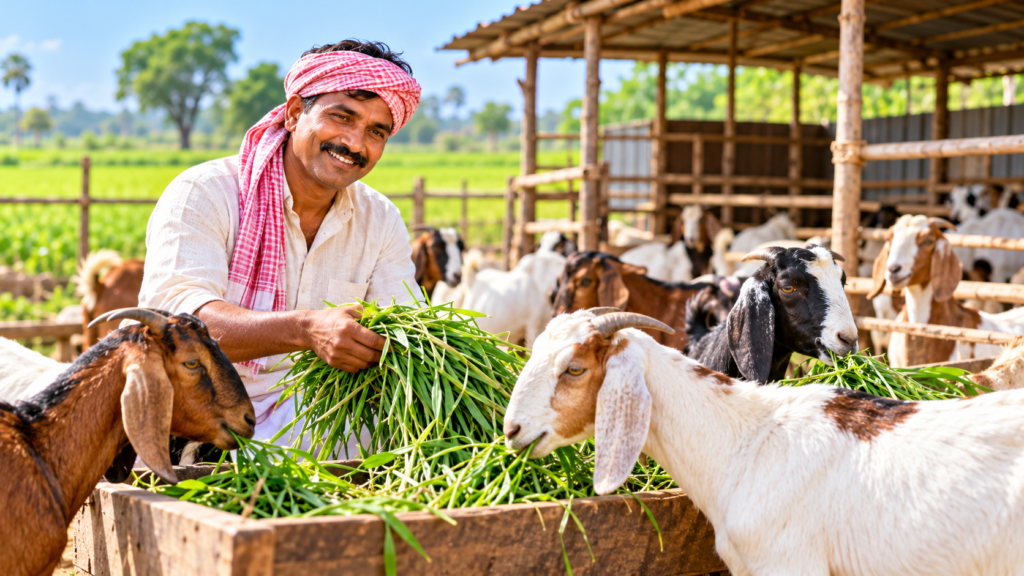
Bakri Palan is the Hindi term for goat rearing or goat farming. It involves raising goats for commercial or household purposes.
Depending on the business model, a farmer may focus on breeding goats, selling animals for meat, supplying breeding stock or producing goat milk where there is a suitable market.
Goat farming can be started on different scales, but the right approach depends on your land, budget, experience, local climate, feed availability and access to buyers.
Common types of goat farming businesses
1. Meat goat farming
The farmer raises goats for sale to meat traders, livestock markets, butchers or other eligible buyers. Demand and prices vary by location, season and animal characteristics.
2. Goat breeding farm
A breeding farm focuses on maintaining suitable breeding animals and producing healthy kids. This type of enterprise may be relevant to certain projects supported under the National Livestock Mission.
3. Goat milk production
Some goat breeds are raised for milk. Before choosing this model, confirm that there is a reliable local market and that you can manage milking, hygiene, storage and distribution.
4. Mixed goat farming
A mixed model may combine breeding and animal sales. It requires careful planning to ensure that breeding animals, young goats and sale-ready animals are managed properly.
For a beginner, it is usually sensible to study local demand and learn basic goat management before investing in a large commercial farm.
Which Government Scheme Supports Bakri Palan in India?
There is no single subsidy that automatically applies to every goat farmer throughout India. The available assistance depends on the type of project, the scheme’s current rules, the applicant’s eligibility and the state or district in which the farm is located.
The most important central scheme to investigate for eligible commercial goat breeding projects is the National Livestock Mission (NLM).
National Livestock Mission (NLM)
The Department of Animal Husbandry and Dairying implements the National Livestock Mission to encourage livestock entrepreneurship, breed development and related activities.
Under its Entrepreneurship Development Programme (NLM-EDP), eligible projects can receive a capital subsidy for specified activities, including sheep and goat breeding farms.
According to a Ministry of Fisheries, Animal Husbandry and Dairying statement published on February 11, 2026, the scheme provides a 50% capital subsidy, up to ₹50 lakh, for eligible project categories. The approved project, eligible expenditure and applicable limits must be confirmed in the current guidelines.
Official sources:
- National Livestock Mission — Department of Animal Husbandry and Dairying
- Official NLM application portal
- Government announcement on NLM subsidy
Is the 50% subsidy available to every goat farmer?
No. This is one of the most important things to understand before making an investment.
The NLM-EDP subsidy is intended for specified eligible entrepreneurial projects, including qualifying goat and sheep breeding farms. A person who simply wants to purchase a handful of goats for household use should not assume that they qualify for the same assistance.
The scheme has project requirements, eligibility conditions, application procedures and scrutiny stages. The applicant must demonstrate that the proposed project meets the relevant criteria.
Before purchasing animals or constructing a farm, review the current scheme guidelines and obtain confirmation from the appropriate authorities.
How Much Subsidy Can You Get for Goat Farming?
The subsidy amount depends on the project category, approved capital cost and the applicable scheme ceiling.
Under the NLM-EDP framework, eligible goat and sheep breeding projects may qualify for a capital subsidy of 50%, subject to the maximum permitted amount of ₹50 lakh and the conditions in force.
The following examples are illustrations of the arithmetic only, not guaranteed subsidy offers.
| Illustrative eligible project cost | 50% of the eligible cost | Important note |
|---|---|---|
| ₹10 lakh | ₹5 lakh | Only if the project and expenditure qualify |
| ₹20 lakh | ₹10 lakh | Approval and eligible-cost assessment required |
| ₹50 lakh | ₹25 lakh | Subject to the applicable project rules |
| ₹1 crore | ₹50 lakh | Maximum ceiling may apply; approval is not automatic |
Example: Suppose an eligible goat breeding project has an approved eligible capital cost of ₹20 lakh. Half of that amount is ₹10 lakh. If the project satisfies all scheme conditions and is approved, the applicable subsidy may be calculated using the eligible cost and scheme rules.
This does not mean the government will immediately transfer ₹10 lakh to the applicant. Subsidy disbursement is subject to verification, project milestones, required documents and the prescribed process.
The applicant must also arrange the remaining project funding through the permitted sources.
Does the subsidy cover every expense?
Not necessarily. Eligibility depends on the scheme’s approved project components and current guidelines.
Do not assume that land purchase, working capital, routine feed expenses, transport, personal expenses or every building cost will be covered. Ask for written clarification about the eligible expenditure before preparing your financial plan.
Can You Get a Government Loan for Bakri Palan?
Goat farming may be eligible for bank financing, depending on the project and the lender’s assessment. However, a loan and a subsidy are different forms of financial assistance.
A loan must normally be repaid according to the agreed terms. A subsidy is assistance provided under a specific programme when the beneficiary satisfies its conditions.
Where can you inquire about a goat farming loan?
You can approach:
- Commercial banks.
- Regional Rural Banks.
- Cooperative banks that finance eligible agricultural or livestock activities.
- Other authorised lending institutions.
- Relevant government livestock or agriculture offices for guidance on available schemes.
The bank will examine your proposed project, repayment capacity, financial documents and other factors under its lending policy.
The National Bank for Agriculture and Rural Development (NABARD) provides information and resources related to agricultural and rural development finance. NABARD should not be assumed to provide a direct subsidy or loan to every individual applicant; ask the financing bank about the arrangements available for your project.
Can you receive both a loan and a subsidy?
A qualifying project may involve bank financing and a government subsidy, depending on the scheme’s rules. The subsidy does not automatically replace the need for the applicant’s contribution or bank approval.
Discuss the financing structure with the bank and the implementing authorities before committing to the project.
Who Is Eligible for the Bakri Palan Subsidy?
Eligibility depends on the particular scheme. There is no universal eligibility checklist that applies to every central and state goat farming programme.
Under the NLM-EDP framework, eligible applicant categories include individuals, Farmer Producer Organisations (FPOs), Self-Help Groups (SHGs), Joint Liability Groups (JLGs), Farmer Cooperative Organisations (FCOs) and Section 8 companies, subject to the applicable project and scheme conditions.
General points to check
Before applying, determine whether:
- Your applicant category is permitted under the scheme.
- Your proposed goat breeding project meets the minimum requirements.
- You have access to suitable land or premises for the project.
- Your financial contribution and financing arrangements are adequate.
- Your project report meets the prescribed requirements.
- You can comply with animal housing, veterinary and management standards.
- You have the required documents and permissions.
- Your project satisfies the current scheme and bank conditions.
The precise eligibility requirements may differ by project category. Do not rely on an unofficial claim that all farmers, women, SC/ST applicants or small goat owners automatically receive a fixed subsidy percentage.
If you are planning a small unit, ask your district animal husbandry office whether a state-level programme is available for your category.
State Government Subsidies for Goat Farming
In addition to central assistance, some states operate livestock development schemes that may support goat or sheep rearing.
The benefits, unit size, subsidy percentage, applicant categories and application windows can vary substantially. Some programmes may be limited to particular districts or beneficiary groups, and some may not be open throughout the year.
For example, state schemes may provide assistance for a small goat unit, animal purchase, a shed or related livestock costs. The actual components and amounts must be confirmed in the relevant state’s current guidelines.
How to find a scheme in your state
- Visit your state government’s official animal husbandry department website.
- Look for livestock development, goat farming or sheep and goat rearing schemes.
- Check whether applications are currently being accepted.
- Read the eligibility conditions and approved unit size.
- Contact the district or block veterinary office for clarification.
- Ask whether the scheme can be combined with other financial assistance.
- Confirm the required documents and the subsidy release process.
You can also search the official myScheme government benefits portal for schemes that may match your location and eligibility.
Avoid assuming that a scheme available in one state is available throughout India.
Documents Required for Bakri Palan Subsidy or Loan
The document list depends on the scheme, applicant type, bank and project. A commercial breeding farm application may require more detailed financial and technical information than a small livestock assistance programme.
Commonly requested documents may include:
- Aadhaar or another accepted identity document.
- PAN, where required.
- Proof of address.
- Passport-size photographs.
- Bank account details and supporting documents.
- Land ownership, lease or premises documents, where applicable.
- A detailed project report.
- Project cost estimates and quotations.
- Bank statements or financial records, as requested.
- Applicant-category certificates, where relevant.
- Business registration or organisation documents, if applying as an entity.
- Training or experience records, if required by the scheme.
- Relevant permissions and declarations.
This is a general preparation list, not a guaranteed official checklist. Check the latest scheme instructions before submitting your application.
Protect your Aadhaar information, bank details and other personal documents. Upload them only through authorised channels.
How to Apply for Bakri Palan Subsidy Under NLM
For eligible commercial goat breeding projects, the official NLM portal is the starting point for understanding and submitting an application under the current process.
Step 1: Check the official scheme guidelines
Visit the National Livestock Mission website.
Read the current guidelines for goat and sheep breeding projects. Confirm the project size, eligible expenditure, applicant categories, funding structure and other requirements.
Step 2: Prepare a goat farming project report
A detailed project report should explain what you intend to establish, how it will operate and how the business will generate income.
It may include:
- The proposed location.
- The type of goat farming activity.
- The number and type of animals planned.
- Housing and equipment requirements.
- Feeding and water arrangements.
- Veterinary care and biosecurity measures.
- Project costs and the applicant’s contribution.
- Proposed bank finance, if applicable.
- Estimated operating expenses and income.
- Expected market channels.
- Repayment assumptions and business risks.
Use realistic figures supported by local quotations and market research. Avoid copying a generic profit estimate without checking whether it applies to your location.
Step 3: Arrange financing
If the project requires bank finance, approach a suitable lender and discuss the proposed loan.
The bank may assess your creditworthiness, repayment capacity, security and other requirements. Loan approval is not guaranteed.
Step 4: Apply through the official portal
Visit nlm.udyamimitra.in and follow the application instructions available for the relevant project category.
Complete the form accurately and upload the required documents. The online process and document requirements should be checked on the portal before applying.
Step 5: Complete the required scrutiny
The application may undergo scrutiny at state, bank and central levels, depending on the applicable process.
Authorities may review your project, eligibility, funding arrangement, supporting documents and compliance with scheme conditions.
Step 6: Wait for approval and follow the prescribed process
Do not assume that submitting an application means the subsidy has been approved.
Follow the instructions issued by the relevant authorities and lender. Complete any required formalities before making major project commitments.
Step 7: Complete project milestones and documentation
Subsidy disbursement may be linked to verification, project completion stages and submission of the required documents. Keep invoices, payment records, bank documents and other evidence organised.
Follow the official instructions on when to incur eligible expenditure and how to claim each permitted subsidy instalment.
Important: Do not buy animals or start construction based on an informal promise of subsidy. Confirm the current scheme rules and required approvals first.
How to Start a Bakri Palan Business Step by Step
Government assistance may help an eligible project, but a sustainable goat farm still depends on sound business planning.
Step 1: Study the local market
Before choosing a breed or farm size, find out who will buy your goats and what they require.
Potential customers may include livestock traders, meat sellers, breeding stock buyers or other local purchasers. Demand and prices vary by location, season, animal age, weight, breed and health.
Speak with several potential buyers rather than relying on a single quoted price.
Step 2: Choose the right goat breed
Breed selection should reflect the climate, feed availability, purpose of farming and local market.
Ask a local veterinary officer or experienced livestock professional about breeds suitable for your area. Consider the health of the animals, their source and the conditions in which they were raised.
Avoid buying animals based only on appearance or a seller’s promise of unusually high returns.
Step 3: Select a suitable location
The farm needs adequate space, ventilation, drainage, clean water and protection from extreme weather.
The housing arrangement should make it easy to feed the animals, clean the premises, isolate sick goats and manage newborn kids.
Check local rules and any required permissions before building a commercial facility.
Step 4: Prepare the goat shed
A suitable shed protects animals from rain, excessive heat, cold, dampness and predators. Its size and design should be appropriate for the number, age and type of goats.
Seek technical guidance on flooring, drainage, ventilation, bedding and space requirements. Overcrowding can increase stress and disease risk.
Step 5: Plan feed and water
Goats need appropriate feed, clean water and suitable minerals to remain healthy.
Your feeding plan may include locally available fodder, browse, hay and supplementary feed, depending on the animals’ nutritional needs and production stage.
Estimate the year-round cost and availability of feed before selecting the farm size. A project that looks profitable during a season of cheap fodder may become expensive when feed prices rise.
Step 6: Arrange veterinary care
Identify a veterinary service before buying your first animals.
Plan for health checks, vaccination as advised locally, parasite control, disease prevention and appropriate treatment. Newly purchased animals may need to be separated temporarily according to veterinary advice.
Keep records of births, deaths, illnesses, treatments, breeding and animal sales.
Step 7: Start with a manageable business model
A beginner should choose a farm size that matches their experience, funds and management capacity.
A small commercial unit and a large breeding farm have very different financial and technical requirements. If you plan to apply under NLM-EDP, make sure your proposed project meets the relevant scheme’s prescribed scale and other conditions.
Step 8: Maintain business records
Record the purchase price of each animal, feed expenditure, veterinary costs, labour, transport, insurance, breeding results and sale proceeds.
These records help you understand whether the farm is making money and may also be needed by a bank or scheme authority.
How Much Does It Cost to Start Goat Farming?
There is no single cost that applies to every goat farming business. The investment depends on the number of animals, breed, location, shed construction, equipment, feed supply and working capital.
Typical budget categories include:
| Expense category | What to include |
|---|---|
| Goat purchase | Healthy breeding or sale animals from a reliable source |
| Housing | Shed, fencing, drainage and necessary equipment |
| Feed | Fodder, hay, supplements and storage |
| Water | Water supply, tanks and drinking arrangements |
| Veterinary care | Health checks, treatment and preventive care |
| Insurance | Eligible animal insurance costs, where available |
| Labour | Owner’s time and any paid workers |
| Transport | Animal transport and delivery costs |
| Working capital | Funds for operating expenses until sales generate income |
Ask local suppliers for quotations and prepare a realistic budget. Leave room for unexpected veterinary expenses and periods when sales are delayed.
For an eligible NLM project, only expenditure allowed under the scheme’s current guidelines should be included in the subsidy calculation.
Is Goat Farming Profitable in India?
Goat farming can generate income, but profit is not guaranteed. Results depend on the purchase cost of animals, feeding expenses, breeding outcomes, disease control, mortality, market prices and management.
A farm can experience losses even when demand for goats is strong if operating costs are too high or animal health problems reduce production.
How goat farming generates revenue
A goat farm may earn income through:
- Sale of goats for meat.
- Sale of healthy breeding animals, where a market exists.
- Sale of milk, where suitable breeds and customers are available.
- Other permitted livestock-related activities supported by the farm’s business model.
Not every farm will have access to all these income sources.
Calculate profit before investing
A simple way to assess the business is:
Net operating profit = Total farm revenue − Total operating expenses
Revenue may include animal sales and other legitimate farm income. Expenses should include feed, veterinary care, labour, transport, insurance, repairs and other operating costs.
You should also account for depreciation, financing costs and other relevant expenses when preparing a complete financial projection.
A government subsidy can reduce part of the eligible capital cost, but it does not guarantee that the farm will become profitable.
Common Mistakes to Avoid in Bakri Palan
1. Believing every goat farmer receives a subsidy
Different schemes have different objectives and eligibility requirements. Verify whether your specific project qualifies.
2. Starting with more animals than you can manage
A large herd requires sufficient housing, feed, working capital and veterinary support. Choose a scale you can manage properly.
3. Ignoring animal health
Poor housing, inadequate nutrition and delayed treatment can cause significant losses. Establish a veterinary plan before the farm begins operating.
4. Relying on unrealistic profit promises
Be cautious about claims that a particular number of goats will produce guaranteed monthly income. Prepare your own projections using local prices and realistic production assumptions.
5. Paying an unofficial agent for guaranteed subsidy approval
No intermediary should be trusted simply because they promise guaranteed approval. Use official portals and authorised offices, and obtain receipts for legitimate payments.
6. Spending before confirming the rules
If you intend to apply for government support, verify the approved project structure and permitted expenditure before purchasing animals or building the shed.
Frequently Asked Questions About Bakri Palan Subsidy
1. Does the Indian government provide a subsidy for goat farming?
Yes. The National Livestock Mission’s Entrepreneurship Development Programme provides capital subsidy support for specified eligible goat and sheep breeding farm projects. State governments may also have separate livestock schemes. Eligibility and subsidy amounts depend on the relevant programme.
2. How much subsidy is available under the National Livestock Mission?
For eligible NLM-EDP project categories, the published framework provides a 50% capital subsidy up to ₹50 lakh. The approved amount depends on the project, eligible expenditure, applicable ceiling and compliance with the scheme guidelines.
3. Can I get a subsidy to buy five or ten goats?
Do not assume that a small goat purchase automatically qualifies under NLM-EDP. The central scheme has specific project requirements. Ask your district animal husbandry department about small-unit or state-level programmes that may apply to your circumstances.
4. Is a goat farming loan the same as a subsidy?
No. A loan must normally be repaid according to its terms. A subsidy is financial assistance under a scheme, subject to eligibility and approval. A project may use both if the relevant rules permit it.
5. Can an individual apply for goat farming subsidy?
Individuals are among the applicant categories recognised under NLM-EDP, subject to the relevant project and scheme conditions. Other eligible categories include certain groups and organisations specified in the guidelines.
6. Is land required for goat farming?
A commercial farm needs suitable premises, housing and access to feed and water. The precise land or premises documents required depend on the project and scheme. Confirm the current requirements before applying.
7. Can women apply for goat farming subsidies?
Women may apply under schemes for which they meet the eligibility conditions. Some state programmes have specific provisions for women or other beneficiary categories. The benefit and selection criteria depend on the scheme.
8. Does NABARD directly give a subsidy to every goat farmer?
No. You should not assume that NABARD directly pays a standard subsidy to every applicant. Ask your bank and the relevant government department about available financing and the role of the institutions involved.
9. Where can I apply for the National Livestock Mission?
Start by reviewing the official National Livestock Mission website and follow the current application instructions on the NLM portal.
10. Can I start goat farming without government subsidy?
Yes. Goat farming can be established using personal funds or eligible financing, provided you can meet the applicable local and business requirements. Make a realistic business plan before investing.
11. Is goat farming profitable for beginners?
It can be, but profit depends on local market demand, feed costs, animal health, breeding performance and management. Beginners should gain practical knowledge and prepare a conservative financial plan before expanding.
12. Which goat breed is best for farming?
The best breed depends on your location, climate, farming purpose and local market. Ask a qualified veterinary or livestock professional to help you choose suitable animals.
Final Verdict: Is Bakri Palan a Good Business Opportunity?
Bakri Palan can be a useful rural business opportunity for people willing to learn livestock management and build a realistic plan. However, success depends on healthy animals, appropriate housing, reliable feed, veterinary support and access to buyers.
The National Livestock Mission may support eligible commercial goat breeding projects through its capital subsidy framework. But the 50% subsidy, up to ₹50 lakh, is not a universal benefit for everyone who wants to purchase goats. Your proposed project must meet the scheme’s requirements and receive the required approvals.
Before investing, compare your costs, identify your customers, prepare a detailed project report and confirm the latest rules with the official authorities. Apply through authorised channels and never rely on promises of guaranteed subsidy approval.
Official resources to check before applying:
- Department of Animal Husbandry and Dairying
- National Livestock Mission
- NLM application portal
- myScheme — Government benefits finder
- NABARD
Disclaimer: Scheme rules, eligibility, approved project costs and application availability can change. This article is for general information and should not replace current official guidelines or advice from your bank and local animal husbandry department.
SHARING IS CARING 💖