
Installing solar panels on your rooftop can significantly change the way you use electricity at home. During sunny hours, your solar system can generate electricity for your household, reducing the amount of power you need to purchase from the grid.
But what happens when your solar panels produce more electricity than your home needs?
This is where solar net metering comes in.
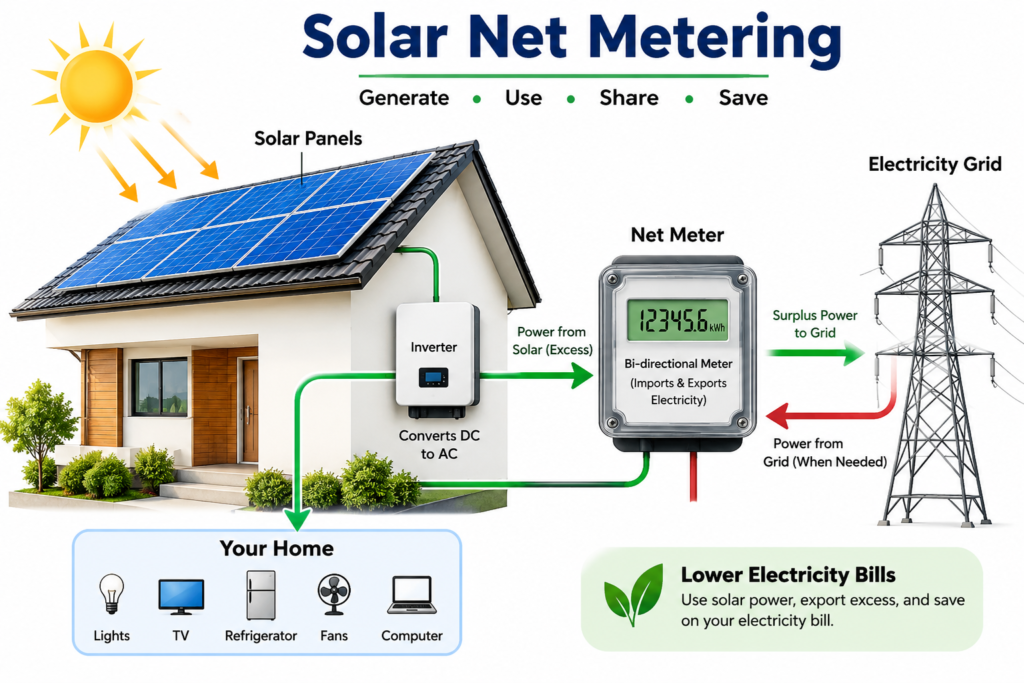
A net meter keeps track of electricity flowing in both directions: electricity you consume from the grid and surplus electricity your solar system sends back to the grid. Depending on the applicable regulations and your electricity provider, the exported energy can be accounted for when your electricity bill is calculated.
In simple words, net metering helps connect your rooftop solar system with the electricity grid and allows imported and exported electricity to be measured.
In this articld we’ll explain how a solar net meter works, how electricity moves between your home and the grid, how your bill can be affected, and what you should know before installing rooftop solar.
Note: Solar regulations, eligibility, settlement mechanisms, charges, and application procedures can differ between states and electricity distribution companies (DISCOMs). Always check the latest rules applicable to your location before making an investment.
What Is Solar Net Metering?
Solar net metering is a billing arrangement used with certain grid-connected solar systems.
Instead of having a conventional electricity meter that only records electricity coming from the grid, a bidirectional or net meter can record electricity flowing:
- From the electricity grid to your home
- From your solar system to the electricity grid
This is particularly useful for homes that have grid-connected rooftop solar.
During the day, your solar panels generate electricity. Your home uses that electricity first. If the panels generate more electricity than your home is using at that moment, the surplus may flow into the grid.
When your solar panels aren’t producing enough electricity, such as at night or during periods of low sunlight, your home can draw electricity from the grid.
The meter records these flows according to the applicable metering and settlement arrangement.
How Does a Solar Net Meter Work?
The easiest way to understand net metering is to imagine a normal day at home.
During sunny hours
Your solar panels generate electricity.
For example:
Solar panels → Inverter → Home appliances
Your refrigerator, fans, lights, computers and other appliances can use the electricity generated by the solar system.
If your solar system produces more electricity than your home needs at that moment, the extra electricity can flow toward the grid.
When solar generation is lower than your demand
Suppose your home is using more electricity than your solar panels are producing.
The additional electricity comes from the grid:
Grid → Net meter → Home
At night
Your solar panels normally aren’t generating electricity at night.
Your home therefore gets electricity from the grid, unless you have a suitable battery-storage system that can supply power.
This two-way movement of electricity is the basic idea behind a grid-connected solar system with net metering.
Simple Solar Net Metering Example
Let’s take a simple example.
Suppose your rooftop solar system generates:
20 units of electricity during the day.
Your household directly uses:
12 units.
That leaves:
8 units of surplus electricity.
If your approved metering arrangement allows that surplus to be exported to the grid, the net meter records the electricity flowing outward.
Later, your home may consume electricity from the grid when solar generation is unavailable.
Suppose you consume:
5 units from the grid at night.
The exact way these imports and exports appear on your electricity bill depends on the applicable state/DISCOM rules and settlement mechanism.
That’s why you shouldn’t assume that every 1 unit exported will automatically cancel exactly 1 unit imported under every solar policy.
How Electricity Flows in a Net-Metered Solar System
A typical grid-connected rooftop solar setup can be understood like this:
Solar Panels
↓
Solar Inverter
↓
Your Home
↓
Net Meter
↕
Electricity Grid
The net meter sits at the grid connection point and measures electricity moving between your property and the distribution network.
The inverter is also important because solar panels generate electricity in DC form, while normal household electrical systems use AC electricity.
The inverter converts the generated electricity into the appropriate form for use by household appliances and grid connection.
What Happens When Your Solar Panels Produce Extra Electricity?
This is one of the most common questions people have before installing rooftop solar.
Imagine that it is a bright afternoon.
Your solar system is producing 5 kW, but your home is using only 2 kW.
The remaining generation may be available for export to the grid, subject to your system configuration and applicable rules.
So instead of that electricity being unused, it can flow toward the distribution grid.
Your net meter records the export.
Later, when your solar system isn’t generating enough electricity, you can draw electricity from the grid.
This is one of the main reasons grid-connected rooftop solar can be attractive to households.
What Happens at Night?
Solar panels don’t normally generate electricity after sunset.
So if your home uses electricity at night, you will generally draw power from the grid unless your solar installation includes an appropriate battery-storage system.
For example:
Daytime:
Solar → Home
Solar → Grid, when there is surplus
Night:
Grid → Home
This is why the net meter needs to measure electricity in both directions.
How Does Net Metering Reduce Your Electricity Bill?
The basic idea is simple.
Without solar:
Grid electricity → Home → Electricity bill
With grid-connected solar:
Solar electricity → Home
and, when there is surplus:
Solar electricity → Grid
while at other times:
Grid electricity → Home
The applicable billing mechanism then accounts for electricity imported from and exported to the grid according to local regulations.
The result can be a lower electricity bill because part of your energy requirement is being met by your rooftop solar system.
However, solar does not necessarily mean that your electricity bill will always become zero.
Fixed charges, taxes, fees, minimum charges, demand charges, or other components may still apply depending on the applicable tariff and regulations.
Net Metering vs. a Normal Electricity Meter
A traditional electricity meter primarily measures the electricity supplied to your property from the grid.
A solar net-metering setup needs to account for electricity moving in both directions.
| Feature | Traditional Meter | Solar Net Metering |
|---|---|---|
| Grid electricity consumed | Yes | Yes |
| Solar generation | No | Solar system measures generation separately |
| Electricity exported to grid | Generally not part of normal household metering | Yes, where applicable |
| Two-way measurement | Generally no | Yes |
| Used with rooftop solar | Not sufficient for export arrangements | Commonly used where approved |
The exact meter type and installation requirements depend on your electricity provider.
Is Net Metering the Same as Gross Metering?
No.
These are different arrangements.
Net Metering
Under a net-metering arrangement, electricity imported from the grid and electricity exported to the grid are accounted for under the applicable rules.
The purpose is generally to measure the consumer’s electricity exchange with the grid and settle it according to the approved mechanism.
Gross Metering
Under gross metering, the electricity generated by the solar system can be measured separately and treated under a different compensation or purchase arrangement.
The exact rules, tariffs and eligibility depend on the relevant regulations.
Therefore, homeowners should check with their state electricity regulator and DISCOM before deciding which arrangement applies.
Is Net Metering Available Everywhere in India?
Not necessarily in exactly the same form.
India has national-level rules and programs related to rooftop solar, but electricity distribution and detailed implementation involve state-level regulators and DISCOMs.
The Ministry of Power has amended the Electricity (Rights of Consumers) Rules, including provisions related to rooftop solar and technical-feasibility requirements. For example, a 2021 amendment increased the net-metering limit referenced in the rules from 10 kW to 500 kW for eligible prosumers, including MSMEs. However, applicable state regulations and implementation requirements still matter.
More recent government material also states that rooftop solar systems up to 10 kW are exempt from a technical-feasibility study under the relevant provisions, while distribution-system strengthening and other implementation details remain subject to the applicable framework.
The important point is: don’t assume that a rule you read for one state automatically applies to every electricity consumer in India.
Always check your local DISCOM.
What Is a DISCOM?
You will often see the word DISCOM when researching rooftop solar.
DISCOM stands for Distribution Company.
It is the electricity distribution company responsible for supplying electricity to consumers in a particular service area.
When you install grid-connected rooftop solar, your DISCOM may be involved in areas such as:
- Application processing
- Technical requirements
- Metering
- Inspection
- Grid connection
- Approval
- Commissioning
- Electricity billing
The exact process differs depending on the location.
The National Portal for Rooftop Solar provides DISCOM information and links to relevant portals.
How to Apply for Solar Net Metering
The exact procedure varies by state and DISCOM, but the process generally involves several stages.
Step 1: Check eligibility
First, determine whether your property and proposed solar system qualify under the applicable rooftop-solar and metering rules.
Step 2: Apply through the appropriate portal
Depending on the program and location, applications may be made through the national rooftop-solar portal or the relevant state/DISCOM system.
The Ministry of New and Renewable Energy provides information about grid-connected rooftop solar and application mechanisms.
Step 3: Select an approved/eligible vendor
Depending on the scheme and installation route, you may need to use an appropriate vendor.
Step 4: Install the solar system
The panels, inverter, mounting structure and other required components are installed according to the applicable technical requirements.
Step 5: Inspection and verification
The DISCOM or authorized personnel may inspect or verify the installation.
Step 6: Meter installation or replacement
The appropriate meter is installed or the existing meter is replaced, depending on the approved setup.
Step 7: Grid connection and commissioning
Once the required approvals and technical requirements are completed, the rooftop solar system can be commissioned for grid-connected operation.
The actual process and timeline can vary by location.
What Is PM Surya Ghar Muft Bijli Yojana?
If you are researching residential rooftop solar in India, you will likely come across the PM-Surya Ghar: Muft Bijli Yojana.
The Government of India launched the scheme in February 2024 to promote rooftop solar for households. The sanctioned scheme has a total financial outlay of ₹75,021 crore and includes central financial assistance for eligible residential consumers.
The official framework provides central financial assistance for eligible residential rooftop solar capacity, with the structure including support for the first 2 kW, additional capacity up to 3 kW, and no additional CFA beyond 3 kW under the cited scheme structure.
Because subsidy rules and implementation details can be updated, homeowners should check the official government portal before making a purchase decision.
How Much Can You Save With Solar Net Metering?
There is no single savings figure that applies to every home.
Your potential savings depend on several factors:
- Size of your solar system
- Solar generation at your location
- Roof orientation and shading
- Household electricity consumption
- Electricity tariff
- Time of electricity usage
- Applicable net-metering rules
- Fixed charges
- Local DISCOM policies
- Solar-system cost
- Maintenance costs
For example, a household that consumes a lot of electricity during sunny hours may directly use more of its solar generation.
Another household may use most of its electricity at night.
Both homes could have the same size solar system but experience different electricity-bill savings.
Does Net Metering Mean a Zero Electricity Bill?
Not necessarily.
This is an important point.
People sometimes hear that installing solar can make an electricity bill “zero.” In reality, the final bill depends on the local tariff and billing structure.
Even if your solar generation substantially offsets your energy consumption, there may be:
- Fixed charges
- Meter charges
- Taxes
- Service charges
- Other applicable fees
The exact treatment varies according to the electricity tariff and local regulations.
So it is better to think of solar net metering as a way to reduce your electricity cost, rather than assuming it will automatically eliminate every charge.
What Happens If Your Solar System Produces Less Electricity Than Expected?
Solar generation changes throughout the year.
Generation can be affected by:
- Cloudy weather
- Rain
- Dust
- Shadows
- Panel orientation
- Panel efficiency
- Temperature
- System maintenance
- Inverter performance
During periods of lower generation, your home may consume more electricity from the grid.
That’s normal for a grid-connected solar system.
A good solar installation should therefore be designed around your actual electricity consumption and the solar potential of your property rather than simply choosing the largest system available.
What Happens During a Power Cut?
This is another common misunderstanding.
A typical grid-connected solar inverter is designed to disconnect from the grid during a grid outage for safety reasons.
That means having rooftop solar does not automatically mean your home will have electricity during a power cut.
If backup power during outages is important to you, you need to consider a suitable battery-storage or backup configuration.
Talk to a qualified solar professional about the appropriate system before assuming your rooftop solar will operate during an outage.
Does a Net Meter Store Electricity?
No.
A net meter is a measurement device, not a battery.
It records electricity flowing between your home and the grid.
A battery, on the other hand, stores electrical energy for later use.
So:
Net meter = measures electricity
Battery = stores electricity
This distinction is important when planning a solar installation.
Advantages of Solar Net Metering
Solar net metering can offer several potential benefits for eligible grid-connected consumers.
1. Lower electricity consumption from the grid
Your solar system can supply part of your household’s electricity demand.
2. Better use of surplus solar generation
When your system produces more electricity than your home needs, surplus generation can potentially be exported to the grid under the applicable arrangement.
3. Reduced electricity costs
Using your own solar generation can reduce the amount of electricity you need to purchase from the grid.
4. Renewable energy generation
Rooftop solar produces electricity without the direct combustion of fossil fuels at the point of generation.
5. Greater energy awareness
A solar system can help households understand how much electricity they consume and how much their solar system produces.
Things to Check Before Installing Solar With Net Metering
Don’t choose a solar system based only on the panel price.
Before installation, check:
Electricity consumption
Look at your electricity bills from the previous 12 months if possible.
Roof condition
Make sure your roof is structurally suitable and has enough usable space.
Shading
Trees, neighboring buildings and other structures can reduce solar generation.
DISCOM rules
Check your local DISCOM’s current rooftop-solar and metering requirements.
Metering arrangement
Confirm whether net metering or another arrangement applies to your property.
Inverter requirements
Use equipment that meets the applicable technical and safety requirements.
Vendor credentials
Check the vendor’s eligibility and reputation before making a payment.
Warranty
Understand the warranty terms for panels, inverter and installation work.
Maintenance
Ask what maintenance is required and whether the installer provides after-sales support.
Net Metering and Solar Panel Maintenance
Solar panels generally require relatively little routine maintenance, but that doesn’t mean you should install them and forget about them.
Keep an eye on:
- Dust accumulation
- Physical damage
- Loose connections
- Inverter alerts
- Unusual drops in generation
- Vegetation or new shading
- Meter readings
If your solar generation suddenly falls without an obvious weather-related reason, contact your installer or a qualified technician.
Frequently Asked Questions About Solar Net Metering
What is a solar net meter?
A solar net meter is a bidirectional electricity meter used in eligible grid-connected solar installations to measure electricity imported from the grid and electricity exported to the grid.
How does a net meter work with solar panels?
Solar panels generate electricity for your home. If generation exceeds your immediate consumption, surplus electricity can flow toward the grid. When your home needs more electricity than the solar system is producing, electricity can be imported from the grid.
Does a solar net meter reduce electricity bills?
It can help reduce electricity costs by allowing your solar generation to offset some of your electricity consumption under the applicable billing and settlement rules.
Can solar net metering make my electricity bill zero?
Not necessarily. Your final bill can still include fixed charges, taxes, fees or other applicable components, depending on your local tariff and regulations.
Does net metering work at night?
The net meter can measure electricity imported from the grid at night, but solar panels generally do not generate electricity after sunset.
Does a net meter store electricity?
No. A net meter measures electricity. It does not store it. Batteries are used for energy storage.
Can solar panels work during a power cut?
A standard grid-connected solar system generally shuts down when the grid is unavailable. A specially designed backup or battery system may provide power during outages.
Is net metering available in every state?
Solar metering policies and implementation can vary between states and DISCOMs. Check the current rules applicable to your electricity connection.
Final Thoughts
Solar net metering can seem complicated at first, but the basic idea is actually quite simple.
Your solar panels generate electricity. Your home uses that electricity when it is available. When there is surplus generation, electricity may flow to the grid. When your solar system isn’t producing enough electricity, your home can draw power from the grid.
The net meter measures these electricity flows according to the applicable rules.
The biggest thing to remember is that solar net metering is not just about installing solar panels and changing a meter. The economics depend on your electricity consumption, solar generation, tariff structure, system size, local regulations and the terms applicable to your connection.
If you’re considering rooftop solar, don’t make the decision based on a single online calculator or a sales pitch. Check your electricity bills, understand your local DISCOM’s requirements, compare installation options and verify the current government rules.
For official rooftop-solar information in India, the Ministry of New and Renewable Energy and the National Portal for Rooftop Solar are useful starting points.
SHARING IS CARING 💖