
Water is one of the most important resources for farming. Whether a farmer grows wheat, rice, vegetables, fruits, or other crops, getting water from a well, borewell, pond, or irrigation source to the field can be expensive. Irrigation pipes help transport water efficiently, but purchasing suitable pipes can add to the cost of cultivation.
To support farmers, various government programmes provide financial assistance for irrigation infrastructure, micro-irrigation systems, and approved agricultural equipment. Depending on the state and scheme, eligible farmers may be able to receive assistance for PVC pipes, HDPE pipes, drip irrigation systems, or sprinkler irrigation equipment.
The term Kisan Sinchai Pipe Yojana is commonly used when people search for irrigation pipe subsidy information. However, farmers should understand that the exact scheme name, subsidy amount, eligible pipe types, and application process may vary by state.
In this guide, you will learn about irrigation pipe subsidies in India, eligibility requirements, possible benefits, documents, the application process, and where to check official government information.
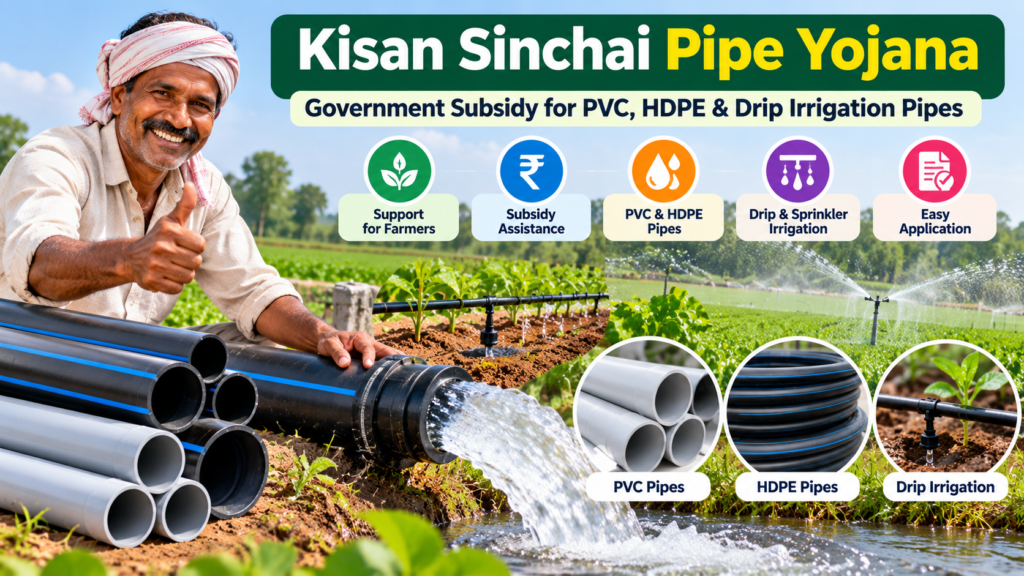
What Is Kisan Sinchai Pipe Yojana?
Kisan Sinchai Pipe Yojana is a commonly used search term for government assistance related to irrigation pipes and water management for agriculture. It should not automatically be treated as the official name of one uniform, nationwide subsidy scheme.
Different government programmes may support different parts of irrigation infrastructure. For example, some schemes focus on transporting water from a source to a field, while others support drip irrigation or sprinkler systems that help farmers use water more efficiently.
Depending on the programme available in your state, assistance may cover eligible items such as:
- PVC irrigation pipes
- HDPE irrigation pipes
- Water-conveyance pipelines
- Drip irrigation systems
- Sprinkler irrigation systems
- Certain approved agricultural water-management equipment
The important point is that not every scheme covers every type of pipe or irrigation equipment. Farmers should check the current notification issued by their state agriculture or horticulture department before purchasing equipment or submitting an application.
For a starting point, visit the Ministry of Agriculture and Farmers Welfare and the government’s myScheme portal.
What Is an Irrigation Pipe Subsidy?
An irrigation pipe subsidy is financial assistance that reduces the eligible cost of purchasing or installing irrigation equipment.
For example, a farmer may need a pipeline to carry water from a borewell to a field. If a suitable government programme covers that type of pipeline, the farmer may receive assistance according to the approved subsidy rate, unit cost, quantity limit, and eligibility conditions.
The benefit may be paid directly to the farmer or provided through an approved supplier or implementation process, depending on the scheme.
A subsidy is not necessarily available to every farmer, and it does not always cover the entire purchase price. Some schemes use a percentage of the eligible cost, while others specify a maximum amount or approved cost per unit.
Before making a purchase, confirm whether the programme requires prior approval, an authorised supplier, an inspection, or a specific application reference.
Which Types of Irrigation Pipes May Be Covered?
The types of pipes eligible for financial assistance depend on the individual scheme. Here are the main categories farmers may encounter.
1. PVC irrigation pipes
PVC stands for polyvinyl chloride. PVC pipes are commonly used in agricultural water-conveyance systems because they are relatively lightweight and available in different diameters and pressure ratings.
They may be suitable for transporting water from an irrigation source to different parts of a farm, depending on the system design and pressure requirements.
Before buying PVC pipes, check the required diameter, pressure rating, intended use, and whether the relevant subsidy programme includes that specification.
2. HDPE irrigation pipes
HDPE stands for high-density polyethylene. HDPE pipes are commonly used for agricultural water distribution, irrigation networks, and certain sprinkler systems.
Their flexibility can make them useful in different field layouts. The appropriate pipe grade and pressure rating depend on the water source, pumping system, distance, and irrigation requirements.
Some state schemes specifically identify HDPE pipes as eligible items, but farmers should verify the applicable rules before purchasing them.
3. Drip irrigation pipes and equipment
Drip irrigation delivers water close to the roots of plants through a network of pipes, filters, emitters, and other components.
It can be useful for crops such as vegetables, fruits, and other crops where controlled water delivery is appropriate. Financial assistance may be available through micro-irrigation programmes for eligible farmers.
However, a subsidy for a complete drip irrigation system is not necessarily the same as a subsidy for buying ordinary PVC or HDPE water-conveyance pipes.
4. Sprinkler irrigation pipes and equipment
Sprinkler irrigation distributes water through pipes and sprinkler heads, allowing water to be applied over a field.
Depending on the crop, field layout, and irrigation source, sprinkler systems may be suitable for various agricultural uses.
Some government programmes support approved sprinkler systems and their eligible components. Check the scheme’s technical specifications to determine which equipment is covered.
Government Schemes Related to Irrigation Pipes and Irrigation Equipment
There is no single subsidy percentage that applies to every farmer across India. The following official programmes and portals are useful starting points for identifying assistance.
1. Per Drop More Crop (PDMC)
The Per Drop More Crop programme supports micro-irrigation, particularly drip and sprinkler systems, to improve water-use efficiency at farm level.
A Ministry of Agriculture and Farmers Welfare announcement published by the Press Information Bureau on 6 February 2024 described financial assistance of 55% for small and marginal farmers and 45% for other farmers for installation of micro-irrigation systems under the programme. States may provide additional incentives.
These figures relate to the programme information in that official announcement. They should not be interpreted as a guaranteed current subsidy for every pipe purchase or every state.
Official reference: PIB — Micro Irrigation and Per Drop More Crop.
2. State agriculture department schemes
Many states operate their own agriculture support programmes, including assistance for approved irrigation equipment and water-conveyance infrastructure.
For example, Rajasthan’s official agriculture portal has published an irrigation pipeline assistance programme with different per-metre limits for specified pipe types and a percentage-based subsidy, subject to its rules. This demonstrates why state-specific verification is essential.
Official reference: Rajasthan Raj Kisan — Irrigation Pipeline.
This Rajasthan programme should not be assumed to apply to farmers living in another state. Check your own state’s current scheme details.
3. State horticulture and micro-irrigation programmes
State horticulture departments may administer drip and sprinkler assistance for eligible crops and farmers. The application process, eligible area, subsidy calculation, and approved suppliers can differ.
For example, Telangana has published micro-irrigation guidance through its horticulture department.
Official reference: Telangana Horticulture Department — Micro Irrigation FAQs.
4. myScheme government portal
The myScheme portal helps users find government programmes and review eligibility and application information.
Visit myScheme.gov.in and search for irrigation, drip irrigation, sprinkler irrigation, agriculture equipment, or farmer subsidies.
The availability of a scheme depends on the state, applicant category, and current programme conditions.
How Much Subsidy Can Farmers Get for Irrigation Pipes?
The amount depends on the specific scheme, eligible equipment, farmer category, location, approved cost, and any maximum limit.
Some programmes offer assistance as a percentage of eligible expenditure. Others specify a maximum amount per metre, per hectare, per unit, or per beneficiary.
For example, an official Rajasthan irrigation pipeline page describes a scheme with assistance based on 50% of the unit cost, subject to specified per-metre limits for certain pipe types. Other states may have different rates and conditions.
Therefore, it would be misleading to promise that every farmer will receive 50%, 75%, 80%, or 100% assistance for PVC or HDPE pipes.
How to estimate your possible subsidy
Once you have confirmed the applicable subsidy rate and eligible cost limit, you can estimate the benefit using the scheme’s formula.
For example, suppose a hypothetical programme allows assistance at 50% of an eligible pipe cost of ₹20,000.
- Eligible cost: ₹20,000
- Subsidy rate: 50%
- Estimated subsidy: ₹10,000
- Remaining cost before other charges: ₹10,000
This is only a calculation example, not an official subsidy offer. Actual assistance may be lower because of scheme limits, approved unit costs, quantity restrictions, or other conditions.
Always use the amount and calculation method specified in your state’s current notification.
Who Is Eligible for an Irrigation Pipe Subsidy?
Eligibility differs from one programme to another. However, applicants may need to meet some or all of the following conditions.
1. Farmer or cultivator status
The applicant may need to be a recognised farmer or cultivator under the scheme’s rules.
2. Agricultural land requirements
Some schemes require ownership or documented rights to cultivate agricultural land. Others may accept specific forms of tenancy or other recognised cultivation arrangements.
Check the rules before applying.
3. Irrigation source
A scheme may require an existing and suitable irrigation source, such as a well, borewell, pump, or other approved water source.
4. Approved equipment
Only specified pipe materials, dimensions, pressure ratings, brands, or irrigation components may qualify.
5. Farmer category
Small and marginal farmers, women farmers, or applicants from certain recognised categories may receive different assistance under some programmes. This is not universal and must be verified.
6. Previous subsidy benefits
Some schemes restrict repeat assistance or limit how frequently a beneficiary can receive support for the same type of equipment or land area.
7. Prior approval
The department may require an application and approval before the farmer purchases or installs the equipment.
Important: Meeting general farmer eligibility requirements does not automatically guarantee a subsidy. The department must confirm that the applicant, equipment, and application satisfy the applicable scheme conditions.
Documents Required for an Irrigation Pipe Subsidy
The exact document list depends on the state and scheme. Farmers may be asked to provide some of the following:
- Aadhaar card or another accepted identity document
- Farmer registration details, if applicable
- Land ownership records or accepted cultivation documents
- Proof of residence
- Bank account details or passbook copy
- Passport-size photograph
- Mobile number
- Details of the irrigation source
- Pipe or equipment quotation from an approved supplier, where required
- Caste certificate, if applying under a category that requires it
- Application form and declarations specified by the department
- Previous subsidy details, if requested
This is a general checklist, not a definitive list for every state. Follow the current notification and application instructions.
How to Apply for Kisan Sinchai Pipe Subsidy Yojana
The application process may be online or offline, depending on the scheme available in your state.
Step 1: Identify the correct scheme
Visit your state’s agriculture or horticulture department website. Search for irrigation pipeline assistance, PVC pipe subsidy, HDPE pipe subsidy, drip irrigation, sprinkler irrigation, or water-conveyance support.
You can also begin with the myScheme government portal.
Step 2: Check the eligibility rules
Read the current notification carefully. Confirm the farmer categories covered, eligible equipment, subsidy calculation, maximum assistance, application period, and whether prior approval is required.
Step 3: Prepare your documents
Keep your identity proof, land records, bank details, and other required documents ready. If a supplier quotation or technical specification is required, obtain it in the format accepted by the department.
Step 4: Submit your application
Use the official online portal if online applications are accepted. Otherwise, contact the designated agriculture office, horticulture office, or authorised service centre.
Fill in your details accurately and keep the application number or receipt.
Step 5: Wait for approval
The department may verify your documents, land details, irrigation requirements, equipment specifications, and eligibility before issuing approval.
Do not assume that submitting an application means it has been accepted.
Step 6: Purchase or install the approved equipment
Follow the instructions in your approval. If the scheme requires an approved supplier or specifies a purchase period, comply with those conditions.
Avoid purchasing equipment before approval if the rules require approval first.
Step 7: Complete inspection or verification
Some schemes require the department to inspect the installation, verify the equipment, or review purchase documents.
Keep the invoice, payment proof, equipment details, and photographs if requested.
Step 8: Receive the subsidy according to the scheme
If your application is approved and all conditions are met, assistance may be paid to the eligible farmer or processed through the authorised supplier or department, depending on the programme.
Check the payment status through the official channel.
How to Check Irrigation Pipe Subsidy Status
If you have already applied, use the application reference or registration details provided by the department.
- Open your state’s official agriculture or horticulture portal.
- Find the application status, beneficiary status, or subsidy status section.
- Enter the requested registration or application details.
- Review the displayed status and any pending requirements.
- If the status is unavailable online, contact the designated agriculture office.
Avoid sharing Aadhaar details, banking information, or application credentials with unknown websites or agents who promise to release a subsidy.
Benefits of Irrigation Pipe Subsidy Schemes
When a farmer qualifies for assistance, irrigation support may offer several practical benefits.
Reduced initial cost
Financial assistance can reduce the amount the farmer needs to spend on eligible irrigation equipment.
Better water transportation
A suitable pipeline can help transport water from the source to the field, depending on the farm layout and system design.
Support for efficient irrigation
Drip and sprinkler systems may help improve water-use efficiency when appropriately designed and maintained.
Better farm management
A well-planned irrigation network can make it easier to deliver water to different field sections.
Potential savings in labour and water handling
A suitable irrigation arrangement may reduce some manual water-transport tasks. Actual savings depend on the farm, water source, crops, equipment, and operating costs.
Subsidies can reduce the initial financial burden, but they do not guarantee higher yields, a particular level of water savings, or increased income.
Important Precautions Before Applying
Before applying for any irrigation pipe subsidy, keep the following points in mind:
- Verify that the scheme is active for the relevant financial year.
- Confirm whether ordinary PVC or HDPE pipes are covered, or whether assistance applies only to specified irrigation systems.
- Check the required pipe size, pressure rating, quality standards, and approved supplier conditions.
- Ask whether prior approval is necessary.
- Confirm the maximum eligible cost, subsidy percentage, and quantity limit.
- Keep the original invoice and payment proof.
- Use official portals and authorised offices.
- Do not pay an unofficial agent who promises guaranteed approval.
- Do not assume that a scheme announced in another state is available in your state.
- Check whether the programme has a limited budget or application window.
These precautions can help prevent unnecessary spending and reduce the risk of applying under the wrong scheme.
Frequently Asked Questions (FAQs)
1. What is Kisan Sinchai Pipe Yojana?
The phrase is commonly used to search for government assistance related to irrigation pipes. The exact official scheme name and eligibility conditions depend on the state or programme concerned.
2. Is there one irrigation pipe subsidy scheme for all farmers in India?
No single subsidy rate or set of conditions should be assumed to apply to every farmer nationwide. State agriculture programmes and central micro-irrigation programmes have different coverage and requirements.
3. Can farmers get a subsidy for PVC pipes?
Some state programmes may cover specified PVC pipes or water-conveyance infrastructure. Check your state’s current scheme notification to confirm whether your required pipe type is eligible.
4. Is HDPE pipe eligible for a government subsidy?
HDPE pipes may be eligible under certain state pipeline programmes or approved irrigation-system schemes. Eligibility depends on the applicable notification, specifications, and purpose of use.
5. Is drip irrigation subsidy the same as a pipe subsidy?
No. A drip irrigation subsidy may cover an approved micro-irrigation system, while a pipeline subsidy may cover transporting water from a source to a field. The eligible components and rules can differ.
6. How much subsidy can a farmer receive?
The amount depends on the scheme, state, eligible cost, farmer category, equipment, and any maximum limit. Confirm the rate through an official notification before estimating your benefit.
7. Can I apply online?
Some schemes accept online applications, while others require applications through agriculture offices, horticulture departments, or authorised service centres. Follow your state’s official instructions.
8. What documents are usually needed?
Commonly requested documents may include identity proof, land records, bank details, farmer registration, an equipment quotation, and other documents specified by the scheme.
9. Should I buy pipes before applying?
Not unless the official rules clearly permit it. Some programmes require prior approval or specify when and how the equipment must be purchased.
10. Where can I find official irrigation subsidy information?
Start with the Ministry of Agriculture and Farmers Welfare, the myScheme portal, and your state’s official agriculture or horticulture department website.
11. Does every farmer receive a subsidy after applying?
No. Assistance depends on eligibility, available funds, approved equipment, verification, application timing, and compliance with the programme’s rules.
12. How can I avoid irrigation subsidy fraud?
Use official government websites, verify the identity of the relevant department or service centre, retain application receipts, and avoid paying unknown agents who promise guaranteed benefits.
Conclusion
Irrigation pipes can help farmers transport water more efficiently, while drip and sprinkler systems can support more targeted water application. Government programmes may reduce the initial cost of eligible irrigation infrastructure, but the available benefits depend on the scheme and the farmer’s circumstances.
If you are searching for the Kisan Sinchai Pipe Yojana, start by identifying the programme available in your state. Check whether PVC pipes, HDPE pipes, drip irrigation equipment, or sprinkler systems are covered, and confirm the eligible subsidy amount before purchasing anything.
Use official agriculture department notifications and government portals to verify the eligibility conditions, application process, and payment rules. Taking a few minutes to check the official information can help you avoid unnecessary expenses and apply for the support that actually fits your needs.
Disclaimer: This article is for general informational purposes only. Scheme names, subsidy rates, eligible equipment, application periods, and document requirements may change. It is not an official government notification or a guarantee of subsidy approval. Always verify current details with the relevant state agriculture or horticulture department before applying.
SHARING IS CARING 💖