
Buying gold jewellery is an exciting experience, whether you are shopping for a wedding, a festival, a birthday gift or something special for everyday wear. But when you visit a jewellery showroom, you may notice that the same type of jewellery is available in 14K, 18K, 22K and 24K gold.
The difference is not just the price. Each karat represents a different level of gold purity, which affects the jewellery’s appearance, durability, suitability for different designs and overall cost.
So, which gold is best for jewellery: 14K, 18K, 22K or 24K?
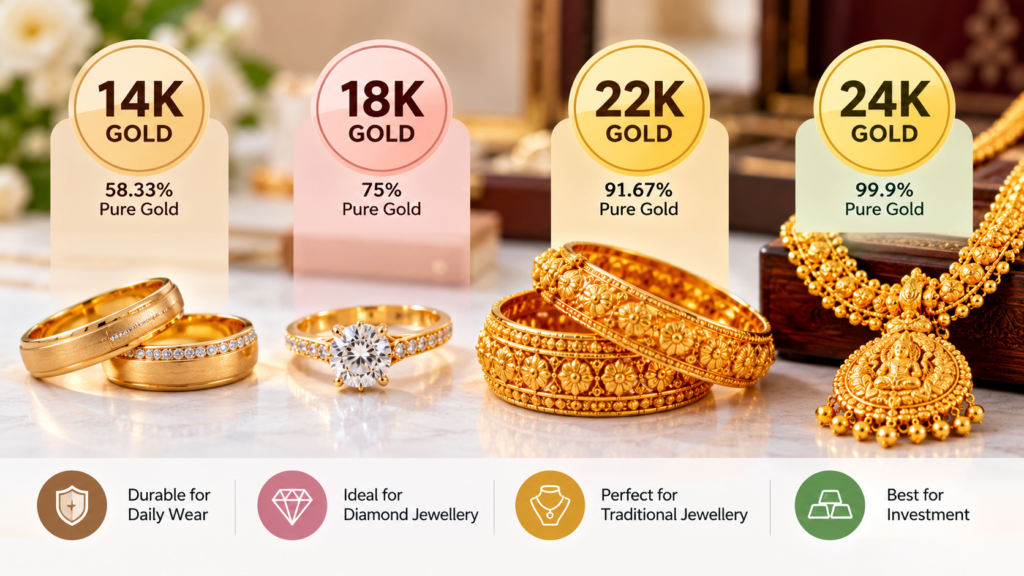
The answer depends on what you want to buy. For traditional Indian jewellery, 22K gold is a popular choice. For diamond rings and gemstone jewellery, 18K gold is often preferred. For some durable everyday designs, 14K gold can be a practical option. Meanwhile, 24K gold is valued for its high purity but is generally less suitable for jewellery that must withstand regular wear.
In this guide, we will compare all four gold purities, explain their advantages and disadvantages, and help you choose the right gold for your needs in India.
What Does Karat Mean in Gold?
Karat, written as K or kt, is a measurement of gold purity. Pure gold is represented by 24 karats, while lower karat gold contains a mixture of gold and other metals.
For example, 18K gold contains 18 parts gold out of 24 parts, meaning it is 75% gold. The remaining portion consists of other metals that can help create the required colour, hardness and working properties.
These additional metals may include copper, silver, zinc or other suitable alloying metals, depending on the jewellery’s composition.
It is important not to confuse karat (K) with carat, which is commonly used to measure the weight of diamonds and other gemstones.
Gold purity chart
| Gold purity | Approximate gold content | Common fineness marking |
|---|---|---|
| 14K gold | 58.33% | 585 |
| 18K gold | 75% | 750 |
| 22K gold | 91.67% | 916 |
| 24K gold | Very high purity; depends on the grade | 999 or 995 for certain recognised grades |
These figures describe common purity standards. In India, BIS recognises specific grades for gold jewellery and artefacts, including 14K (585), 18K (750), 22K (916) and 24KS (995). The marking on a particular item should be checked rather than assuming every product sold as 24K has the same fineness.
14K vs 18K vs 22K vs 24K Gold: Quick Comparison
Here is a quick overview before looking at each type in detail.
| Feature | 14K gold | 18K gold | 22K gold | 24K gold |
|---|---|---|---|---|
| Gold content | About 58.33% | 75% | About 91.67% | Very high purity |
| General durability | Often suitable for everyday designs | Good balance of purity and durability | Softer than lower-karat alloys | Generally the softest option |
| Common uses | Everyday rings, bracelets and selected designs | Diamond rings, gemstone jewellery and fine designs | Traditional Indian jewellery and wedding pieces | Investment products and selected specialised items |
| Relative gold value by weight | Usually lower | Higher than 14K | Higher than 18K | Highest for comparable weight when purity is higher |
| Design flexibility | Many durable alloy designs | Suitable for many detailed settings | Suitable for traditional designs, with care | Limited for items requiring high resistance to bending |
| Best suited for | Budget-conscious everyday wear | Fine jewellery and gemstone settings | Traditional gold jewellery | High-purity gold products |
Actual durability depends on the alloy, design, thickness, setting and quality of workmanship. Karat alone cannot guarantee that a ring, chain or bracelet will last longer.
What Is 14K Gold?
14K gold contains approximately 58.33% pure gold, with the remaining 41.67% made up of other metals.
Because it contains a higher proportion of alloying metals than 18K or 22K gold, 14K gold is often used for jewellery designed to balance appearance, strength and price.
Benefits of 14K gold
1. Often suitable for daily wear
Many 14K gold designs are suitable for rings, bracelets, chains and other jewellery worn regularly. The final durability still depends on the design and how the item is used.
2. Usually more affordable
For jewellery of comparable gold weight and design, 14K gold generally contains less pure gold than 18K or 22K gold. This can make its gold-content cost lower, although the final retail price also depends on labour, gemstones, branding and other charges.
3. Available in different colours
Depending on its alloy composition, 14K gold may be made in yellow, white or rose gold.
4. Useful for practical designs
Its properties can suit jewellery that needs to withstand frequent handling. The choice of alloy and construction remains important.
Disadvantages of 14K gold
- It contains less gold than 18K, 22K and high-purity 24K gold.
- Its colour can differ from higher-karat yellow gold.
- Some people may prefer the richer appearance associated with higher-purity gold.
- Certain alloying metals may cause skin reactions in sensitive individuals.
Who should consider 14K gold?
Consider 14K gold if you want an everyday piece, a particular modern design or a lower initial price. Before buying, check the purity marking, alloy information where available and the jeweller’s after-sales policy.
What Is 18K Gold?
18K gold contains 75% pure gold and approximately 25% other metals. It is a popular choice for fine jewellery, particularly pieces that incorporate diamonds or coloured gemstones.
It offers a middle ground between the higher gold content of 22K gold and the potentially greater hardness of some lower-karat alloys.
Benefits of 18K gold
1. A balance between purity and practicality
18K gold provides a substantial gold content while allowing alloy compositions that can support many jewellery designs.
2. Popular for diamond jewellery
It is commonly used in diamond rings, earrings, pendants and other fine jewellery. The suitability of a setting depends on its construction, stone type and intended use.
3. Different colour options
18K gold can be made in yellow, white or rose gold, depending on the metals used in the alloy.
4. Suitable for detailed designs
Many jewellers use 18K gold for jewellery that includes gemstones, intricate settings and modern shapes.
Disadvantages of 18K gold
- It generally costs more than comparable 14K jewellery with similar gold weight and workmanship.
- It contains less pure gold than 22K gold.
- It can still scratch, bend or become damaged depending on the design and how it is worn.
- White gold may require maintenance to preserve its desired finish, depending on its coating and alloy.
Who should consider 18K gold?
18K gold is worth considering for diamond jewellery, gemstone rings and fine jewellery where you want a relatively high gold content along with a design suited to regular use.
For a diamond ring, also compare the setting’s construction, gemstone security, repair options and warranty rather than choosing by karat alone.
What Is 22K Gold?
22K gold contains approximately 91.67% pure gold. In India, it is widely associated with traditional gold jewellery, including wedding jewellery, necklaces, bangles, earrings and festive designs.
Its high gold content gives it the appearance many buyers associate with traditional yellow gold. However, the higher purity also means it is generally softer than many lower-karat gold alloys.
Benefits of 22K gold
1. High gold content
22K jewellery contains substantially more gold than 14K and 18K jewellery of the same gold weight.
2. Popular for traditional Indian jewellery
It is commonly chosen for bridal sets, bangles, chains, necklaces and festive jewellery.
3. A familiar choice for gold buyers
Many Indian consumers are comfortable comparing 22K jewellery because it is widely available from established jewellers.
4. Gold content contributes to its value
The amount of gold in a piece is an important factor in its metal value. The resale amount, however, also depends on purity verification, deductions, the buyer’s terms and the current market price.
Disadvantages of 22K gold
- It is generally softer than 14K and 18K gold alloys.
- Delicate pieces may be more vulnerable to bending or deformation during rough use.
- It may not be the first choice for every type of gemstone setting.
- Its higher gold content can make comparable pieces more expensive.
Who should consider 22K gold?
22K gold is an excellent option to consider if you want traditional Indian gold jewellery for weddings, festivals or family occasions.
For rings, fine chains and pieces that will be worn every day, ask the jeweller whether the specific design and construction are suitable for your lifestyle.
What Is 24K Gold?
24K is the highest common karat designation for gold purity. In ordinary consumer discussions, it usually refers to very high-purity gold, but the exact fineness marking matters.
For example, 999 fineness means 99.9% gold, while the BIS-recognised 24KS jewellery or artefact grade is marked 995. These are not identical purity levels.
24K gold is highly valued for its gold content, but pure gold is relatively soft. That makes it less suitable for many jewellery designs that experience bending, impacts or frequent movement.
Benefits of 24K gold
1. Very high gold purity
It contains more gold by weight than 14K, 18K or 22K gold.
2. Valuable as a gold product
High-purity gold is commonly used for investment-oriented products, such as qualifying coins and bars. Buyers should verify the product’s purity, authenticity and applicable purchase or resale terms.
3. A rich natural gold colour
High-purity gold has a distinctive yellow appearance.
Disadvantages of 24K gold
- It is relatively soft and can deform more easily than many gold alloys.
- It is generally less suitable for intricate jewellery exposed to daily wear.
- Its high gold content can make it more expensive for a comparable gold weight.
- It is not automatically the best choice for resale or investment; premiums, spreads, product type and buyer terms matter.
Who should consider 24K gold?
Consider high-purity gold if your priority is gold content rather than a durable everyday jewellery design. For jewellery, ask a reputable jeweller whether the specific item is suitable for its intended use and confirm its exact purity marking.
Which Gold Is Best for Jewellery?
There is no single answer for every buyer. The best gold depends on the type of jewellery, your budget, how often you will wear it and whether purity or design durability matters most.
Best gold for daily wear
14K or 18K gold may be worth considering for daily-wear jewellery, particularly when the design needs to withstand regular handling.
14K gold often offers a lower gold-content cost, while 18K gold offers a higher gold content. Neither is automatically more durable in every design, so inspect the construction and ask about repairs and maintenance.
Best gold for diamond jewellery
18K gold is a common choice for diamond jewellery. Its gold content and alloy options can suit many gemstone settings.
However, a secure diamond setting depends on the setting design, metal condition, workmanship and the type of stone. Ask the jeweller how the piece should be cared for and inspected.
Best gold for wedding jewellery
22K gold is a popular choice for traditional Indian wedding jewellery. Its high gold content and familiar yellow colour appeal to many buyers.
If the design contains delicate sections or gemstones, ask whether the chosen purity is appropriate for the construction.
Best gold for a lower initial budget
14K gold may be a practical option when you want a particular design at a lower initial price. Compare the final bill, not only the quoted price per gram.
Making charges, stone costs, taxes and brand premiums can significantly affect the price of the finished item.
Best gold for high purity
24K or another clearly specified high-purity grade is the choice when maximum gold content is the priority. For jewellery, however, high purity must be weighed against the softness of the metal.
Best gold for investment
High-purity gold products may be suitable for people seeking exposure to gold, but jewellery is not the same as an investment bar or coin. Jewellery may involve making charges and resale deductions that affect how much you recover.
Before buying gold as an investment, compare product premiums, buyback terms, authenticity, storage and selling costs.
Why Does 22K Gold Usually Cost More Than 18K Gold?
The price difference mainly comes from the amount of pure gold in the item, assuming the same net gold weight.
For example, a hypothetical 10-gram piece of 22K gold contains approximately 9.167 grams of gold, while a 10-gram piece of 18K gold contains 7.5 grams of gold.
The 22K piece therefore contains more pure gold. But the final jewellery price also includes other factors, such as:
- The current gold rate used by the jeweller.
- Net gold weight.
- Making or labour charges.
- Gemstone and diamond costs.
- Wastage charges, if applicable and properly explained.
- Applicable taxes.
- Brand or design premiums.
This is why a simple comparison of karat alone cannot tell you the final price of a necklace, ring or bracelet.
How to Calculate Gold Purity
Gold purity can be expressed as a percentage or in parts per thousand, known as fineness.
The basic formula is:
Gold purity percentage = (Karat ÷ 24) × 100
Examples:
- 14K: (14 ÷ 24) × 100 = approximately 58.33%.
- 18K: (18 ÷ 24) × 100 = 75%.
- 22K: (22 ÷ 24) × 100 = approximately 91.67%.
- 24K: represents the highest karat designation; the actual purity depends on the product’s fineness.
Remember that these calculations describe the stated karat purity. They do not establish whether an individual item is genuine. For that, check its hallmark and use the appropriate verification process.
How to Check Gold Purity Before Buying in India
Checking purity is one of the most important steps when purchasing gold jewellery.
1. Look for the BIS hallmark
For hallmarked jewellery in India, check the relevant BIS hallmark and purity or fineness marking.
Common fineness markings include:
- 14K585 for 14K gold.
- 18K750 for 18K gold.
- 22K916 for 22K gold.
- The appropriate marking for the particular high-purity grade sold as 24K or 24KS.
The exact applicable markings should match the product and current BIS requirements.
2. Verify the HUID where applicable
HUID stands for Hallmark Unique Identification. Hallmarked jewellery under the current system carries a unique six-character alphanumeric identifier.
Use the official BIS CARE app’s Verify HUID feature to check the item’s details. If the information does not match what the seller tells you, ask for clarification before purchasing.
Read the official BIS hallmarking consumer information.
3. Ask for a proper bill
Keep an itemised invoice showing the jewellery description, net precious-metal weight, purity, applicable hallmarking charges and other amounts charged.
The invoice is important if you later need to ask questions about purity, exchange, repair or resale.
4. Compare the final price
Ask the jeweller to explain the gold rate, net weight, making charges, gemstone costs, taxes and any other charges.
Two items with the same karat can have very different final prices because of their designs, brands and workmanship.
5. Buy from a reputable jeweller
Check the seller’s registration and reputation, and read the exchange and buyback policy before making a purchase. Keep your invoice and any warranty or product documentation.
Is Higher-Karat Gold Always Better?
Not necessarily.
Higher-karat gold contains more pure gold, but it is not automatically better for every jewellery design. A high-purity piece may be more expensive and more susceptible to deformation, while a lower-karat alloy may suit certain everyday designs.
For example, a buyer looking for a diamond ring that will be worn frequently may prefer an appropriate 18K design. Someone shopping for traditional wedding bangles may prefer 22K gold. A buyer prioritising high gold purity may choose a high-purity product instead of a jewellery piece.
The sensible approach is to match the gold purity to the purpose of the purchase.
Common Mistakes to Avoid When Buying Gold Jewellery
Before you pay, avoid these common mistakes:
- Choosing only by price: A cheaper piece may have a different purity, weight or design.
- Assuming 24K is best for every purpose: High purity does not automatically mean better durability.
- Ignoring the hallmark: Verify the applicable purity markings and HUID where required.
- Comparing gross weight instead of net gold weight: Gemstones and other components may contribute to the total weight.
- Overlooking making charges: These charges can affect the final bill and resale economics.
- Assuming the full purchase price will be recovered: Making charges, taxes, market changes and resale terms can affect the amount you receive.
- Forgetting about maintenance: Jewellery worn every day may need periodic inspection, cleaning or repairs.
A little research before buying can help you select a piece that fits both your budget and your expectations.
Frequently Asked Questions
1. Which gold is best for jewellery: 14K, 18K, 22K or 24K?
It depends on the jewellery. 14K and 18K can be suitable for many everyday and modern designs, 22K is popular for traditional Indian jewellery, and 24K is generally more suitable for high-purity gold products than jewellery that needs to withstand regular wear.
2. Is 22K gold better than 18K gold?
22K gold contains more pure gold by weight. However, 18K gold can offer more design flexibility for certain gemstone settings. The better choice depends on the intended use, design, price and durability requirements.
3. Is 14K gold real gold?
Yes. 14K gold is a gold alloy containing approximately 58.33% gold. Its remaining composition consists of other metals. Check the purity marking and buy from a reputable seller.
4. Is 18K gold suitable for everyday wear?
Many 18K gold designs are suitable for everyday wear. Durability depends on the alloy, design, thickness, setting and care. Rings or bracelets exposed to frequent impacts may need more attention.
5. Why is 24K gold not commonly used for everyday jewellery?
Very high-purity gold is relatively soft and can bend or deform more easily than many lower-karat alloys. For this reason, 14K, 18K and 22K alloys are often more practical for different types of wearable jewellery.
6. What is the difference between 22K and 24K gold?
22K gold contains approximately 91.67% gold. 24K is the highest common karat designation, but the exact purity of a product depends on its fineness marking. High-purity gold products are often marked 999 or 995, depending on the grade.
7. Which gold is best for diamond rings?
18K gold is a common option for diamond rings because it offers a high gold content and can be used in suitable gemstone settings. The security and quality of the setting matter just as much as the karat.
8. Is 14K gold cheaper than 22K gold?
For comparable gold weight, 14K gold generally contains less pure gold and may therefore cost less. However, the final price also depends on design, labour, gemstones, brand and other charges.
9. What does 916 mean on gold jewellery?
916 is a fineness marking that represents approximately 916 parts gold per 1,000 parts of the alloy, or about 91.6% gold. It is commonly associated with 22K gold.
10. What does 750 mean on gold jewellery?
750 means that the alloy contains 750 parts gold per 1,000 parts, or 75% gold. This is the standard fineness associated with 18K gold.
11. Can I wear 22K gold jewellery every day?
You can wear many 22K pieces regularly, but their suitability depends on their design and construction. Because 22K gold is relatively soft, delicate jewellery may require extra care to avoid bending or damage.
12. Does gold jewellery retain its full purchase value when resold?
Not necessarily. Resale value depends on the current gold rate, verified purity, net gold weight, deductions and the buyer’s policy. Making charges and other retail costs may not be recovered.
13. How can I check whether my gold jewellery is genuine?
Check the applicable BIS hallmark and purity marking, verify the HUID using the official BIS CARE app where applicable, and retain the invoice. If you remain uncertain, contact a recognised assaying and hallmarking centre about testing options.
14. Is white gold available in 14K and 18K?
Yes. White gold is made by alloying gold with other metals to produce a lighter colour. Its composition and any surface coating can vary, so ask the jeweller about the alloy and maintenance requirements.
Final Verdict: Which Karat Is Best for Jewellery?
When comparing 14K vs 18K vs 22K vs 24K gold, remember that the highest purity is not always the best choice for every purpose.
- 14K gold: Worth considering for selected everyday designs and buyers seeking a lower initial price.
- 18K gold: A popular choice for diamond jewellery, gemstone settings and fine designs.
- 22K gold: A strong option to consider for traditional Indian gold jewellery, including wedding pieces.
- 24K or other high-purity gold: Best suited to buyers who prioritise gold content, particularly when purchasing suitable investment products rather than everyday jewellery.
Before buying, check the purity, hallmark, net gold weight, final bill and seller’s exchange or buyback terms. Choose jewellery that matches your lifestyle and budget instead of assuming that the highest karat is automatically the best.
The right purchase is one that gives you confidence in the gold’s purity, suits the way you intend to wear it and fits your budget comfortably.
SHARING IS CARING 💖