
Solar panels are a smart way to generate electricity at home, but they need a little attention to keep working as intended. If you have rooftop solar panels, you may have noticed dust, bird droppings, dry leaves, or water stains collecting on their surface.
This is especially common in parts of India where summers are dusty, construction work is frequent, or pollution leaves a thin layer of grime on exposed surfaces. Even after a good rainfall, some dirt may remain on the panels.
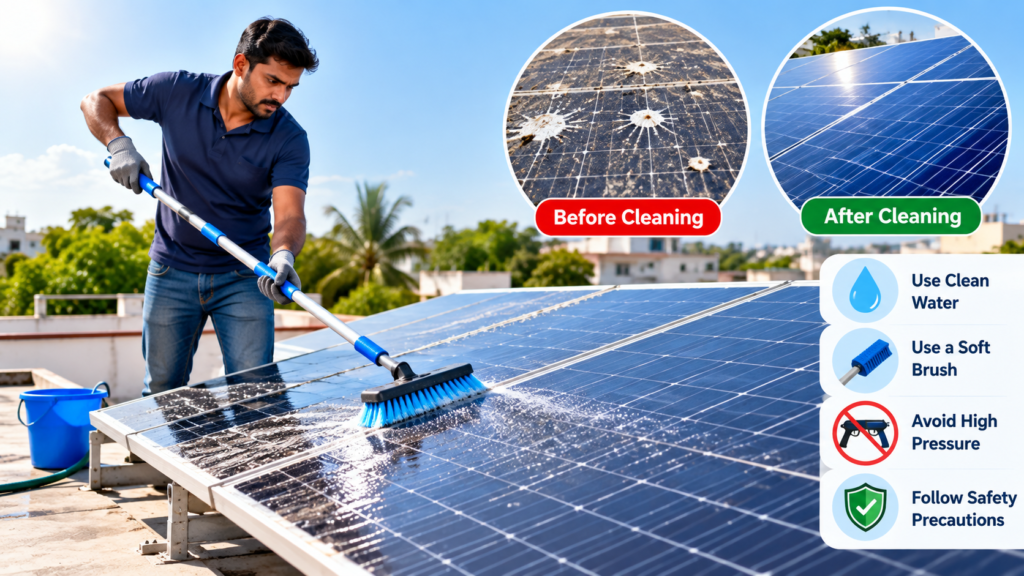
The good news is that many ground-accessible solar panels can be cleaned with water and suitable soft cleaning equipment. You do not usually need expensive cleaning products. What matters most is using the correct method, avoiding damage, and putting safety first.
In this guide, you will learn how to clean solar panels at home, what equipment you need, how often to clean them, which mistakes to avoid, and when professional cleaning is the better option.
Why Is Solar Panel Cleaning Important?
Solar panels generate electricity when sunlight reaches their photovoltaic cells. Dust and other deposits on the glass can block some sunlight, potentially reducing energy production.
The effect depends on the amount and type of dirt, local weather, panel angle, and other site conditions. A thin layer of dust may have only a small effect in some places, while heavy dust or bird droppings can cause more noticeable losses.
Here are a few reasons why routine inspection and appropriate cleaning are useful.
1. Helps remove dust and surface dirt
Dust, pollen, pollution, and bird droppings can accumulate over time. Cleaning removes these deposits and helps keep the panel surface clear.
2. Can help maintain electricity generation
Heavy soiling can reduce the amount of sunlight reaching the cells. Removing it may improve output when dirt was the cause of reduced production.
However, cleaning will not fix every performance problem. Shading, inverter faults, wiring issues, ageing panels, or other equipment problems may also affect generation.
3. Helps you spot visible damage
While inspecting accessible panels, you may notice cracked glass, loose-looking cables, damaged mounting hardware, or unusual staining.
Do not touch exposed wiring or attempt electrical repairs. If anything looks damaged, contact your solar installer or a qualified technician.
4. Helps prevent stubborn deposits from building up
Bird droppings, sticky residue, and certain deposits may become more difficult to remove if left for a long time. Checking your panels periodically helps you identify when cleaning is actually needed.
There is no need to clean panels every day. The right schedule depends on local conditions and the manufacturer’s guidance.
What Causes Dust and Stains on Solar Panels?
Before cleaning, it helps to understand what you are dealing with.
- Dust and sand: Wind can carry fine particles that settle on panel glass.
- Bird droppings: These can form stubborn spots and block sunlight in small areas.
- Pollen and leaves: Trees near the roof may leave pollen, small leaves, or other organic material.
- Pollution: Traffic, nearby factories, and construction can contribute to surface grime.
- Water spots: Minerals in water can leave visible marks after droplets evaporate.
- Sticky residue: Sap or other substances may require more careful cleaning than ordinary dust.
Different deposits may need different approaches. Avoid scraping the glass or using strong chemicals simply because a stain is difficult to remove.
What Do You Need to Clean Solar Panels at Home?
For panels that can be reached safely from the ground or from a suitable, secure platform, prepare the following:
- Clean water, preferably low in minerals if water spotting is a concern.
- A soft, non-abrasive sponge or cloth approved for solar panel cleaning.
- A suitable soft brush or purpose-made solar panel cleaning tool.
- A hose with gentle water flow, if permitted by the manufacturer.
- A clean microfibre cloth for accessible areas, if recommended for your panel type.
- Gloves and suitable protective equipment for the cleaning environment.
A long-handled cleaning tool may help with some installations, but it does not make an unsafe roof safe. Do not lean over roof edges or work near electrical cables to reach a panel.
Do you need a special solar panel cleaning liquid?
Usually, water is sufficient for ordinary dust. If a cleaning solution is required, use only a product approved by the panel manufacturer.
Avoid abrasive powders, rough scouring pads, harsh chemicals, and household cleaners that could damage the glass, anti-reflective coating, frame, or seals.
How to Clean Solar Panels at Home: Step-by-Step Guide
Follow these steps only if the panels can be accessed safely and the manufacturer permits the cleaning method.
Step 1: Check the manufacturer’s instructions
Start by checking the installation manual or your solar installer’s maintenance guidance. Panel materials, coatings, mounting arrangements, and electrical systems can differ.
Some systems have specific requirements for cleaning, water temperature, equipment, or shutdown procedures. Follow those instructions rather than relying on a universal method.
If you cannot identify the panel model, contact your installer before using any cleaning chemical or specialised equipment.
Step 2: Choose a safe time for cleaning
Avoid cleaning panels in strong midday sunlight when the glass may be hot. A sudden temperature difference from cold water can stress some panel materials, and working on a hot roof can also be uncomfortable and dangerous.
A cool, calm period is generally preferable, provided the surface is not wet or slippery and you can reach the panels safely.
Early morning or another cooler time may be suitable, but never climb onto a damp roof to follow a schedule.
Step 3: Inspect the panels from a safe position
Look for dust, bird droppings, leaves, visible cracks, damaged frames, or unusual marks.
If the panels are on a steep roof, use a safe ground-level viewpoint or arrange professional inspection. Never walk directly on solar modules; their glass and internal components can be damaged even if no crack is immediately visible.
If you see exposed wiring, broken glass, damaged connectors, or loose mounting hardware, do not touch the affected area. Contact your installer.
Step 4: Remove loose dust gently
If the manufacturer’s instructions permit it, use a suitable soft brush or cleaning tool to remove loose dust from safely accessible panels.
Do not use a rough broom, metal scraper, abrasive pad, or tool that could scratch the glass. Avoid applying heavy pressure.
For panels that are out of reach, do not improvise by leaning out of a window or over a roof edge. Arrange professional cleaning instead.
Step 5: Rinse with clean water
Use gentle water flow if the manufacturer allows it. The aim is to loosen and wash away surface dirt without forcing water into electrical enclosures, connectors, or other components.
Avoid high-pressure washers unless the manufacturer explicitly permits a particular method and pressure. Strong jets can damage seals or other components.
Do not direct water at damaged panels, exposed electrical parts, or loose connections. If the system appears damaged, stop and seek professional assistance.
Step 6: Clean stubborn bird droppings carefully
Bird droppings may stick to the surface. If your manufacturer’s instructions permit, wet the deposit with suitable clean water and allow it to soften before gently removing it with a non-abrasive tool approved for the panel.
Do not scrape dried deposits with a knife, metal blade, or rough brush. These can scratch the glass or damage its coating.
If the stain does not come away easily, consult the manufacturer’s instructions or arrange professional cleaning.
Step 7: Deal with water spots correctly
If your local water supply contains many dissolved minerals, dried droplets may leave spots. Using water with lower mineral content may help reduce these marks when the manufacturer recommends it.
Do not use acids, solvents, or household descaling products without explicit approval for your panel type.
In some cases, a gentle rinse is all that is needed. Avoid polishing the glass with abrasive materials.
Step 8: Allow the panels to drain and dry naturally
Let the panels drain and dry according to the manufacturer’s recommendations. Avoid wiping the surface aggressively just to remove every last droplet.
Once cleaning is complete, check from a safe position that no debris remains and that you have not disturbed cables, connectors, or mounting equipment.
Step 9: Check solar generation after cleaning
If your solar system has a monitoring app or inverter display, compare its performance under reasonably similar sunlight conditions before and after cleaning.
Remember that electricity production changes with cloud cover, temperature, shade, time of day, and season. A single reading does not prove that cleaning increased output.
If generation remains unexpectedly low, contact your installer. The issue may be unrelated to surface dirt.
Important: This procedure is for appropriate surface cleaning only. It is not a guide to repairing, opening, rewiring, or servicing the electrical system.
How Often Should You Clean Solar Panels?
There is no single cleaning schedule that works for every home. Cleaning frequency depends on dust levels, rainfall, panel angle, nearby trees, bird activity, local pollution, and the manufacturer’s recommendations.
| Location or condition | Practical approach |
|---|---|
| Areas with frequent dust or construction | Inspect more often and clean when deposits accumulate |
| Areas with regular rainfall | Inspect periodically; rain may remove some dust but not all residue |
| Homes near trees | Check for leaves, pollen, and bird droppings |
| Areas with heavy bird activity | Inspect for concentrated deposits |
| Panels with persistent water spots | Ask your installer about suitable water quality and cleaning methods |
| Difficult-to-access rooftops | Arrange a professional inspection and cleaning schedule |
A simple starting point is to inspect the panels periodically and clean them when there is visible buildup or a noticeable change that may be related to soiling. Your installer may recommend a more specific schedule based on local conditions.
Do not assume that cleaning more frequently always saves money. The cost of cleaning, water use, access risks, and any potential improvement in output should all be considered.
Does Rain Clean Solar Panels Properly?
Rain can wash away some loose dust, particularly on panels installed at an angle. However, it may not remove sticky deposits, bird droppings, pollen, or mineral stains.
Rainwater can also leave residue if dirt is redistributed across the surface or if droplets dry unevenly. Therefore, rainfall does not guarantee that panels are completely clean.
The best approach is to inspect the panels safely rather than cleaning automatically after a fixed number of rainy days.
Can Dirty Solar Panels Increase Your Electricity Bill?
If your solar panels produce less electricity because of heavy soiling, your home may need to draw more electricity from the grid than it otherwise would. This can affect your bill, depending on your consumption, tariff, net-metering arrangement, and solar generation.
However, a higher electricity bill does not automatically mean your panels need cleaning. Seasonal sunlight changes, increased appliance use, shading, inverter faults, and tariff changes can also affect your bill.
Before paying for cleaning, check the generation data from your inverter or monitoring app, if available. If output has dropped unexpectedly, ask your installer to investigate other possible causes as well.
Common Solar Panel Cleaning Mistakes to Avoid
Avoid these mistakes when maintaining your rooftop solar system.
- Walking on solar panels: The glass and internal structure can be damaged, and slipping is a serious risk.
- Using high-pressure water: Strong water jets may damage seals or components.
- Cleaning hot panels with cold water: Sudden temperature changes can stress some materials.
- Using rough brushes or metal scrapers: These may scratch the surface or damage coatings.
- Applying unapproved chemicals: Some cleaners can damage the panel surface, seals, or frame.
- Ignoring electrical hazards: Damaged cables, connectors, or modules should be handled by qualified professionals.
- Climbing onto a wet or steep roof: Falling is a greater risk than any possible gain from cleaning.
- Assuming low generation means dirty panels: Electrical faults, shade, weather, and other factors can also reduce output.
- Using untreated water without considering mineral deposits: Hard water may leave visible spots as it dries.
- Cleaning too frequently without checking conditions: Unnecessary cleaning increases effort, water use, and exposure to risk.
Should You Clean Solar Panels Yourself or Hire a Professional?
The right choice depends on accessibility, the type of dirt, and your ability to work safely.
DIY cleaning may be suitable when:
- The panels can be reached safely from the ground or an appropriate secure working platform.
- The manufacturer permits the cleaning method.
- The task involves ordinary surface dust or light dirt.
- You do not need to touch electrical components or climb onto the panels.
Professional cleaning is the better option when:
- The panels are installed on a steep, high, or difficult-to-access roof.
- Heavy bird droppings or stubborn deposits remain.
- The system has damaged glass, exposed wiring, or other visible faults.
- The installation requires specialised equipment.
- You are unsure how to clean the particular panel type safely.
Ask your solar installer whether cleaning is included in your maintenance plan. A professional can also check for visible installation issues while following the appropriate safety procedures.
Tips to Keep Solar Panels Clean for Longer
You cannot prevent every deposit, but a few habits may help reduce unnecessary cleaning.
- Inspect panels from a safe position after dusty weather or nearby construction.
- Keep an eye on trees that may drop leaves or create shade.
- Check for bird droppings and other stubborn deposits.
- Monitor solar output through the inverter or app, if available.
- Follow the manufacturer’s maintenance recommendations.
- Use only approved cleaning equipment and products.
- Keep the roof and access area safe for authorised maintenance.
- Arrange professional cleaning when the panels are difficult to reach.
Do not install spikes, covers, or other devices on or near panels without checking their compatibility and potential effect on shading, drainage, or warranties.
Frequently Asked Questions (FAQs)
1. What is the best way to clean solar panels at home?
For safely accessible panels, follow the manufacturer’s instructions and use suitable soft cleaning equipment with clean water when permitted. Avoid abrasive tools, harsh chemicals, and unsafe rooftop access.
2. Can I clean solar panels with tap water?
It depends on your water quality and the manufacturer’s guidance. Tap water may work for ordinary dirt, but water with high mineral content can leave spots. Ask your installer whether lower-mineral water is preferable for your system.
3. Can I use soap to clean solar panels?
Use a cleaning solution only if the manufacturer approves it for your panel. Ordinary dust often needs only water. Some soaps and detergents can leave residue or affect certain coatings.
4. Can I use a pressure washer on solar panels?
Do not use a pressure washer unless the panel manufacturer explicitly permits the equipment and specifies the acceptable conditions. High-pressure water can damage seals or other components.
5. Does cleaning solar panels improve electricity generation?
Cleaning may improve output when accumulated dirt is reducing the amount of sunlight reaching the cells. The improvement varies, and cleaning will not fix faults caused by shading, damaged components, or inverter problems.
6. How often should rooftop solar panels be cleaned in India?
It depends on local dust, rainfall, pollution, bird activity, panel angle, and the manufacturer’s instructions. Inspect periodically and clean when needed instead of following a rigid schedule that may not suit your location.
7. Is it safe to clean solar panels during summer?
Choose a cooler time permitted by the manufacturer, and never work on a dangerously hot roof. Avoid pouring cold water on very hot panels because sudden temperature changes can stress some materials.
8. Can rainwater clean solar panels automatically?
Rain can remove loose dust but may not remove bird droppings, sticky residue, or mineral deposits. Inspect the panels safely to determine whether additional cleaning is necessary.
9. Can I walk on rooftop solar panels while cleaning them?
No. Walking on modules can damage them and creates a serious fall risk. Use safe access methods and hire a professional for hard-to-reach installations.
10. What should I do if solar generation stays low after cleaning?
Check your monitoring data and consider weather, shading, and seasonal changes. If the drop continues or seems unusual, contact your solar installer to check the inverter, wiring, and system performance.
Final Thoughts
Keeping solar panels clean can help you manage dust and surface deposits that may interfere with electricity generation. For many households, periodic inspection and gentle cleaning are enough to address ordinary dirt.
The most important thing is to avoid damaging the panels or putting yourself at risk. Follow the manufacturer’s instructions, use suitable cleaning equipment, and leave difficult rooftop work or electrical issues to qualified professionals.
A clean panel is useful, but a safe and properly maintained solar system matters even more.
Disclaimer: This article provides general solar panel maintenance information and is not a substitute for the manufacturer’s instructions or professional advice. Rooftop solar systems can involve fall hazards and electrical risks. Do not walk on panels, touch exposed wiring, or attempt electrical repairs.
SHARING IS CARING 💖