
Introduction
Trust is one of the most valuable parts of any relationship.
Whether you’re speaking with a friend, colleague, family member, or business partner, honest communication builds confidence and strengthens connections. But there are times when something doesn’t feel quite right. A story changes, details seem inconsistent, or your instincts tell you to pay closer attention.
Many people wonder:
“How can I tell if someone is being dishonest?”
The truth is that there is no single question, facial expression, or body language cue that can reliably prove someone is lying. Human behavior is complex, and nervousness, stress, poor memory, or cultural differences can all influence how someone responds.
Instead of trying to “catch” someone, a better approach is to ask thoughtful questions that encourage clear, consistent, and detailed answers.
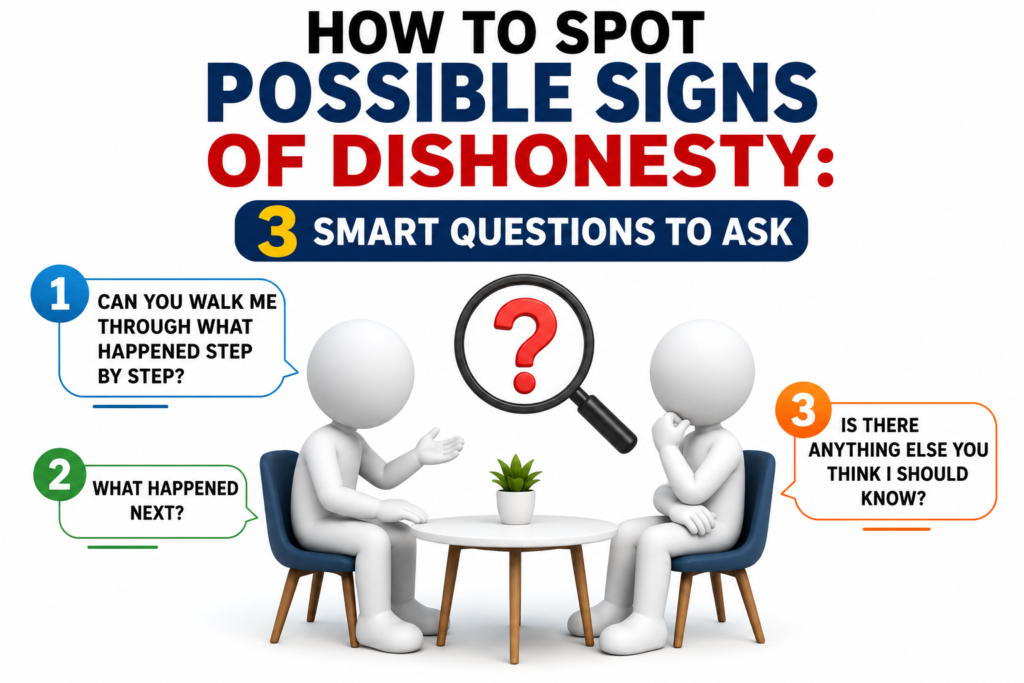
Communication experts and researchers often recommend looking at patterns rather than relying on one sign. This article explores three smart questions that may help you notice inconsistencies while keeping the conversation respectful and open.
Remember, these questions are conversation tools, not lie detectors.
Why People Sometimes Appear Dishonest
Before learning the questions, it’s important to understand something many people overlook.
Not everyone who seems nervous or avoids eye contact is lying.
People may appear uncomfortable because they are:
- Feeling anxious.
- Embarrassed.
- Afraid of being judged.
- Struggling to remember details accurately.
- Under stress.
- Naturally shy.
Likewise, someone who speaks confidently isn’t automatically telling the truth.
This is why it’s important to avoid making quick assumptions based on one behavior alone.
The goal isn’t to accuse someone.
It’s to better understand what they’re communicating.
Success Picture Insight
Good communication begins with curiosity, not suspicion.
Question 1: “Can You Walk Me Through What Happened Step by Step?”
Instead of asking:
“Are you lying?”
Try asking:
“Can you walk me through what happened step by step?”
This question encourages the other person to explain events in their own words rather than answering with a simple “yes” or “no.”
Why This Question Helps
When people describe an experience naturally, they often provide details in a logical sequence.
If someone is struggling to remember because they are nervous or because time has passed, that’s perfectly normal.
However, if the story changes significantly each time it’s explained, or important details shift without a clear reason, it may be worth asking respectful follow-up questions.
The key is to focus on consistency, not perfection.
Memory is never perfect.
Minor differences are common.
Large contradictions deserve clarification—not immediate judgment.
A Real-Life Example
Imagine a manager discussing a missed project deadline with an employee.
Instead of asking:
“Did you finish the work?”
They ask:
“Can you walk me through what happened from the time you received the assignment?”
This allows the employee to explain the situation fully.
Perhaps there were unexpected obstacles.
Perhaps there was a misunderstanding.
Or perhaps there are inconsistencies that need further discussion.
The conversation becomes more productive because it focuses on understanding rather than accusation.
Success Picture Insight
People often reveal more through explanation than through simple answers.
Question 2: “What Happened Next?”
One of the easiest ways to encourage a more complete explanation is to ask a gentle follow-up.
After someone finishes their story, simply ask:
“What happened next?”
This keeps the conversation open without sounding confrontational.
Why This Question Matters
When people describe genuine experiences, they can usually continue explaining events naturally.
They remember additional context, conversations, or actions as they think through the timeline.
On the other hand, if someone has omitted important information, follow-up questions may encourage them to expand or clarify their account.
Again, this is not proof of deception.
It’s simply an opportunity to gather more information before reaching conclusions.
The Importance of Listening
Many people focus so much on asking questions that they forget the most important skill:
Listening.
Pay attention to:
- Whether the story remains generally consistent.
- Whether important details suddenly change.
- Whether answers become clearer after follow-up questions.
- Whether the person is willing to explain rather than becoming defensive immediately.
Remember that nervousness alone is not evidence of dishonesty.
Some truthful people become anxious simply because they feel uncomfortable being questioned.
Success Picture Insight
Listening carefully often teaches you more than speaking quickly.
Why Respect Matters
If your goal is simply to expose someone, the conversation is unlikely to be productive.
If your goal is to understand the truth, patience and respect become your greatest tools.
Approaching conversations calmly helps people feel comfortable enough to explain themselves honestly.
Respect builds trust.
Trust encourages openness.
And openness often leads to better communication than confrontation ever could.
Question 3: “Is There Anything Else You Think I Should Know?”
Sometimes, the most effective question is also the simplest.
After listening carefully, try asking:
“Is there anything else you think I should know?”
This question gives the other person an opportunity to add details without feeling pressured.
It also shows that you’re interested in understanding the complete picture rather than trying to “win” the conversation.
Why This Question Works
People don’t always share every detail immediately.
Sometimes they forget something.
Sometimes they don’t realize a detail is important.
Sometimes they need a little more time to organize their thoughts.
By asking an open-ended question, you encourage a fuller explanation instead of forcing a defensive response.
If new information appears, don’t assume it proves dishonesty.
Instead, calmly ask follow-up questions to understand the situation better.
Success Picture Insight
The goal isn’t to catch people making mistakes. It’s to encourage honest conversations.
Common Myths About Detecting Lies
Movies and television often make lie detection look easy.
In reality, communication experts caution against relying on popular myths.
Let’s look at a few common misconceptions.
Myth 1: “Liars Always Avoid Eye Contact”
This is one of the most widespread myths.
In reality:
- Some honest people avoid eye contact because they’re shy or anxious.
- Some dishonest people intentionally maintain eye contact because they know people expect liars to look away.
Eye contact alone cannot tell you whether someone is being truthful.
Myth 2: “Nervous People Must Be Lying”
Nervousness has many causes.
A person might feel anxious because:
- They’re worried about being misunderstood.
- They’re naturally introverted.
- They dislike conflict.
- They feel stressed or overwhelmed.
Being nervous doesn’t automatically mean someone is dishonest.
Myth 3: “One Body Language Signal Reveals Everything”
Crossed arms.
Touching the face.
Looking away.
Speaking slowly.
None of these behaviors alone can accurately identify deception.
Experts generally recommend looking at the overall context rather than focusing on one isolated behavior.
Success Picture Insight
Context tells a more complete story than any single gesture ever can.
Look for Patterns, Not Individual Behaviors
Imagine you’re putting together a puzzle.
One puzzle piece doesn’t reveal the full picture.
You need multiple pieces before the image becomes clear.
Communication works the same way.
Instead of focusing on one answer, consider:
- Does the overall story remain consistent?
- Are changes in the story explained reasonably?
- Does the person answer questions openly?
- Are they willing to clarify confusing details?
- Do their actions generally match their words over time?
Patterns are often more meaningful than isolated moments.
Emotional Intelligence Matters More Than Interrogation
Many people believe the secret to finding the truth is asking tougher questions.
In reality, emotional intelligence often produces better conversations.
Emotional intelligence means:
- Listening without interrupting.
- Remaining calm.
- Avoiding assumptions.
- Asking respectful follow-up questions.
- Paying attention to both facts and feelings.
When people feel respected, they’re more likely to communicate openly.
Aggressive questioning usually has the opposite effect.
A Real-Life Example
Imagine your teenager comes home much later than expected.
Instead of immediately saying,
“You’re lying to me!”
You calmly ask,
“Can you tell me what happened?”
Then,
“What happened after that?”
Finally,
“Is there anything else you’d like me to know?”
This approach creates space for an honest conversation instead of an argument.
Success Picture Insight
People often become more truthful when they feel heard rather than judged.
Trust Is Built Over Time
No conversation exists in isolation.
If someone has consistently been honest for years, one confusing answer shouldn’t automatically destroy trust.
Likewise, if someone repeatedly changes important stories over time, it’s reasonable to ask thoughtful questions and pay attention to recurring patterns.
Healthy relationships aren’t built on suspicion.
They’re built on communication.
Trust grows through:
- Honesty.
- Accountability.
- Consistency.
- Respect.
- Open conversations.
These qualities strengthen relationships far more effectively than trying to become an expert at spotting lies.
Before You Assume, Consider Other Explanations
Human memory isn’t perfect.
People forget details.
Stress affects recall.
Different people remember the same event differently.
Before assuming dishonesty, ask yourself:
- Could they simply be confused?
- Could they be under stress?
- Is this misunderstanding caused by poor communication?
- Have I listened carefully before forming an opinion?
Sometimes the simplest explanation is the correct one.
Key Takeaways
Let’s summarize the three questions that can help encourage clearer and more honest conversations:
1. “Can you walk me through what happened step by step?”
This encourages detailed explanations instead of simple yes-or-no answers.
2. “What happened next?”
A gentle follow-up often helps people provide additional context and clarify details.
3. “Is there anything else you think I should know?”
This creates an opportunity for someone to add information they may have forgotten or initially left out.
Remember, these questions are not lie detectors. They are conversation tools that may help you better understand a situation.
How to Have More Honest Conversations
Asking good questions is only one part of effective communication.
Here are a few habits that can help build trust in everyday conversations.
Listen More Than You Speak
Many people focus on preparing their next question instead of truly listening.
Give the other person time to finish speaking before responding.
Sometimes the most valuable information comes after a short pause.
Stay Calm
People are more likely to communicate openly when they don’t feel attacked.
Even if you suspect something isn’t right, keep your tone respectful.
A calm conversation often reveals more than an emotional argument.
Avoid Leading Questions
Instead of asking:
“You’re hiding something, aren’t you?”
Try asking:
“Can you help me understand what happened?”
Open-ended questions encourage honest discussion without putting someone immediately on the defensive.
Pay Attention to the Whole Picture
Don’t judge someone’s honesty based on a single behavior.
Instead, consider:
- Their overall consistency.
- Their willingness to explain.
- Their past behavior.
- The context of the situation.
- Whether their actions align with their words over time.
Patterns are generally more informative than isolated moments.
Why Trust Matters More Than Catching Someone
Many people search for ways to detect lies because they want certainty.
But healthy relationships aren’t built by constantly trying to catch people making mistakes.
They’re built through:
- Honest communication.
- Mutual respect.
- Accountability.
- Empathy.
- Consistent actions.
If trust has been damaged, meaningful conversations and shared effort are often more effective than searching for a “perfect” lie-detection technique.
Success Picture Insight
Strong relationships are built on understanding, not constant suspicion.
Final Thoughts
Honesty is one of the foundations of meaningful relationships.
Whether you’re speaking with a friend, family member, coworker, or business partner, the goal should never be to trap someone.
The goal should be to understand them.
The three questions in this article aren’t magic formulas.
They won’t guarantee that you’ll uncover every lie.
What they can do is encourage more thoughtful conversations, reveal inconsistencies that deserve clarification, and help create an environment where honest communication is more likely.
Sometimes you’ll discover there was no deception at all—only misunderstanding.
Other times, careful listening and respectful follow-up questions may help you recognize that something doesn’t quite add up.
Either way, approaching conversations with patience, curiosity, and respect is far more valuable than relying on myths or stereotypes about lying.
At Success Picture, we believe that better communication leads to stronger relationships, better decisions, and a more successful life.
The next time you’re unsure about someone’s story, don’t rush to judge.
Ask thoughtful questions.
Listen carefully.
And remember that trust grows through open, respectful communication—not assumptions.
Frequently Asked Questions (FAQ)
Can these three questions always detect a lie?
No. There is no scientifically proven set of questions that can reliably identify every lie. These questions are designed to encourage fuller explanations and help you better understand a situation.
Is avoiding eye contact a sign of lying?
Not necessarily. People may avoid eye contact because they are shy, anxious, uncomfortable, or from a culture where direct eye contact is less common. Eye contact alone is not a reliable indicator of honesty.
Should I confront someone immediately if their story changes?
Not always. Memory is imperfect, and people sometimes forget or misremember details. It’s usually better to ask respectful follow-up questions before drawing conclusions.
What’s the most important skill for recognizing possible dishonesty?
Careful listening. Paying attention to the overall consistency of someone’s story over time is generally more helpful than focusing on a single behavior or body language cue.
Can better communication improve trust?
Yes. Honest conversations, empathy, active listening, and mutual respect are key ingredients in building and maintaining trust in personal and professional relationships.
Conclusion
The strongest conversations aren’t the ones where someone “wins.”
They’re the ones where both people leave with a better understanding of each other.
When you approach difficult discussions with patience instead of pressure, curiosity instead of accusation, and respect instead of judgment, you’re far more likely to build trust and uncover the truth.
Communication isn’t about catching people.
It’s about connecting with them.
SHARING IS CARING 💖