
Have you received a traffic challan and want to know whether you can settle it through Lok Adalat? Many vehicle owners in India look for this option because it may help them resolve eligible traffic cases without going through a lengthy court process.
However, not every traffic challan is eligible for settlement. Some pending or compoundable traffic matters may be considered during a Lok Adalat, while certain serious or non-compoundable offences cannot be settled through this process. Even an otherwise eligible challan may not be accepted for a particular Lok Adalat session if it does not meet the local requirements.
In this guide, you will learn what Lok Adalat is, which traffic challans may be eligible, which offences are generally excluded, how to check your challan status, and what to do if your challan is not accepted.
Important: Lok Adalat rules, eligible offence lists, appointment procedures, and settlement arrangements can vary by state and by session. Always check the official notice issued for your location before making a decision.
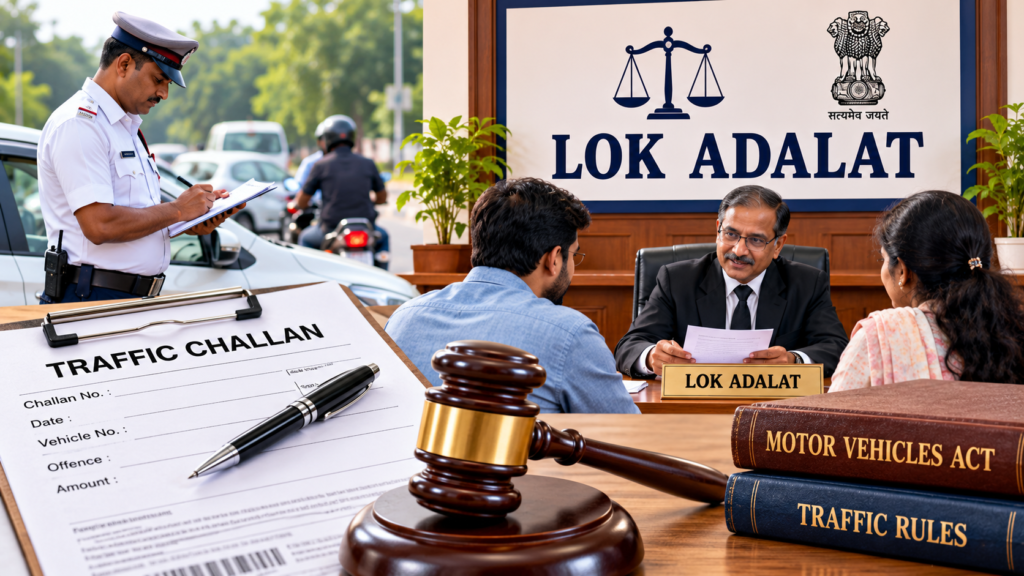
What Is Lok Adalat?
Lok Adalat, often called a people’s court, is an alternative dispute-resolution mechanism in India. It helps resolve eligible disputes through an amicable settlement rather than a lengthy conventional legal process.
Lok Adalats operate under the Legal Services Authorities Act, 1987. They can take up appropriate pending cases and certain disputes that have not yet reached court. However, an offence that is not legally compoundable cannot be settled through an ordinary Lok Adalat.
For traffic challans, a Lok Adalat may provide an opportunity to resolve eligible matters, subject to the applicable law and the arrangements made by the relevant authority.
For example, a person with an eligible pending traffic challan may be able to appear before the designated Lok Adalat and request settlement. The final outcome depends on the case, the applicable rules, and the decision recorded during the proceedings.
You can read the official guidance on the Delhi State Legal Services Authority’s Lok Adalat page and the National Legal Services Authority website.
Which Traffic Challans Can Be Settled Through Lok Adalat?
The following types of traffic matters may be considered for settlement when the relevant law permits compounding and the local authority includes the case in its eligible list.
1. Eligible pending traffic challans
Some traffic challans that remain unpaid or are pending before the appropriate traffic court may be considered for settlement during a Lok Adalat session.
However, simply having an unpaid challan does not mean it will automatically qualify. The case may need to be pending before the relevant authority or meet the conditions specified in the official notice.
2. Compoundable traffic offences
Compoundable offences are offences for which the law permits an authorised person or authority to accept a prescribed compounding amount and close the matter in accordance with the applicable legal process.
Certain traffic violations may fall into this category. Whether a particular challan can be settled depends on the offence recorded, the relevant legal provision, and who is legally authorised to compound it.
3. Eligible traffic cases referred by a court
Some traffic matters already pending before a court may be referred to Lok Adalat when they are suitable for settlement under the applicable rules.
If you have received a court notice, check the case details and the official Lok Adalat instructions. Do not assume that every court-related challan will be included.
4. Eligible notices listed by the local traffic authority
Authorities may publish a list of eligible challans or provide an online process for registering for a specific Lok Adalat session.
If your challan appears on the official eligible list and you meet the stated conditions, follow the instructions for registration, appointment, and settlement.
Remember: The categories above are general guidance, not a guarantee of eligibility. The official list for your state and the specific Lok Adalat session takes priority.
Which Traffic Challans Are Not Allowed in Lok Adalat?
This is one of the most important questions for vehicle owners. A challan may be excluded because the underlying offence cannot legally be compounded, because the case is outside the Lok Adalat’s permitted scope, or because the local session does not accept that category.
1. Non-compoundable offences
A non-compoundable offence cannot be settled by using the ordinary Lok Adalat compounding process. The Delhi State Legal Services Authority expressly states that matters involving offences that are not compoundable under law cannot be settled in Lok Adalat.
If your challan relates to an offence that the law does not permit to be compounded, you should follow the applicable court or legal process instead.
2. Serious offences that require formal legal proceedings
Serious road-safety offences may require proceedings under the applicable law and may not qualify for settlement through a routine traffic-challan Lok Adalat.
Do not decide eligibility solely from the amount of the fine or the wording shown on a notice. Check the exact offence and legal section. Some offences carry additional consequences beyond payment of a fine.
3. Cases excluded by the official session notice
A particular Lok Adalat may accept only selected types of traffic challans. If the official notice excludes your category or your challan is not listed in the designated portal, you may not be able to settle it during that session.
This does not necessarily mean that the challan can never be resolved through any available legal route. It means you should check the correct procedure for your case.
4. Challans that have not been listed or referred as required
In some locations, the traffic authority may require people to check eligibility online, obtain a token or appointment, or confirm that the case has been included for the relevant session.
If your challan is not available for selection, do not rely on unofficial agents who promise guaranteed settlement. Contact the relevant traffic police, court, or legal services authority for clarification.
5. Matters requiring a different legal procedure
Some cases may need to be handled by the appropriate court or authority instead of being processed through a traffic-challan Lok Adalat. The correct route depends on the offence, the stage of the case, and the law that applies.
A challan being old, unpaid, or high-value does not by itself establish whether it is eligible or ineligible.
Common Traffic Challans: Are They Eligible?
The following table is a general guide. It is not an official nationwide list, and it should not be used as a final legal determination.
| Type of traffic matter | General guidance |
|---|---|
| Eligible pending minor traffic challan | May be considered if the offence is compoundable and the session accepts it |
| Eligible court-pending traffic case | May be considered if referred or listed under the applicable procedure |
| Challan not shown on the official eligible list | Confirm with the relevant authority before attending |
| Non-compoundable offence | Cannot be settled through ordinary Lok Adalat compounding |
| Serious offence requiring formal proceedings | Eligibility must be checked under the applicable law; do not assume settlement is available |
| Challan from another state | Follow the issuing state’s process and confirm which authority has jurisdiction |
| Challan already paid or disposed of | Usually requires checking the official record rather than seeking another settlement |
Do not treat a particular violation—such as signal jumping, wrong parking, overspeeding, or riding without a helmet—as automatically eligible or ineligible nationwide. The exact legal provision, case status, and current state-specific instructions matter.
How to Check Whether Your Challan Is Eligible for Lok Adalat
Follow these steps before planning your visit.
Step 1: Check your traffic challan online
Visit the official eChallan portal of the Ministry of Road Transport and Highways.
Use the available challan search options and enter the requested details. Check the challan number, vehicle registration number, offence description, amount, and current status.
Make sure you are using the official government website rather than an unfamiliar payment link sent through a message.
Step 2: Identify the exact offence
Read the offence description and, where available, the legal section mentioned in the challan. The description helps you identify which rules may apply.
If the wording is unclear, ask the issuing traffic authority or seek legal assistance rather than guessing.
Step 3: Visit your state or district’s official Lok Adalat page
Look for the latest notice issued by your State Legal Services Authority, District Legal Services Authority, traffic police, or relevant court.
Check whether the notice specifies eligible challans, registration dates, court locations, appointment requirements, and documents to carry.
Step 4: Check whether registration or a token is required
Some sessions may use an online registration or token system. Follow the official instructions exactly and keep your confirmation details.
Registration does not necessarily guarantee settlement. The challan must still be eligible and handled according to the applicable procedure.
Step 5: Attend or follow the official settlement process
If your challan is eligible, follow the instructions for attending the designated court or Lok Adalat. Carry the requested documents and retain any receipt or settlement order provided.
If you are unable to attend or cannot find your challan, contact the relevant authority to ask about the correct next step.
How to Check Lok Adalat Traffic Challan Information in Delhi
For Delhi residents, the following official resources can help:
- Delhi Traffic Police — National Lok Adalat: https://www.traffic.delhipolice.gov.in/en/national-lok-adalat
- Delhi State Legal Services Authority — Lok Adalat: https://delhi.nalsa.gov.in/lok-adalat/
- Official eChallan portal: https://echallan.parivahan.gov.in/
Read the current notice before visiting. Dates, token availability, court locations, and eligible categories can change from one session to another.
If you live in another state, use the official website of your State Legal Services Authority or traffic police. Delhi’s procedure should not automatically be assumed to apply elsewhere.
What Documents Should You Carry?
The documents required may differ by state and session. Depending on the official instructions, you may need:
- A copy or details of the traffic challan.
- Vehicle registration certificate (RC), where requested.
- Driving licence, where relevant.
- Identity proof, if required by the authority.
- The SMS, notice, or court-case details relating to the challan.
- The official appointment or token confirmation, if applicable.
- Payment or settlement records if the challan has already been paid or partly resolved.
Check the current notice before attending so that you do not make an unnecessary trip.
Can You Get a Discount on a Traffic Challan in Lok Adalat?
A Lok Adalat may help settle an eligible matter on terms recorded by the authorised forum. However, there is no universal rule that every traffic challan receives a discount or that the amount will always be reduced by a fixed percentage.
The settlement amount, if a settlement is legally available, depends on the applicable law and the authorised process. Never assume that a particular percentage will be waived.
Be cautious of social media posts or agents claiming that all challans can be cleared for a fixed amount. Confirm the official process and pay only through the authorised channel.
What Happens If Your Challan Is Not Eligible?
If your challan cannot be settled through the Lok Adalat session, take the following steps:
- Check the reason for exclusion. Confirm whether the offence is non-compoundable, the case is not listed, or the session has other eligibility restrictions.
- Contact the issuing authority. Ask the traffic police or relevant court how the matter should be handled.
- Follow the notice or court instructions. Do not ignore a summons or legal notice simply because Lok Adalat settlement is unavailable.
- Use official payment channels where appropriate. If the challan is payable online, use the official portal or another authorised method.
- Seek legal advice if necessary. This is especially important if the case involves a serious offence, a disputed allegation, or potential consequences beyond a fine.
If you believe the challan was issued incorrectly, ask about the official procedure to challenge or contest it. Do not assume that paying it or waiting for a Lok Adalat will resolve every issue.
Is Lok Adalat Settlement Final?
A settlement recorded by a Lok Adalat has legal consequences. Under the Legal Services Authorities Act, an award made by a Lok Adalat is generally final and binding on the parties, and the Act provides that an appeal does not lie against that award in the ordinary way.
Before agreeing to settlement, verify the offence, amount, and terms carefully. If you disagree with the allegation or are uncertain about the consequences, seek legal advice before accepting the settlement.
You can read more in the official Lok Adalat information published by the National Legal Services Authority.
Important Things to Remember Before Settling a Challan
Keep these points in mind:
- Not every traffic challan is eligible for Lok Adalat.
- Non-compoundable offences cannot be settled through ordinary Lok Adalat proceedings.
- Eligibility depends on the applicable law, offence, case status, and local session instructions.
- A pending challan is not automatically eligible just because it has remained unpaid for a long time.
- A lower settlement amount or a discount is not guaranteed.
- Use official government and legal-services websites to check information.
- Keep your payment receipt and settlement documents after the matter is resolved.
- Do not ignore a court notice or assume that registering for a Lok Adalat automatically closes your case.
Frequently Asked Questions (FAQs)
1. Can all traffic challans be settled in Lok Adalat?
No. Only matters that are legally eligible and accepted under the relevant Lok Adalat arrangements can be considered. Non-compoundable offences cannot be settled through ordinary Lok Adalat proceedings.
2. Which challans are not allowed in Lok Adalat?
There is no single nationwide list that applies to every session. Non-compoundable offences are excluded from ordinary Lok Adalat settlement. Other challans may be excluded under the applicable law or the session’s official eligibility instructions.
3. Can I settle an unpaid traffic challan through Lok Adalat?
Possibly. An unpaid challan may be considered if the offence is eligible and the relevant authority includes it in the settlement process. Check the official notice and the challan’s current status.
4. Can I settle a challan online?
Online services may be available for checking challan details, registration, tokens, or payments, depending on the state and session. The actual settlement process may require following additional instructions or appearing before the designated forum.
5. Is a court challan eligible for Lok Adalat?
Some eligible cases pending before a court may be referred to Lok Adalat. Whether yours qualifies depends on the offence and the applicable procedure.
6. Will Lok Adalat waive my entire traffic fine?
Not necessarily. Settlement terms vary, and a full waiver or fixed discount is not guaranteed. Confirm the amount officially before making payment.
7. Can I settle a traffic challan issued in another state?
You should follow the issuing state’s process and confirm which authority handles the case. The procedure in your current state may not apply to a challan issued elsewhere.
8. What if my challan does not appear on the Lok Adalat portal?
Check the official notice, dates, and registration requirements. If it still does not appear, contact the relevant traffic police, court, or legal services authority for guidance.
9. Do I need a lawyer to attend Lok Adalat for a traffic challan?
A lawyer may not be necessary for every straightforward eligible matter, but requirements and circumstances vary. Consider legal assistance if the offence is serious, the allegation is disputed, or you are unsure about the consequences.
10. Where can I check official Lok Adalat updates?
Start with the National Legal Services Authority, your State Legal Services Authority, the relevant District Legal Services Authority, and your traffic police’s official website.
Final Words
Lok Adalat can be a useful way to resolve eligible traffic challans, but it is not a universal shortcut for clearing every traffic violation. The key is to identify the exact offence, check whether the law permits settlement, and follow the official instructions for your state and Lok Adalat session.
Before travelling to a court or paying anyone, verify your challan on the official eChallan portal and consult the relevant traffic police or legal services authority. This will help you avoid misinformation, unnecessary visits, and unofficial payment requests.
Disclaimer: This article provides general information for public awareness and is not legal advice. Traffic laws, compounding provisions, eligibility criteria, and Lok Adalat procedures may vary and can change. Confirm the current rules with the relevant authority or a qualified legal professional before acting.
SHARING IS CARING 💖