
Hair loss can be frustrating, especially when you start noticing a receding hairline, thinning hair on the crown, or visible patches of scalp. For many men, these changes become more noticeable after the age of 35 or 40. You may find more hair on your pillow, in the shower, or on your comb, and wonder whether there is a safe way to slow the process and encourage regrowth.
The good news is that some everyday habits can help maintain healthier hair and reduce preventable damage. Eating a balanced diet, treating your scalp gently, managing stress, and addressing nutritional deficiencies may all play a role in supporting healthy hair.
However, the best solution depends on the cause of your hair loss. Natural remedies may improve scalp care, but they cannot reliably reverse every type of baldness. If you have ongoing thinning or clearly visible bald patches, identifying the underlying cause is an important first step.
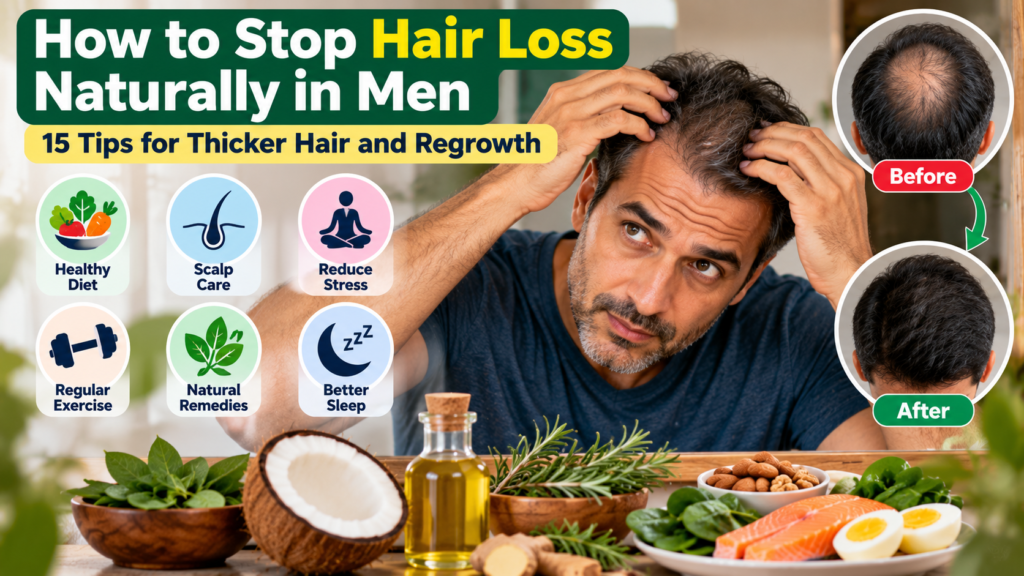
In this guide, you will learn 15 practical ways to support hair health, understand which products may help, and discover when professional treatment may be necessary.
What Causes Hair Loss in Middle-Aged Men?
Before choosing a hair oil, shampoo, supplement, or treatment, it helps to understand why your hair is falling out.
1. Male pattern baldness
Male pattern baldness is a common cause of hair loss in men. It is influenced by genetics and sensitivity to certain hormones. Hair often becomes thinner around the temples and crown, and the hairline may gradually recede.
This type of hair loss usually develops over time. Natural oils and dietary changes alone are unlikely to reverse significant genetic hair loss.
2. Stress and illness
Physical or emotional stress, a serious illness, surgery, or rapid weight loss can trigger increased hair shedding. This may occur weeks or months after the stressful event.
When the underlying trigger resolves, hair growth may gradually recover, although the timeline varies.
3. Nutritional deficiencies
Not getting enough protein, iron, or certain other nutrients may contribute to hair problems. However, taking supplements without a confirmed need is not a guaranteed solution and may sometimes be harmful.
4. Thyroid problems and other medical conditions
Thyroid disorders, certain autoimmune conditions, scalp infections, and some medications can contribute to hair loss. A healthcare professional can help determine whether testing or treatment is appropriate.
5. Hair and scalp damage
Frequent high-heat styling, harsh chemical treatments, tight hairstyles, and rough brushing can damage hair shafts and contribute to breakage.
Important: Sudden hair loss, smooth round bald patches, scalp pain, redness, scaling, or scarring should be assessed by a dermatologist rather than treated only with home remedies.
15 Natural Ways to Support Hair Growth and Reduce Hair Fall
1. Eat a balanced, protein-rich diet
Hair is made largely of a protein called keratin. Your body needs adequate nutrition to maintain normal hair growth.
Include a variety of protein sources in your meals, such as:
- Eggs
- Lentils and beans
- Milk, curd, and paneer
- Fish or lean meat, if you eat them
- Soybeans and tofu
- Nuts and seeds
Try to include protein in your main meals instead of relying on one food or a special hair-growth drink.
A balanced diet supports overall health, but it cannot guarantee regrowth if your hair loss is primarily genetic.
2. Include iron-rich foods
Iron deficiency can contribute to hair loss in some people. Foods containing iron include lentils, beans, leafy green vegetables, meat, and iron-fortified foods.
Vitamin C-rich foods, such as oranges, guava, tomatoes, and peppers, can help your body absorb iron from plant foods.
If you suspect an iron deficiency, consult a healthcare professional before starting an iron supplement. Excess iron can be harmful, and not all hair loss is caused by low iron.
3. Eat a variety of vitamins and minerals
A nutritious diet provides vitamins and minerals needed for normal body functions, including hair growth.
Include a variety of fruits, vegetables, whole grains, nuts, seeds, and protein-rich foods. Avoid assuming that more vitamins automatically mean thicker hair.
High doses of some supplements can cause side effects, and excessive amounts of certain nutrients may actually worsen hair loss.
4. Massage your scalp gently
A gentle scalp massage may feel relaxing and can be part of a healthy hair-care routine.
Use your fingertips rather than your nails. Move gently across the scalp without pulling or rubbing aggressively.
There is not enough strong evidence to conclude that scalp massage alone can reverse male pattern baldness. Treat it as a relaxation and grooming habit, not a proven regrowth treatment.
5. Use coconut oil to reduce hair damage
Coconut oil can help reduce protein loss from hair in some circumstances, making it a useful option for conditioning dry or fragile hair.
If your hair feels dry or breaks easily, try applying a small amount to the hair lengths before washing. Adjust the amount depending on your hair type.
Remember that coconut oil is primarily a conditioning option. It is not a proven treatment for genetic hair loss and will not necessarily regrow hair in bald areas.
Stop using it if you develop irritation or scalp problems.
6. Be cautious with rosemary oil
Rosemary oil is often promoted as a natural hair-growth remedy. Some limited research has examined its possible effects, but the evidence is not strong enough to establish it as a reliable replacement for established hair-loss treatments.
If you decide to try it, never apply concentrated essential oil directly to your scalp. Use an appropriately formulated product and follow its directions. A patch test may help identify irritation, although it cannot guarantee that a reaction will not occur.
Avoid using it on irritated or broken skin, and discontinue it if you experience itching, burning, redness, or a rash.
7. Choose a gentle shampoo
A shampoo cleans the scalp and hair; it does not necessarily treat the underlying cause of hair loss.
Choose a gentle product that suits your scalp. If you have dandruff, itching, or excessive oiliness, a shampoo designed for that particular problem may help manage the symptoms.
You do not need an expensive shampoo simply because it is marketed as a hair-growth product. Look at the ingredients, your scalp’s needs, and how your hair responds.
8. Avoid excessive heat styling
Frequent use of very hot hair dryers, straighteners, and curling tools can weaken hair and contribute to breakage.
To protect your hair:
- Use lower heat settings.
- Avoid holding a dryer too close to the scalp.
- Limit repeated straightening or other high-heat treatments.
- Let your hair air-dry when practical.
- Avoid aggressive brushing when hair is wet and fragile.
These steps can reduce damage, but they do not stop genetic hair loss.
9. Stop pulling or tightly styling your hair
Repeated tension on hair follicles can contribute to traction-related hair loss.
Avoid hairstyles that pull tightly on the roots, and be gentle when combing or tying your hair. Do not repeatedly tug at thinning areas to check how much hair comes out.
Reducing tension can help prevent additional damage, particularly if tight styling is part of the problem.
10. Manage stress and maintain a regular sleep routine
Long periods of stress may contribute to increased hair shedding in some people. Improving your sleep routine, taking regular walks, practising breathing exercises, or making time for relaxing activities may help support general well-being.
Aim for consistent sleep and make time for physical activity that suits your health and fitness level.
These habits are beneficial for overall health, but they should not be presented as a guaranteed cure for male pattern baldness.
11. Avoid smoking and support your overall health
Smoking is associated with several health risks, and some research has explored its relationship with hair loss. Quitting smoking is a sensible step for general health, even though it cannot guarantee hair regrowth.
Regular physical activity, balanced meals, adequate sleep, and appropriate management of chronic health conditions are useful parts of an overall wellness routine.
12. Do not take hair-growth supplements blindly
Biotin, zinc, iron, and other supplements are frequently marketed for hair growth. However, supplements are most likely to help when they address a genuine nutritional deficiency or a specific medical need.
Taking high doses without medical guidance can be ineffective or harmful. Some supplements can also interfere with laboratory tests or medications.
If your hair loss is persistent, ask a healthcare professional whether your symptoms, diet, medical history, or examination suggest a need for blood tests or supplementation.
13. Track your hair loss with photographs
It can be difficult to judge changes in hair density by looking in the mirror every day.
Take photographs of your hairline, temples, and crown once a month. Use similar lighting, camera distance, hairstyle, and angles.
This can help you notice whether thinning is progressing and give a dermatologist useful information about the pattern of hair loss.
Avoid taking photographs every day or changing several products at once, because this can make it harder to assess what is happening.
14. Consider evidence-based hair-loss treatments
Natural care is useful for protecting hair, but some types of hair loss require a targeted treatment.
Topical minoxidil is an established treatment for certain forms of hair loss, including male pattern hair loss. It may help slow hair loss and stimulate some regrowth in suitable users. Results vary, and improvement may take several months.
Minoxidil is not side-effect-free. It may cause scalp irritation or other adverse effects, and the benefits generally require continued use. Follow the product instructions and discuss suitability with a healthcare professional, especially if you have medical conditions or take other medicines.
Prescription treatments, such as finasteride, may be appropriate for some men with male pattern hair loss. They require a discussion of potential benefits, risks, contraindications, and side effects with a qualified prescriber.
Do not start prescription medicines or use someone else’s medication without professional advice.
For further information, see the American Academy of Dermatology’s guide to hair-loss treatments and the NHS hair-loss information page.
15. Consult a dermatologist when hair loss continues
If your hair keeps thinning despite improving your diet and hair-care routine, do not spend months trying one product after another without finding out why.
A dermatologist can examine your scalp, review your medical history and medications, and decide whether further tests are needed. Treatment depends on the type of hair loss.
This is particularly important if you notice sudden shedding, distinct bald patches, scalp inflammation, broken hairs, or rapidly worsening hair loss.
Getting the right diagnosis early can help you avoid wasting money on products that are unlikely to address the real problem.
Which Hair-Growth Products Are Worth Considering?
Different products serve different purposes. The most useful choice depends on whether your main concern is dryness, breakage, dandruff, or hair loss from the follicle.
| Product or option | Main purpose | Important consideration |
|---|---|---|
| Gentle shampoo | Cleans the scalp and hair | Does not reliably reverse genetic hair loss |
| Conditioner | Reduces friction and improves manageability | Helps with dryness and breakage, not follicle regrowth |
| Coconut oil | Conditions hair and may reduce protein loss | Not a proven baldness treatment |
| Rosemary oil products | Marketed for scalp and hair care | Evidence for regrowth remains limited |
| Nutritional supplements | Address specific nutrient deficiencies | Best used when there is a genuine need |
| Topical minoxidil | Treats certain types of hair loss | Can cause side effects; results vary |
| Prescription hair-loss treatment | May slow or treat specific forms of hair loss | Requires professional assessment and discussion of risks |
Be cautious with products that promise guaranteed regrowth in a few days, claim to cure every type of baldness, or advertise themselves as completely free of side effects.
A Simple Daily Hair-Care Routine for Men
You do not need a complicated routine with ten different products. Start with a few consistent habits.
Morning
- Eat a balanced breakfast with a protein source.
- Avoid pulling or aggressively styling your hair.
- Use a scalp product only if it suits your needs and you understand how to use it.
During the day
- Drink enough water to stay hydrated.
- Eat balanced meals rather than following extreme diets.
- Take breaks or use stress-management techniques when needed.
Evening
- Wash your hair when needed using a suitable shampoo.
- Use conditioner if your hair is dry or prone to breakage.
- Avoid excessive heat styling.
- Maintain a consistent sleep routine.
Once a month
- Take photographs of the hairline and crown.
- Note any changes in shedding, scalp symptoms, or hair density.
- Review whether your routine is helping and seek professional advice if the problem continues.
If you use a medical hair-loss treatment, follow its instructions rather than substituting this general routine for treatment.
Can Bald Patches Grow Back Naturally?
That depends on the cause.
Hair may regrow when temporary shedding resolves or when an underlying problem is treated. Some forms of patchy hair loss also have specific medical treatments.
However, longstanding male pattern baldness may not respond significantly to oils, scalp massage, or dietary changes alone. Hair loss associated with scarring can also be difficult to reverse.
If you notice smooth, round bald patches or sudden loss of hair in particular areas, seek a medical assessment. Do not assume every bald patch is ordinary age-related hair loss.
How Long Does Hair Regrowth Take?
Hair growth is gradual, so it is unrealistic to expect dramatic results within a few days.
The timeline depends on the cause, the treatment, the degree of hair loss, and the person’s response. When a treatment such as minoxidil is appropriate, noticeable improvement may take around six to twelve months. Some people respond better than others, and full regrowth is not guaranteed.
Take photographs under consistent conditions and discuss progress with your healthcare professional. Avoid repeatedly changing treatments before giving an appropriate treatment plan enough time to work.
Common Hair-Loss Mistakes to Avoid
Be careful not to make these common mistakes:
- Expecting a hair oil to reverse genetic baldness.
- Taking multiple supplements without knowing whether you need them.
- Applying undiluted essential oils directly to the scalp.
- Scrubbing the scalp aggressively in an attempt to stimulate growth.
- Buying products that promise guaranteed results.
- Ignoring sudden hair loss or inflamed, painful, or scaly patches.
- Stopping a prescribed treatment without discussing it with your prescriber.
- Assuming that a product described as natural cannot cause a reaction.
A simple, consistent routine and an accurate diagnosis are generally more useful than repeatedly buying products based on advertising claims.
Frequently Asked Questions About Hair Loss in Men
1. What is the best natural way to reduce hair loss in men?
Start with a balanced diet, adequate protein, gentle hair care, reduced heat damage, and good general health habits. These steps may support healthy hair and reduce preventable breakage, but they cannot reliably reverse genetic hair loss.
2. Can coconut oil regrow hair on bald spots?
Coconut oil may condition hair and help reduce protein loss, but there is not strong evidence that it regrows hair in bald spots or reverses male pattern baldness.
3. Does rosemary oil really help hair growth?
Evidence remains limited. Rosemary oil is often promoted for hair growth, but it should not be considered a proven replacement for established treatments. Essential oils may also irritate the skin if used incorrectly.
4. Can men over 40 regrow thinning hair?
Some men can improve hair density or slow further loss, depending on the cause and treatment. Results vary, and longstanding bald areas may be harder to treat. A dermatologist can help identify realistic options.
5. Which vitamin is best for hair growth?
There is no single vitamin that works for every person. Correcting a confirmed deficiency may help, but taking extra vitamins without a deficiency does not guarantee hair growth. High doses of certain nutrients can be harmful.
6. Is minoxidil completely safe and free of side effects?
No treatment is guaranteed to be free of side effects. Minoxidil may help some people with particular types of hair loss, but scalp irritation and other adverse effects are possible. Read the product information and seek professional advice if you are unsure whether it is suitable for you.
7. How can I tell whether my hair loss is genetic?
A gradually receding hairline and thinning at the crown, particularly with a family history of similar hair loss, may suggest male pattern baldness. A dermatologist can assess the pattern and consider other causes.
8. Should I wash my hair every day if it is thinning?
There is no single washing schedule that suits everyone. Choose a frequency based on your scalp, hair type, sweat, and product use. Gentle washing does not usually cause genetic hair loss, although rough handling can increase breakage.
9. When should I see a dermatologist for hair loss?
Seek advice if hair loss is persistent, worsening, sudden, patchy, or accompanied by itching, redness, pain, scaling, or scarring. A medical assessment is also sensible if you are worried about the amount of hair you are losing.
10. Can stress cause hair loss?
Stressful events can trigger increased shedding in some people. Hair loss may become noticeable after a delay, and recovery can take time once the trigger improves. Persistent or patchy loss should still be assessed because other conditions can cause similar symptoms.
Final Thoughts
Hair loss can affect confidence, but you do not have to rely on expensive products or unverified home remedies to take sensible action.
Begin with a balanced diet, gentle hair care, reduced heat damage, and a routine that supports your general health. Be realistic about what natural remedies can achieve, and avoid supplements or products that promise guaranteed results.
If you have thinning hair, a receding hairline, or visible scalp patches, the most useful next step may be to identify the cause with a dermatologist. Depending on the diagnosis, appropriate treatment may help slow hair loss or improve regrowth.
The goal is not to try every product available. It is to find a safe, practical approach that suits your type of hair loss and gives you realistic expectations.
Medical disclaimer: This article is for general educational purposes only and is not a substitute for diagnosis or treatment from a qualified healthcare professional. Hair-loss treatments may have side effects and may not be suitable for everyone.
SHARING IS CARING 💖