
Is a single woman happier than a married woman? Or does marriage offer a kind of happiness that single life cannot provide?
These questions have no simple answer. Some women love being single because they enjoy independence, freedom, personal growth, and the ability to make their own decisions. Others find happiness in marriage because they have a loving partner with whom they can share their experiences, responsibilities, dreams, and challenges.
At the same time, some married women feel overwhelmed by expectations and responsibilities, while some single women occasionally experience loneliness or feel left out of a society that often treats marriage as a major milestone.
The truth is that happiness does not depend on marital status alone. It depends on the quality of our relationships, our freedom to make choices, our emotional well-being, and the life we create for ourselves.
In this article, we explore the advantages and disadvantages of single life and married life for women, the pressures society places on them, and what truly makes a woman happy.
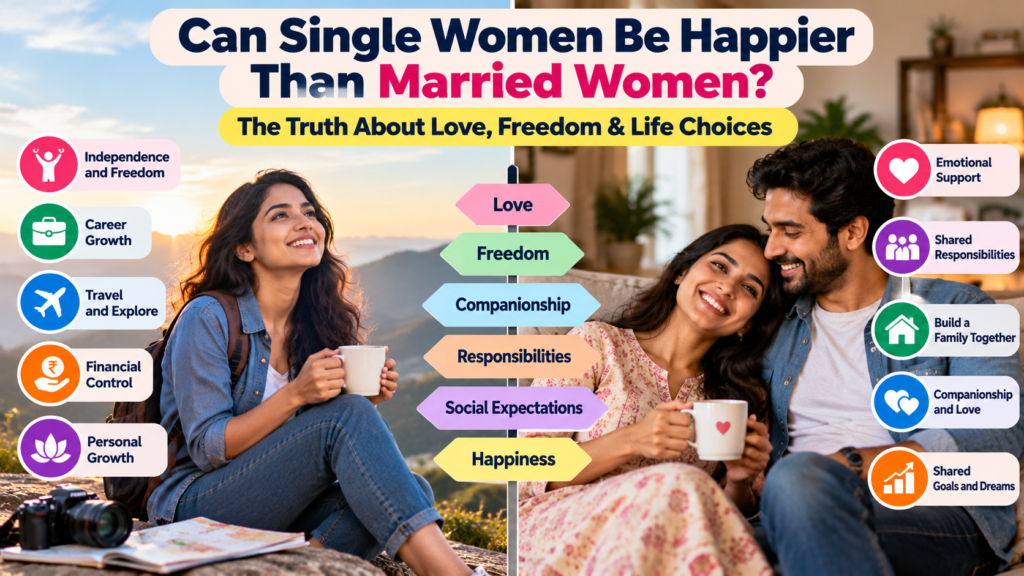
Can Single Women Be Happier Than Married Women?
Yes, single women can be happier than married women, just as married women can be happier than single women. There is no universal rule that determines which group experiences a better life.
A woman who values independence, personal space, career growth, travel, and freedom may find single life deeply satisfying. She can organise her day according to her preferences, make important decisions without consulting a partner, and spend her money and time in ways that reflect her priorities.
On the other hand, a woman who values emotional intimacy, companionship, shared responsibilities, and building a life with someone may find a loving marriage more fulfilling.
Problems arise when people assume that everyone wants the same things from life.
Some women marry because they genuinely want a lifelong partnership. Others marry because of family expectations, social pressure, or the fear of remaining single. Similarly, some women enjoy being single by choice, while others would prefer a relationship but have not found the right partner.
The real question is not whether single women are happier than married women. It is whether a woman feels loved, respected, emotionally secure, and free to live according to her values.
The Benefits of Being Single as a Woman
Being single can offer several advantages, particularly for women who appreciate independence and personal freedom.
1. Freedom to Make Your Own Decisions
One of the biggest advantages of single life is the freedom to make decisions without having to consider a partner’s preferences in every situation.
A single woman can decide where to live, which career to pursue, how to spend her money, and how to organise her daily routine. She can change jobs, move to another city, return to education, or start a business based on her own goals.
In a healthy marriage, partners discuss major decisions and respect each other’s independence. However, even a supportive relationship involves coordination, compromise, and consideration of another person’s needs.
For someone who strongly values autonomy, being single can feel refreshing.
2. More Control Over Personal Time
Time is one of the most valuable things we have, yet relationships often require us to balance our individual preferences with another person’s needs.
A single woman may have greater flexibility to pursue hobbies, exercise, travel, meet friends, or simply enjoy a quiet evening at home.
She does not necessarily have to coordinate every weekend or holiday with a partner’s schedule.
This flexibility can be especially valuable for women who are building careers, studying, caring for family members, or exploring their interests.
Of course, single women can also have demanding responsibilities. Work, children, parents, and household duties do not disappear simply because someone is unmarried.
Still, having fewer relationship-related obligations can make life feel more manageable for some people.
3. Financial Independence
Being single can provide greater control over personal finances.
A woman may decide how much to save, which investments to consider, where to live, and how to spend her earnings without needing to coordinate every decision with a spouse.
Financial independence can also encourage women to develop budgeting skills, build savings, and plan for their future.
However, being single does not automatically make life cheaper. A single person may have to manage rent, household expenses, healthcare costs, and emergencies without sharing those costs with a partner.
Likewise, a supportive marriage can make financial planning easier when both partners contribute fairly.
The important factor is not simply whether a woman is single or married, but whether she has financial security, control over her money, and the ability to make informed choices.
4. Freedom From Unfair Relationship Expectations
In some families and communities, women are expected to take responsibility for cooking, cleaning, organising family events, caring for relatives, and remembering household details.
These expectations can become exhausting when a woman is also working full-time or pursuing her own ambitions.
An unequal marriage may leave a woman feeling as though she has taken on the responsibilities of a spouse without receiving equal support in return.
Single women may be able to avoid some of these relationship-related expectations, although they can still face pressure from family members or society.
A woman’s happiness often improves when she has the freedom to decide how she wants to live instead of following expectations simply because she is a woman.
5. More Opportunities for Personal Growth
Single life can provide an opportunity to understand yourself more deeply.
You may discover what you genuinely enjoy, what makes you feel fulfilled, and what kind of future you want to create.
Some women use this period to focus on education, professional development, fitness, travel, creative interests, or building friendships.
Others learn to become more comfortable with their own company and develop confidence in making decisions independently.
Personal growth is not exclusive to single life. Marriage can also help people grow emotionally and develop patience, understanding, and responsibility.
However, being single can offer additional space for self-discovery when that is what a person needs.
6. Less Pressure to Compromise on Everyday Choices
Even a good relationship involves compromise.
Partners may have different food preferences, sleeping schedules, social habits, spending priorities, or ideas about holidays. They may disagree about where to live, how to raise children, or how frequently to visit relatives.
These differences can be managed through communication and mutual respect, but they still require effort.
A single woman may enjoy making everyday choices without negotiating them with another person.
For someone who has spent years adjusting to other people’s expectations, this independence can feel particularly meaningful.
The Challenges of Being Single
Although single life offers many advantages, it also has challenges. It is important to discuss these honestly rather than presenting single life as a perfect solution to every problem.
1. Loneliness and the Need for Companionship
Independence does not mean that a person never feels lonely.
A single woman may enjoy her freedom and still wish she had someone with whom to share an ordinary evening, a difficult day, a personal achievement, or an exciting piece of news.
There may be moments when she wants emotional reassurance or simply wishes someone were there to listen without needing an explanation.
These feelings are natural. Wanting companionship does not mean someone has failed to enjoy single life.
However, loneliness is not limited to unmarried people. Someone can feel lonely even while living with a spouse, children, or a large family.
What matters is the quality of emotional connection in a person’s life.
Strong friendships, supportive family relationships, community involvement, and meaningful activities can help single women develop a fulfilling social life.
2. Social Pressure to Get Married
In many communities, marriage is treated as an expected stage of adulthood.
Unmarried women may repeatedly hear questions such as:
- When are you getting married?
- Have you found someone yet?
- Why are you still single?
- Who will take care of you when you get older?
- Don’t you want to start a family?
Even when these questions are asked with good intentions, hearing them repeatedly can become frustrating.
Some women feel that their achievements in education, work, business, and personal development are overlooked because they are not married.
This pressure can be particularly strong when relatives and friends begin getting married or having children.
Yet a woman’s life cannot be measured by her marital status. Her worth does not depend on whether she has a husband, and choosing to remain single is not a failure.
3. Social Activities Can Feel Designed for Couples
Many social events, holidays, and family gatherings revolve around couples and families.
Wedding invitations, romantic celebrations, couple-oriented travel packages, and certain social traditions may unintentionally make single people feel excluded.
In some communities, unmarried women may also face restrictions or assumptions about travelling alone, returning home late, or participating in particular family or religious events.
These experiences vary widely across cultures, families, and locations.
The problem is not that every social activity must be redesigned around single people. Rather, it is that everyone should have the opportunity to participate without being made to feel incomplete because of their relationship status.
4. Managing Responsibilities Alone
A single woman may have to handle household expenses, financial planning, home maintenance, medical appointments, and emergencies independently.
If she lives alone, she may not have another person immediately available when she becomes ill or needs practical help.
This does not mean single women are incapable of managing their lives. Many do so successfully and confidently.
However, building a reliable support network can make a significant difference.
Maintaining friendships, staying connected with relatives, developing financial security, and planning for emergencies can help create a sense of safety and stability.
5. Questions About the Future
Some single women worry about what life will look like as they grow older.
They may wonder who will accompany them during difficult periods, help with practical responsibilities, or share important milestones.
These concerns are understandable, but marriage is not a guarantee against loneliness or insecurity.
A supportive spouse can be an important source of companionship, but relationships can also change through illness, separation, or loss.
Planning for the future, developing meaningful relationships, and maintaining independence are valuable for everyone, regardless of marital status.
The Benefits of Being Married to a Loving Partner
Marriage can bring meaningful happiness when it is based on love, mutual respect, emotional safety, and shared responsibility.
1. Having Someone to Share Your Life With
One of the most beautiful aspects of a loving relationship is having someone with whom you can share everyday experiences.
It might be discussing how your day went, laughing about something small, planning a holiday, celebrating a promotion, or sitting together after a difficult day.
These ordinary moments can become meaningful because they are shared with someone who knows you well.
A loving partner may understand your habits, remember important details, recognise when something is bothering you, and offer comfort without requiring you to explain everything.
For people who value emotional intimacy, this companionship can be one of the greatest benefits of marriage.
2. Emotional Support During Difficult Times
Life includes disappointments, illness, financial pressure, family problems, and unexpected changes.
A caring partner can provide emotional support during these periods. They may help you think through a difficult decision, share practical responsibilities, or simply sit beside you when there is nothing useful to say.
Of course, a partner cannot solve every problem, and a healthy relationship does not require one person to carry all the emotional weight.
Still, knowing that someone is willing to face life’s difficulties with you can provide comfort and reassurance.
The key is that support should be mutual. Both partners deserve to feel heard, respected, and cared for.
3. Sharing Responsibilities
Marriage can make everyday responsibilities easier when both partners contribute fairly.
Couples can share household tasks, financial planning, caring responsibilities, and decisions about their future.
Instead of one person carrying the entire burden, partners can use their different strengths to support each other.
However, this benefit depends on how responsibilities are divided. If one partner is expected to do nearly all the cooking, cleaning, childcare, and family coordination, marriage may increase their workload rather than reduce it.
A healthy partnership requires practical cooperation, not simply living in the same house.
4. Building Shared Memories and Traditions
Couples may enjoy creating traditions that become meaningful over time.
These could include celebrating festivals together, visiting favourite places, cooking family recipes, taking annual holidays, or marking personal milestones.
They may also build a shared home, raise children if they choose to, or support each other’s long-term goals.
These experiences can create a sense of continuity and belonging.
Yet shared memories are not limited to marriage. Single people also create meaningful traditions with friends, siblings, parents, children, and their wider communities.
The important point is that people need opportunities to connect and share experiences in ways that feel meaningful to them.
5. Growing Together Through Life
A strong marriage can provide an opportunity for two people to grow together.
Partners may encourage each other to pursue ambitions, develop new skills, improve their health, or become more confident.
They may learn to communicate better, handle disagreements constructively, and understand perspectives different from their own.
Over time, a healthy relationship can become a partnership in which both people feel supported in becoming the best versions of themselves.
This kind of growth is possible when neither partner expects the other to give up their identity or ambitions to preserve the relationship.
The Challenges of Married Life for Women
Marriage can be fulfilling, but it also involves responsibilities and potential difficulties.
1. Balancing Personal Freedom With Partnership
A marriage brings two people together, and their decisions often affect each other.
A job opportunity in another city, a major purchase, a family commitment, or a holiday may require discussion and planning.
This coordination is not necessarily a disadvantage. In a respectful relationship, partners can make better decisions by considering each other’s needs.
However, it can become frustrating when one person expects to control the other’s choices or refuses to respect their independence.
A healthy marriage allows both partners to remain individuals while building a life together.
2. Unequal Household Responsibilities
In some households, women are still expected to manage most domestic responsibilities, even when they have demanding jobs outside the home.
They may be expected to cook, clean, organise family occasions, care for children, look after elderly relatives, and maintain relationships with extended family members.
When these responsibilities are not shared fairly, women can experience exhaustion and resentment.
The solution is not necessarily to avoid marriage. It is to challenge the assumption that household work is automatically a woman’s responsibility.
Partners should discuss expectations openly and divide tasks according to their circumstances, abilities, preferences, and available time.
3. Pressure From Extended Family
Marriage may bring new relationships with in-laws and extended family members.
These relationships can be supportive and loving, but they may also involve conflicting expectations about traditions, finances, living arrangements, childcare, and family obligations.
Women may sometimes feel pressured to prioritise their husband’s family over their own needs or relationships.
Healthy boundaries are important. Both partners should be able to maintain relationships with their own families while treating each other’s relatives with respect.
4. Emotional Loneliness Within Marriage
Being married does not automatically mean feeling understood.
A woman may share a home with her husband yet feel unable to discuss her worries, ambitions, fears, or disappointments.
If communication is poor or affection is missing, marriage can sometimes feel more isolating than living alone.
This is why the quality of a relationship matters so much.
A marriage certificate cannot guarantee love, understanding, or emotional security. Those qualities are built through everyday actions, honest communication, trust, and mutual care.
Single Women vs Married Women: A Comparison
The following comparison highlights some common differences. Individual experiences vary, so neither column describes every single or married woman.
| Aspect | Single life | Married life |
|---|---|---|
| Personal freedom | Often greater independence in everyday decisions | Decisions may require coordination with a partner |
| Companionship | Can be developed through friends, family, and community | A loving spouse may provide daily companionship |
| Finances | Greater individual control, but expenses may be managed alone | Expenses may be shared, depending on the arrangement |
| Household responsibilities | Managed individually or shared with housemates or family | Can be shared, but may be unequal |
| Social expectations | May involve pressure to marry | May involve pressure to meet expectations of marriage |
| Personal growth | May offer more independent time and flexibility | Can involve growth through partnership |
| Loneliness | Possible despite independence and social connections | Possible even within marriage |
| Future planning | Often planned independently with support from a network | May involve joint plans and responsibilities |
The comparison shows why it is difficult to declare one lifestyle better than the other. Each offers different possibilities and challenges.
Why Society Often Treats Marriage as a Requirement for Women
In many societies, marriage has traditionally been associated with adulthood, family stability, social acceptance, and financial security.
Women may experience stronger pressure because expectations about marriage, motherhood, caregiving, and family responsibilities are often closely linked.
An unmarried woman may be asked to explain her personal choices in ways that a married woman is not. She may be judged for living alone, travelling independently, focusing on her career, or choosing not to have children.
These attitudes are changing in many places, but social expectations can still influence how women are treated.
It is worth remembering that marriage is a personal relationship, not a measure of a woman’s success or value.
A woman can build a meaningful life through her career, friendships, family relationships, creative interests, community involvement, or other personal goals.
Likewise, choosing marriage can be a deeply meaningful decision when it reflects what she genuinely wants.
Neither marriage nor single life should be treated as a compulsory destination for every woman.
Can a Woman Be Happy Without a Husband?
Absolutely.
A woman can experience happiness, love, purpose, security, and fulfilment without having a husband.
She may find these things through her children, friends, parents, siblings, professional achievements, community, personal interests, or the simple pleasure of living according to her values.
Some women are happily single throughout their lives. Others enjoy single life for many years before choosing a relationship. Some are widowed or divorced and build fulfilling lives after major changes.
Their experiences may be different, but none of these paths is inherently less meaningful than marriage.
At the same time, wanting a loving partner is entirely natural. There is no need to pretend that companionship is unimportant simply to prove independence.
A woman can be independent and still desire a relationship. She can enjoy being single and occasionally feel lonely. She can be married and still need personal space.
Human emotions are not limited to one category.
What Matters More Than Marital Status?
Instead of asking whether single women or married women are happier, it may be more useful to consider the conditions that help people live satisfying lives.
Emotional Safety
People generally benefit from relationships in which they can speak honestly, express feelings, and disagree without fear of humiliation or intimidation.
Personal Independence
Having some control over your choices, finances, time, and future can contribute to confidence and well-being.
Meaningful Relationships
Friendships, family connections, romantic partnerships, and community relationships can all provide belonging and support.
Financial Security
Being able to meet basic needs, prepare for emergencies, and make informed decisions can reduce stress.
Purpose and Personal Growth
Work, learning, creative interests, caregiving, volunteering, and personal ambitions can give life meaning.
Freedom From Unfair Expectations
People are more likely to build lives that suit them when they can make decisions without constant pressure to follow a particular social path.
These factors can matter whether someone is single, married, divorced, widowed, or in another kind of relationship.
For more information about the role of human connection in well-being, readers can explore the World Health Organization’s Social Connection resources.
How to Build a Happy Life Whether You Are Single or Married
There is no universal formula for happiness, but a few practical habits can help people create a more satisfying life.
If You Are Single
- Build friendships that provide genuine support.
- Learn to enjoy your own company without feeling that you must always be productive.
- Develop financial independence and plan for the future.
- Pursue interests that give you purpose and enjoyment.
- Set boundaries with people who repeatedly pressure you about marriage.
- Stay open to love if you want a relationship, but do not treat marriage as a deadline.
- Create traditions and experiences that make your life feel rich and meaningful.
If You Are Married
- Communicate openly about your feelings and expectations.
- Share household and caregiving responsibilities fairly.
- Respect each other’s friendships, interests, and personal space.
- Discuss financial decisions honestly.
- Make time for companionship rather than focusing only on responsibilities.
- Address disagreements respectfully instead of allowing resentment to build.
- Remember that love involves actions, not simply promises or social status.
If You Are Unsure What You Want
Give yourself permission to think about what happiness means to you.
You do not need to make a major life decision just because friends are getting married or relatives are asking questions.
Consider the kind of relationship you want, the responsibilities you are willing to take on, and the values you want your life to reflect.
Making a thoughtful choice is more important than making a choice that satisfies everyone else.
Frequently Asked Questions
1. Are single women happier than married women?
Not necessarily. Some single women are happier because they value independence and flexibility, while others prefer the companionship of marriage. Happiness depends on personal preferences, relationship quality, emotional well-being, financial security, and individual circumstances.
2. Is it better for a woman to stay single or get married?
Neither choice is automatically better. Staying single may suit someone who values independence, while marriage may suit someone who wants a committed partnership. The best decision is the one that aligns with the woman’s values and circumstances.
3. Can a single woman live a fulfilling life without a husband?
Yes. A fulfilling life can include friendships, family, career, hobbies, personal growth, community involvement, and meaningful experiences. A husband is not a requirement for a woman to have purpose or happiness.
4. Why do some married women feel unhappy?
Possible reasons include unequal responsibilities, financial stress, poor communication, lack of affection, family pressure, controlling behaviour, or incompatible expectations. These issues vary by relationship, and being married does not automatically guarantee emotional fulfilment.
5. Why do some single women feel lonely?
Loneliness can occur when a person lacks meaningful emotional connections, even if they enjoy independence. Friendships, family relationships, social activities, and community involvement can help build a stronger support network.
6. Does marriage make life easier for women?
It can, particularly when partners share responsibilities, support each other emotionally, and work together financially. However, an unequal or unhealthy marriage may create additional stress instead.
7. Is it selfish for a woman to choose single life?
No. Choosing to remain single is a personal decision. A woman is not obligated to marry to meet social expectations or satisfy other people’s preferences.
8. Can a married woman maintain her independence?
Yes. A healthy marriage can allow both partners to maintain their identities, friendships, ambitions, finances, and personal interests while building a shared life.
9. Can a woman be happy after divorce or the death of her husband?
Yes. Life after divorce or the loss of a spouse can involve grief, adjustment, and difficult emotions. Over time, many people build meaningful lives through family, friendships, personal goals, and new experiences. There is no single timetable for healing, and continuing to feel love for a former or deceased partner can coexist with finding happiness again.
10. What is the most important factor in a happy marriage?
There is no single factor that guarantees a happy marriage. Mutual respect, trust, communication, emotional safety, shared responsibility, and a willingness to work through difficulties are all important foundations.
Conclusion: Happiness Is About the Life You Choose, Not Your Marital Status
Can single women be happier than married women? Yes, in some circumstances. Can married women be happier than single women? Absolutely.
A woman who enjoys independence may find great satisfaction in single life. Another may find her deepest happiness in a loving marriage where she feels respected, understood, and supported.
Neither experience needs to be judged against the other.
Marriage can offer companionship, shared memories, emotional support, and a sense of partnership. Single life can offer independence, flexibility, self-discovery, and freedom from certain relationship responsibilities. Both can also involve challenges, uncertainty, and moments of loneliness.
The most important distinction is not between being single and being married. It is between living a life that reflects your values and living one primarily to satisfy other people’s expectations.
If you are single, you do not need to consider your life incomplete. If you are married, you do not need to assume that marriage alone will make you happy. In either situation, meaningful relationships, mutual respect, personal freedom, and emotional well-being matter.
A loving relationship can be a wonderful part of life, but it should add to your happiness rather than become the only source of it.
Ultimately, the goal is not to prove that single women are happier than married women, or the other way around. The goal is to build a life in which you feel valued, connected, secure, and free to be yourself.
SHARING IS CARING 💖