
Introduction
Fairness is a value that most people support.
From childhood, we are taught that everyone should be treated equally. Sharing equally, following the same rules, and receiving the same opportunities are often considered signs of fairness.
However, real life is more complex.
Imagine a doctor giving every patient the exact same medicine regardless of their illness.
Imagine a teacher providing the same lesson to students with completely different learning needs.
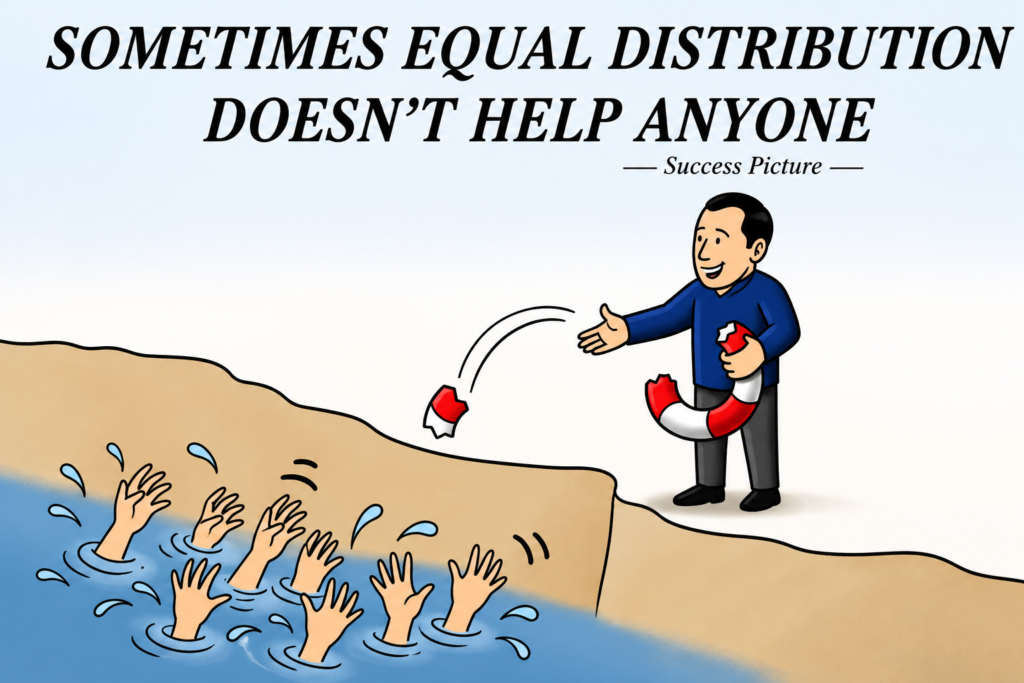
Imagine a lifeguard throwing identical life jackets to people facing different levels of danger.
Would that truly be fair?
Probably not.
This is where understanding the difference between equality and equity becomes important.
Equality means giving everyone the same resources or support.
Equity means providing people with the specific resources or support they need to achieve a fair outcome.
While equality sounds fair on the surface, it does not always solve problems because people begin from different circumstances and face different challenges.
Understanding this distinction can improve leadership, education, workplaces, communities, and even personal relationships.
What Is Equality?
Equality means treating everyone the same.
Everyone receives identical resources, opportunities, or assistance regardless of individual circumstances.
Examples include:
- Every student receives the same textbook.
- Every employee receives identical training.
- Every person receives the same amount of support.
- Every participant follows the same rules.
Equality focuses on uniform treatment.
The goal is consistency.
In many situations, equality is important because it helps prevent discrimination and favoritism.
However, equal treatment does not always produce equal results.
What Is Equity?
Equity focuses on individual needs.
Instead of giving everyone the same thing, equity provides the support necessary for each person to succeed.
Examples include:
- Additional tutoring for struggling students.
- Accessibility accommodations for people with disabilities.
- Customized training for employees with different experience levels.
- Targeted assistance for individuals facing unique challenges.
Equity recognizes that people start from different positions.
The goal is not identical treatment.
The goal is fair opportunity.
Why Equality Alone Sometimes Falls Short
Imagine three people trying to look over a tall fence.
One person is tall.
One is average height.
One is very short.
If each person receives the same-sized box to stand on, the tall person may see clearly while the shortest person still cannot see over the fence.
The assistance was equal.
The outcome was not.
This example illustrates a common problem.
People face different obstacles.
Providing identical support does not always eliminate those obstacles.
Sometimes fairness requires flexibility.
The Difference Between Equal Treatment and Effective Help
Many organizations unintentionally confuse equality with effectiveness.
Giving everyone identical resources may seem fair, but it may not address actual needs.
Consider these situations:
In Education
Students learn differently.
Some excel through reading.
Others learn better through visual instruction or hands-on experience.
Providing identical teaching methods may leave some students behind.
In the Workplace
New employees often need more guidance than experienced professionals.
Equal support may not produce equal performance.
In Healthcare
Different patients require different treatments.
Providing identical care would ignore individual medical needs.
In each case, effectiveness comes from understanding differences rather than ignoring them.
Why Equity Is Not Special Treatment
One common misconception is that equity means giving unfair advantages.
In reality, equity aims to remove barriers that prevent people from reaching their potential.
Equity does not guarantee success.
It simply seeks to create a fair opportunity for success.
For example:
Providing a wheelchair ramp does not give someone an unfair advantage.
It removes an obstacle that others may not face.
Providing language support for students learning a new language does not guarantee better grades.
It helps create a more equal opportunity to learn.
Equity focuses on access rather than advantage.
The Role of Empathy in Equity
Understanding people’s needs requires empathy.
Empathy means considering experiences beyond your own perspective.
Without empathy, it is easy to assume everyone faces the same challenges.
However, people’s lives differ based on factors such as:
- Health
- Education
- Family circumstances
- Financial resources
- Experience
- Physical abilities
- Social environments
Empathy helps us recognize these differences and respond appropriately.
True fairness often begins with understanding.
Equality vs. Equity in Leadership
Great leaders understand that managing people effectively requires flexibility.
A leader who treats every team member identically may overlook individual strengths and challenges.
Effective leaders recognize that employees may need:
- Different communication styles
- Different levels of support
- Different learning opportunities
- Different development plans
This approach does not reduce fairness.
It improves performance and engagement.
Leadership is not about treating everyone exactly the same.
It is about helping each person succeed.
Equity Creates Better Outcomes
Research and real-world experience consistently show that people perform better when support matches their needs.
When barriers are reduced:
- Students learn more effectively.
- Employees perform better.
- Communities become stronger.
- Opportunities become more accessible.
The objective is not equal input.
The objective is fair opportunity and meaningful outcomes.
Why One-Size-Fits-All Solutions Often Fail
Many problems remain unsolved because solutions are designed for the average person.
The challenge is that there is no truly “average” person.
People differ in:
- Learning styles
- Skills
- Experiences
- Goals
- Challenges
One-size-fits-all approaches often ignore these differences.
Personalized solutions tend to be more effective because they address actual needs rather than assumed needs.
Applying Equity in Everyday Life
Equity is not limited to governments, schools, or large organizations.
It can be practiced in daily interactions.
As a Parent
Children often have different personalities and learning styles.
Supporting them may require different approaches.
As a Friend
Different people need different forms of encouragement and support.
As a Manager
Understanding individual strengths can improve team performance.
As a Community Member
Recognizing unique challenges can help create more inclusive environments.
Small acts of understanding can make a significant difference.
Balancing Equality and Equity
Equality and equity are not enemies.
Both have important roles.
Equality provides consistent standards and equal rights.
Equity addresses individual needs and barriers.
The most effective systems often combine both principles.
Everyone deserves equal dignity, respect, and opportunity.
At the same time, people may need different forms of support to access those opportunities.
Balancing equality and equity creates a stronger foundation for fairness.
ALSO READ…
- Happiness Is Not About Position—It’s About Perspective
- How Social Media Likes Became Today’s Emotional Currency
- The Powerful Lesson About Friendship and Money Most People Learn Too Late
- Why Money Should Be a Tool, Not a Prison
- How You See Yourself Shapes Your Entire Life
A Powerful Lesson About Fairness
Fairness is not always about giving everyone the same thing.
Sometimes fairness means giving people what they need to succeed.
A teacher who adjusts lessons for different learners is not being unfair.
A coach who provides personalized training is not showing favoritism.
A leader who recognizes individual challenges is not abandoning equality.
They are practicing equity.
They are focusing on outcomes rather than appearances.
Conclusion
The difference between equality and equity is simple but powerful.
Equality gives everyone the same resources.
Equity provides the resources people need based on their circumstances.
While equal treatment is important, it does not always solve problems because people face different challenges and begin from different starting points.
Real fairness requires more than identical support.
It requires understanding, empathy, and a willingness to address individual needs.
The goal should not be treating everyone exactly the same.
The goal should be creating opportunities where everyone has a genuine chance to thrive.
Because sometimes the fairest solution is not equal distribution—it is meaningful support that helps people reach their full potential.
SHARING IS CARING 💖