
Introduction: A Nation Born Amid Challenges
On August 15, 1947, India achieved independence after nearly two centuries of colonial rule.
The moment was historic, emotional, and transformative.
Yet freedom came with enormous challenges.
The newly independent nation faced widespread poverty, low literacy rates, food shortages, weak industrial infrastructure, and the painful consequences of Partition. Millions of people were displaced, communities were divided, and the future appeared uncertain.
Many international observers doubted whether India could survive as a unified democracy.
Few could have imagined that the same country would one day become one of the world’s largest economies, a nuclear power, a spacefaring nation, a global technology hub, and the world’s most populous democracy.
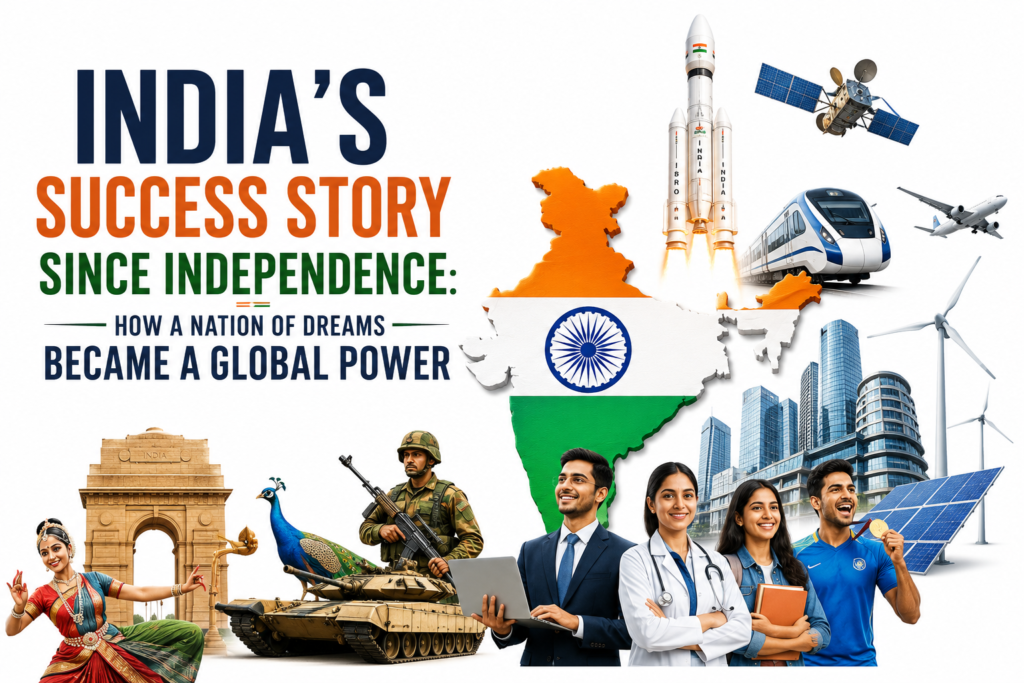
Today, India’s Success Story Since Independence is one of the most remarkable national transformations in modern history.
This is the story of how a nation of dreams became a global power.
The Early Years: Building a Nation from Scratch
When India became independent in 1947, the challenges were overwhelming.
More than 80% of the population lived in villages.
Life expectancy was around 32 years.
Literacy levels were extremely low.
Industrial production was limited.
The country’s infrastructure was underdeveloped.
Yet India’s leaders understood that the first priority was nation-building.
One of the most significant achievements was the adoption of the Constitution of India in 1950.
The Constitution guaranteed democracy, equality, fundamental rights, and universal adult suffrage.
This was revolutionary.
At a time when many newly independent countries experienced political instability, India chose democracy.
That decision would become one of the foundations of India’s rise as a global power.
The Green Revolution: Feeding a Billion Dreams
In the 1950s and early 1960s, India struggled with food shortages.
The country depended heavily on imports.
Many feared that India would never become self-sufficient in food production.
Then came one of the most important chapters in India’s success story: the Green Revolution.
Scientists, policymakers, and farmers worked together to increase agricultural productivity.
High-yield crop varieties, improved irrigation systems, fertilizers, and modern farming techniques transformed Indian agriculture.
Real-Life Impact
In Punjab, Haryana, and parts of Uttar Pradesh, farmers witnessed unprecedented increases in crop production.
Fields that once produced modest harvests began generating surplus food.
The transformation was dramatic.
India moved from food scarcity to food security.
Today, India is one of the world’s largest producers of:
- Rice
- Wheat
- Milk
- Fruits
- Vegetables
The Green Revolution proved that determination and innovation could solve even the most daunting national challenges.
The White Revolution: The Milk Miracle
Another remarkable achievement came through the efforts of visionary leader Verghese Kurien.
At the time, India was not a major milk producer.
Millions of small dairy farmers struggled with low incomes and limited opportunities.
Kurien’s cooperative model transformed the dairy industry.
The movement eventually became known as the White Revolution.
The Amul Success Story
What began as a cooperative initiative in Gujarat eventually became the foundation for the famous Amul brand.
The success of dairy cooperatives empowered millions of rural families.
Today, India is the world’s largest milk producer.
This achievement demonstrates how grassroots innovation can create national transformation.
India’s Democratic Success: A Rare Achievement
Many experts predicted that democracy would struggle in a diverse country as large as India.
They were wrong.
India has successfully conducted regular elections for decades.
Power has changed hands peacefully multiple times.
Citizens from every background have participated in shaping the nation’s future.
Why This Matters
Maintaining democracy in a nation with:
- Hundreds of languages
- Multiple religions
- Vast cultural diversity
- Over a billion citizens
is an extraordinary achievement.
India’s democratic system remains one of the strongest pillars of its journey from independence to global power.
The Economic Transformation of 1991
By the late 1980s, India faced a serious economic crisis.
Foreign exchange reserves were dangerously low.
Economic growth was slowing.
The nation needed bold reforms.
In 1991, India introduced major economic liberalization measures.
These reforms opened the economy, encouraged private enterprise, and increased global investment.
The results were transformative.
Real-Life Impact
Entrepreneurs gained greater opportunities.
New industries emerged.
International companies invested in India.
Millions of jobs were created.
The reforms marked the beginning of India’s modern economic growth story.
The Rise of India’s Information Technology Industry
Few sectors symbolize India’s global success more than information technology.
In the 1990s and early 2000s, Indian software professionals began making a significant impact worldwide.
Cities such as:
- Bengaluru
- Hyderabad
- Pune
- Chennai
became technology hubs.
Indian companies gained international recognition.
Global Indian Companies
Today, firms such as:
- Infosys
- Tata Consultancy Services (TCS)
- Wipro
serve clients around the world.
Millions of Indian professionals work in technology, engineering, data science, cybersecurity, and artificial intelligence.
India’s IT revolution not only created wealth but also transformed the country’s global image.
The Story of India’s Space Program
Perhaps no achievement captures the imagination quite like India’s space journey.
In the early years, resources were limited.
The space program operated with modest budgets compared to major global powers.
Yet Indian scientists persisted.
The Bicycle Story
One famous image from India’s early space program shows scientists transporting rocket components on bicycles and bullock carts.
While resources were limited, ambition was not.
That determination eventually led to extraordinary achievements.
Chandrayaan and Beyond
The success of missions such as:
- Chandrayaan-1
- Chandrayaan-3
- Mars Orbiter Mission
demonstrated India’s scientific capabilities to the world.
India became the first nation to successfully land near the Moon’s south polar region.
The achievement inspired millions of young students.
It also proved that innovation and determination can overcome limited resources.
India’s Healthcare and Pharmaceutical Leadership
India has become one of the world’s largest pharmaceutical producers.
The country’s healthcare and pharmaceutical sectors play a vital role in global medicine supply.
During global health emergencies, India provided medicines and vaccines to numerous countries.
This strengthened India’s reputation as a responsible global partner.
Real-Life Impact
Affordable medicines manufactured in India have improved healthcare access for millions around the world.
The country’s pharmaceutical expertise continues to contribute significantly to global health.
India’s Infrastructure Revolution
Modern India has witnessed massive infrastructure development.
From highways and airports to digital connectivity and metro systems, the scale of transformation has been extraordinary.
Major initiatives have expanded:
- Road networks
- Railway modernization
- Airport connectivity
- Urban transportation
- Rural electrification
The impact is visible across the country.
Improved infrastructure supports economic growth, investment, and quality of life.
Digital India: Transforming Daily Life
India’s digital transformation is one of the most remarkable success stories of the 21st century.
Millions of people now use digital services for:
- Banking
- Payments
- Education
- Healthcare
- Government services
The UPI Revolution
India’s Unified Payments Interface (UPI) has transformed digital transactions.
From large cities to small villages, people can make instant payments using smartphones.
This innovation has become a global case study in digital inclusion.
India’s Defense Strength: Protecting a Nation’s Sovereignty
A nation’s growth is only sustainable when its security is protected.
Since independence, India has faced multiple security challenges, including wars, border disputes, terrorism, and regional instability.
Yet each challenge strengthened the country’s determination to build a capable defense system.
Today, India possesses one of the world’s largest armed forces.
Real-Life Example: The Kargil Conflict of 1999
One of the defining moments in modern Indian history was the Kargil War.
Indian soldiers fought under extremely difficult conditions in the high-altitude mountains of Jammu and Kashmir.
Despite challenging terrain and weather conditions, the armed forces successfully reclaimed strategic positions.
The bravery displayed during the conflict inspired the entire nation.
The sacrifice of soldiers such as Captain Vikram Batra, whose famous words “Yeh Dil Maange More” became a symbol of courage, continues to inspire generations.
Building Defense Self-Reliance
India has increasingly focused on indigenous defense production through initiatives aimed at reducing dependence on imports.
Today, India manufactures:
- Missiles
- Naval vessels
- Fighter aircraft components
- Radar systems
- Defense electronics
This progress contributes significantly to India’s rise as a global power.
Becoming a Nuclear Power
One of India’s most significant strategic achievements was becoming a nuclear-capable nation.
Pokhran Tests
In 1974 and later in 1998, India conducted nuclear tests in Pokhran, Rajasthan.
These tests demonstrated India’s scientific and technological capabilities.
More importantly, they established India as a nation capable of safeguarding its strategic interests.
While India advocates peace and responsible use of nuclear technology, achieving nuclear capability enhanced its position on the global stage.
This marked another milestone in India’s success story since independence.
Education: Empowering Millions Through Knowledge
At independence, literacy levels were extremely low.
Millions of children lacked access to quality education.
Today, India’s educational transformation is one of the most significant developments in its national journey.
Expansion of Educational Institutions
India has built:
- Thousands of universities
- Engineering colleges
- Medical institutions
- Research centers
- Schools in rural and urban areas
Prestigious institutions such as:
- Indian Institutes of Technology
- Indian Institutes of Management
have gained international recognition.
Real-Life Impact
Graduates from Indian institutions now lead global companies, conduct cutting-edge research, and contribute to innovation across industries.
Indian-origin leaders have held top positions in some of the world’s most influential companies, showcasing the strength of India’s talent pool.
India’s Startup Revolution
One of the most exciting chapters in modern India is the rise of entrepreneurship.
A few decades ago, starting a business was often considered risky and difficult.
Today, India is one of the world’s largest startup ecosystems.
Real-Life Examples
Companies such as:
- Flipkart
- Zomato
- Paytm
began as ambitious ideas and grew into major businesses.
Thousands of startups now operate in sectors including:
- FinTech
- Artificial Intelligence
- HealthTech
- EdTech
- E-commerce
- Clean Energy
Young entrepreneurs are solving local and global problems while creating jobs and driving innovation.
This entrepreneurial spirit has become a defining feature of modern India’s growth story.
India’s Sporting Success: Inspiring a Nation
Sports have played a powerful role in India’s national identity.
While cricket remains enormously popular, India’s achievements now extend across multiple disciplines.
Historic Sporting Moments
Cricket World Cup Victory (1983)
When India won the Cricket World Cup in 1983 under the leadership of Kapil Dev, it transformed Indian cricket forever.
Many consider this victory a turning point in Indian sports culture.
Olympic Success
Athletes such as:
- Abhinav Bindra
- Neeraj Chopra
- P. V. Sindhu
- Mary Kom
have inspired millions.
Their achievements demonstrate that India can compete at the highest levels globally.
Women’s Contribution to India’s Growth
No discussion of India’s success story since independence is complete without recognizing the achievements of women.
Indian women have excelled in:
- Science
- Politics
- Sports
- Business
- Defense
- Education
Real-Life Example: Kalpana Chawla
Kalpana Chawla became a symbol of aspiration and achievement.
Her journey from a small town in India to space inspired countless young students.
Today, women continue to break barriers across industries and contribute significantly to national development.
India’s Global Diplomatic Influence
India’s voice on the international stage has grown considerably since independence.
The country actively participates in:
- Global climate discussions
- Trade negotiations
- Peacekeeping missions
- International development initiatives
G20 Leadership
India’s presidency of the G20 highlighted its growing diplomatic influence.
The event demonstrated India’s ability to bring nations together and address global challenges.
India increasingly serves as a bridge between developed and developing countries.
India’s Cultural Influence Around the World
India’s influence extends far beyond economics and politics.
Its culture has become a global phenomenon.
Yoga’s Global Reach
Yoga, which originated in India, is now practiced by millions worldwide.
Every year, countries across the globe celebrate the International Day of Yoga.
Indian Cinema and Entertainment
Indian films, music, and digital content reach audiences across continents.
The growth of India’s creative industries has strengthened its global cultural presence.
This cultural influence contributes significantly to India’s soft power.
Renewable Energy and Sustainable Development
As the world focuses on sustainability, India has emerged as a leader in renewable energy development.
The country has invested heavily in:
- Solar energy
- Wind energy
- Green hydrogen
- Sustainable infrastructure
Solar Revolution
India hosts some of the world’s largest solar energy projects.
These initiatives help reduce dependence on fossil fuels while supporting long-term economic growth.
The country’s commitment to clean energy demonstrates its readiness to address future challenges responsibly.
The Vision for India 2047
As India approaches the centenary of independence in 2047, the nation has ambitious goals.
The vision includes:
- Becoming a developed economy
- Expanding technological leadership
- Strengthening infrastructure
- Enhancing education and healthcare
- Leading in innovation and sustainability
The Demographic Advantage
India possesses one of the world’s youngest populations.
This demographic strength creates tremendous opportunities.
If supported through education, skills development, and innovation, India’s youth can become one of its greatest assets.
Lessons from India’s Journey
India’s transformation offers valuable lessons for the world.
1. Democracy Can Thrive at Scale
India proved that democracy can succeed in a large and diverse society.
2. Innovation Can Overcome Resource Constraints
From the Green Revolution to space exploration, India repeatedly turned challenges into opportunities.
3. Education Changes Nations
Investment in knowledge and skills created opportunities for millions.
4. Diversity Can Be a Strength
India’s cultural, linguistic, and religious diversity contributes to its resilience and creativity.
5. Long-Term Vision Matters
Many achievements required decades of effort, patience, and commitment.
Final Conclusion: The Story Is Far From Over
The story of India is not merely a record of economic statistics or technological achievements.
It is the story of ordinary people accomplishing extraordinary things.
It is the story of farmers feeding a nation.
Scientists reaching the Moon.
Entrepreneurs creating global businesses.
Athletes inspiring millions.
Teachers shaping future generations.
And citizens strengthening the world’s largest democracy.
From the challenges of 1947 to becoming one of the world’s most influential nations, India’s Success Story Since Independence demonstrates what determination, innovation, and collective effort can achieve.
The nation has already traveled an extraordinary distance.
Yet perhaps the most exciting chapter is still ahead.
As India moves toward 2047 and beyond, the dream that began at independence continues to evolve—stronger, more confident, and more ambitious than ever before.
The rise of India is not just a story of the past.
It is one of the defining stories of the future.
SHARING IS CARING 💖