
Getting a driving licence in India is an important step toward becoming an independent and responsible driver. Whether you want to ride a scooter, drive a motorcycle, or use a car, you need the appropriate driving licence before driving on public roads.
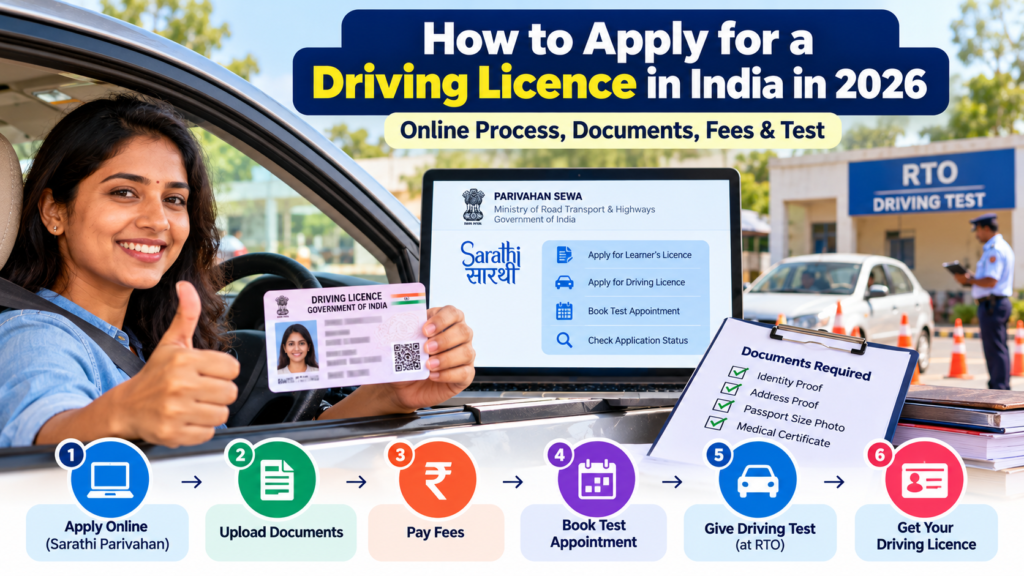
The good news is that much of the driving licence application process can be started online through the official Parivahan and Sarathi portals. You can fill out the application, upload documents where the service is available, pay the required fees, and book a test appointment. Depending on your state and application type, you may still need to visit the Regional Transport Office (RTO).
In this guide, you will learn how to apply for a driving licence in India in 2026, including eligibility, documents, application steps, fees, the learner’s licence, the driving test, application status, and how to download your licence.
What Is a Driving Licence?
A driving licence (DL) is an official document issued by the relevant licensing authority that permits a person to drive the category of motor vehicle specified on the licence.
In India, the licensing process is generally divided into two main stages:
- Learner’s Licence (LL): A temporary licence that allows you to learn to drive according to applicable learner conditions.
- Permanent Driving Licence (DL): Issued after you meet the requirements and pass the driving test, where required.
You must have a valid licence for the type of vehicle you intend to drive. For example, a licence for a motorcycle does not automatically authorise you to drive every type of commercial or transport vehicle.
Driving Licence Application: Important Details
| Particular | Details |
|---|---|
| Service | New driving licence application |
| Country | India |
| Application portal | Sarathi Parivahan |
| First step | Apply for a learner’s licence |
| Minimum age | Depends on vehicle category |
| Permanent licence | Generally available after holding a valid learner’s licence for at least 30 days |
| Learner’s licence validity | Generally 6 months |
| Driving test | As required by the licensing authority |
| Application fee | Depends on the service and applicable charges |
| Issuing authority | State or Union Territory licensing authority |
Official information: Parivahan Sewa.
Types of Driving Licences in India
Before applying, choose the correct licence category for the vehicle you want to drive.
1. Learner’s Licence
A learner’s licence is the first step for most new applicants. It allows you to learn and practise driving while following the applicable learner restrictions.
It is generally valid for six months. You can apply for a permanent driving licence after holding a valid learner’s licence for at least 30 days.
2. Permanent Driving Licence
A permanent driving licence is issued after you complete the required process and pass the driving test, where applicable.
You must apply for the appropriate vehicle category and follow the appointment and document instructions provided by your licensing authority.
3. Motorcycle Licence
If you want to ride a motorcycle or scooter, select the relevant motorcycle category. The category you need depends on whether the vehicle is with or without gears and the applicable licensing rules.
4. Light Motor Vehicle Licence
A light motor vehicle (LMV) category is commonly relevant to private cars and certain other light motor vehicles. Select the category that matches your vehicle and intended use.
5. Transport Vehicle Licence
Driving a transport vehicle can involve additional age, medical fitness, qualification, and other requirements. Check the relevant category and rules with the state transport department before applying.
Eligibility for a Driving Licence in India
Your eligibility depends on your age and the category of vehicle you want to drive.
Minimum Age Requirements
The general age requirements include the following:
- 16 years: A learner’s licence may be available for a motorcycle without gears up to 50cc, subject to the applicable legal conditions and written consent of the parent or guardian.
- 18 years: Generally, the minimum age for a non-transport motor vehicle, including an ordinary private car or motorcycle with gears.
- 20 years: Generally, the minimum age for a transport vehicle licence, subject to the applicable rules and other requirements.
Do not assume that meeting the age requirement alone guarantees eligibility. Additional conditions may apply to particular vehicle categories.
Other Eligibility Conditions
You should generally:
- Meet the minimum age requirement for your vehicle category.
- Provide valid proof of age and address.
- Complete the learner’s licence process.
- Meet applicable physical fitness and medical requirements.
- Pass the learner’s test and driving test, where required.
- Submit accurate application details and pay the prescribed fees.
For the official information, visit Parivahan Sewa.
Documents Required for a Driving Licence
Keep your documents ready before starting the application. The exact requirements may differ depending on your state, age, vehicle category, and application type.
Commonly requested documents include:
1. Proof of Age
Depending on what your licensing authority accepts, this may include:
- Aadhaar card
- Birth certificate
- Passport
- School certificate
- Other accepted age-proof documents
2. Proof of Address
Examples of documents that may be accepted include:
- Aadhaar card
- Passport
- Voter ID
- Utility bill or another approved address document
- Other documents accepted by the relevant authority
The authority may require a particular document or additional proof depending on your circumstances.
3. Medical Certificate
A medical certificate may be required for certain applicants and vehicle categories. Form 1A is used for the prescribed medical certificate where applicable. Check the current requirements for your age and licence category.
4. Application Forms
The relevant forms can be accessed through the official Parivahan website. Form requirements vary according to the service being requested.
5. Other Items
You may also need:
- Application number or acknowledgement
- Fee payment receipt
- Appointment confirmation
- Original documents for verification
- A suitable vehicle for the driving test, as instructed by the RTO
Official forms are available on the Parivahan Forms page.
Important: Do not upload or submit false documents. Incorrect information can delay or jeopardise your application.
How to Apply for a Driving Licence Online in India in 2026
For a new applicant, the process generally begins with a learner’s licence. Follow these steps.
Step 1: Visit the Official Sarathi Parivahan Website
Open the official website:
https://sarathi.parivahan.gov.in
Select your state or Union Territory from the available list.
Make sure you are using the official government website rather than an unofficial agent’s website.
Step 2: Apply for a Learner’s Licence
After selecting your state, look for the learner’s licence section and choose the option for a new learner’s licence application.
The exact menu labels may differ between states.
Read the instructions carefully before continuing.
Step 3: Fill Out the Application Form
Enter the requested details, which may include:
- Applicant’s name
- Date of birth
- Address
- Contact details
- Vehicle category
- Other required information
Check every entry before submitting the form. Your name, date of birth, and other details should match your supporting documents.
Step 4: Upload the Required Documents
If online document upload is available for your state and application, upload the requested documents in the specified format.
Ensure that the images or scanned copies are clear and readable.
Some applications may require document verification or an RTO visit. Follow the instructions shown on the portal.
Step 5: Pay the Application Fees
Use the fee payment option provided on the official portal if online payment is available for your application.
Save your payment receipt and application number. You may need them to check the status of your application or complete a later stage.
If online payment is unavailable, follow the instructions given by the relevant licensing authority.
Step 6: Complete the Learner’s Licence Test
Applicants may be required to take a test covering traffic signs, road rules, safe driving, and other relevant subjects. The available testing method depends on the state and service.
Prepare by studying traffic signs, signals, road markings, right-of-way rules, and safe driving practices.
If an appointment or in-person verification is required, attend it with the requested documents.
Step 7: Get Your Learner’s Licence
After completing the required steps successfully, follow the portal’s instructions to view, print, or download your learner’s licence, where the facility is available.
Keep a copy for your records and follow all learner restrictions when practising.
How to Apply for a Permanent Driving Licence
After receiving your learner’s licence, you can move to the permanent driving licence stage when you meet the eligibility requirements.
Step 1: Wait for the Required Period
A permanent driving licence application can generally be made after you have held a valid learner’s licence for at least 30 days.
Your learner’s licence is generally valid for six months, so plan your application and test within its validity period.
Step 2: Visit the Sarathi Portal
Open Sarathi Parivahan and select your state.
Choose the option for a new driving licence or the relevant permanent licence service.
Step 3: Enter Your Learner’s Licence Details
Enter the requested learner’s licence number and date of birth. Continue according to the instructions displayed on the portal.
Step 4: Complete the Application
Fill in any required details, choose the relevant vehicle category, and complete the document and fee steps shown for your application.
Step 5: Book the Driving Test
If online slot booking is available, select an available test appointment. Otherwise, follow your RTO’s instructions.
Keep the appointment confirmation and payment receipt.
Step 6: Attend the Driving Test
Attend the test at the scheduled time with the required documents. Bring a vehicle of the relevant category if instructed by the licensing authority.
The examiner will assess your ability to operate the vehicle safely and follow the applicable driving requirements.
Step 7: Receive Your Driving Licence
If you pass and complete all required formalities, your licence will be processed by the licensing authority. Delivery and digital availability may depend on the applicable service and state procedures.
For the official permanent licence procedure, see Parivahan’s Permanent Licence guidance.
Driving Licence Fees in India in 2026
The total cost depends on the licence service, vehicle category, test requirements, and any applicable state or user charges.
The following figures are listed in the central fee schedule published through Parivahan. Confirm the final amount shown for your application before paying.
| Service | Listed fee |
|---|---|
| Issue of learner’s licence, per vehicle class | ₹150 |
| Learner’s licence test or repeat test | ₹50 |
| Driving competence test or repeat test, per vehicle class | ₹300 |
| Issue of driving licence | ₹200 |
| Addition of another vehicle class | ₹500 |
| International Driving Permit | ₹1,000 |
| Renewal of driving licence | ₹200 |
Source: Parivahan licensing-related fees and charges.
These are listed service fees, not a guarantee of the final amount payable in every case. Additional user charges, state-specific requirements, or other applicable fees may affect the total. Check the amount displayed by the official portal or your licensing authority.
How to Check Driving Licence Application Status
You can check your application status online by following these general steps:
- Visit Sarathi Parivahan.
- Select your state or Union Territory.
- Find the application status option.
- Enter your application number and any other requested details.
- Submit the details to view the current status.
If your status has not changed for some time, check whether document verification, a test appointment, or another action is pending.
For a delay or an incorrect status, contact the relevant RTO or state transport department.
How to Download a Driving Licence Online
If your licence has been issued and the relevant online facility is available, you may be able to access or print it through the official portal.
General steps:
- Visit Sarathi Parivahan.
- Select your state.
- Look for the relevant driving licence service or print option.
- Enter the requested licence or application details.
- Follow the instructions to view or print the available document.
You can also check whether your issued licence is available through official government digital document services, such as DigiLocker or mParivahan.
The exact options depend on your licence record and the service available in your state. A pending application cannot be treated as an issued driving licence.
Is It Possible to Get a Driving Licence Without Visiting the RTO?
Some steps, including filling out an application, paying fees, uploading documents, and booking appointments, may be available online.
However, online application does not automatically mean that the entire licensing process is completed online. Depending on the service and state rules, you may need to attend a learner’s test, verify documents, or appear for a practical driving test at the designated location.
Always follow the instructions displayed on the official portal and any appointment notice.
Common Mistakes to Avoid When Applying
A few simple precautions can help prevent delays.
Entering Incorrect Personal Details
Check your name, date of birth, and address before submitting the application. Mismatches between the form and your documents may lead to verification problems.
Choosing the Wrong Vehicle Category
Select the category that matches the vehicle you intend to drive. If you are unsure, check the official vehicle-category descriptions or contact your licensing authority.
Missing the Appointment
Keep your appointment date and time saved. Arrive early and bring the documents requested by the RTO.
Ignoring the Learner’s Licence Validity
A learner’s licence is generally valid for six months. Do not leave the permanent licence process until the last minute.
Using Unofficial Websites or Agents
Use official government websites for applications and payments. Be cautious of anyone promising a guaranteed licence without the required process or tests.
Driving Without the Required Licence
Do not drive on public roads unless you are legally authorised to do so and are complying with the applicable learner or licence conditions.
Tips to Prepare for the Driving Test
The practical test is intended to assess whether you can control the vehicle and drive safely.
Before the test:
- Practise starting, stopping, turning, and controlling the vehicle smoothly.
- Learn how to use mirrors and indicators correctly.
- Practise reversing and other manoeuvres relevant to the test.
- Follow lane discipline and traffic signs.
- Check your seat, mirrors, and safety equipment before starting.
- Stay calm and follow the examiner’s instructions.
- Bring the vehicle and documents required for your appointment.
Do not focus only on passing the test. Safe driving habits are important every time you use the road.
Important Official Links for Driving Licence Services
Use these government resources for applications, forms, and verification.
| Purpose | Official link |
|---|---|
| Main transport services portal | Parivahan Sewa |
| Learner’s and permanent licence applications | Sarathi Parivahan |
| Learner’s licence application guidance | How to Apply for a Learner’s Licence |
| Permanent driving licence procedure | Permanent Licence |
| Application forms | Parivahan Forms |
| Digital document services | DigiLocker |
Portal options and procedures can vary by state. If a service is not available online, contact the relevant state transport department or RTO.
Frequently Asked Questions (FAQs)
1. How can I apply for a driving licence in India in 2026?
Visit the official Sarathi Parivahan website, select your state, and follow the learner’s licence application process. After meeting the requirements and holding a valid learner’s licence for the required period, apply for a permanent driving licence and complete the required test and formalities.
2. What is the minimum age for a driving licence in India?
The general minimum age is 18 years for an ordinary non-transport motor vehicle. A limited learner’s licence category may be available from age 16 for a motorcycle without gears up to 50cc, subject to legal conditions and parental or guardian consent. Transport vehicle categories generally have a higher minimum age and additional requirements.
3. Can I apply for a driving licence online?
You can complete several steps online through Sarathi Parivahan, depending on your state. However, you may still need to attend a test or visit the RTO for verification or other required formalities.
4. How many days after getting a learner’s licence can I apply for a permanent licence?
You can generally apply after holding a valid learner’s licence for at least 30 days. Check your licence validity and the instructions for your state.
5. How long is a learner’s licence valid?
A learner’s licence is generally valid for six months. Check the validity date printed on your licence and complete the next stage within the permitted period.
6. What is the fee for a driving licence in India?
The fee depends on the service and applicable charges. The central fee schedule lists ₹150 for issuing a learner’s licence, ₹50 for the learner’s test, ₹300 for the driving competence test, and ₹200 for issuing a driving licence. Confirm the final payable amount on the official portal.
7. Is a driving test compulsory for a permanent licence?
Applicants generally need to complete the applicable driving competence test. Follow the instructions for your vehicle category and state, as the exact process can depend on the relevant rules and service.
8. How can I check my driving licence application status?
Visit Sarathi Parivahan, select your state, open the application status service, and enter the requested application details.
9. Can I download my driving licence online?
If your licence has been issued and the relevant service is available, you may be able to view or print it online. You can also check official digital document services such as DigiLocker or mParivahan.
10. What should I do if my driving licence application is delayed?
Check the application status and see whether any document, payment, appointment, or verification step is pending. If the status does not explain the delay, contact your RTO or state transport department.
Conclusion
Applying for a driving licence in India in 2026 is more convenient because many application steps can be completed online. However, applicants still need to meet the eligibility requirements, submit accurate documents, pay the applicable fees, and complete the required tests and verification.
Start by visiting the official Sarathi Parivahan portal, select your state, and follow the instructions for your learner’s licence. Once you meet the requirements, apply for the permanent licence and attend the scheduled test if required.
Most importantly, treat a driving licence as more than just a document. Learn the road rules, practise safely, and drive responsibly.
Disclaimer: This article is for general informational purposes only. Driving licence procedures, fees, document requirements, and online facilities may vary by state and vehicle category. Check the official Parivahan portal and your state transport department for the latest requirements before applying.
SHARING IS CARING 💖