
When an unexpected expense arrives, arranging money quickly can become stressful. It could be a medical bill, a school or college fee, a home repair, or a temporary shortage of business funds. If you own gold jewellery, borrowing against it may be one option worth considering.
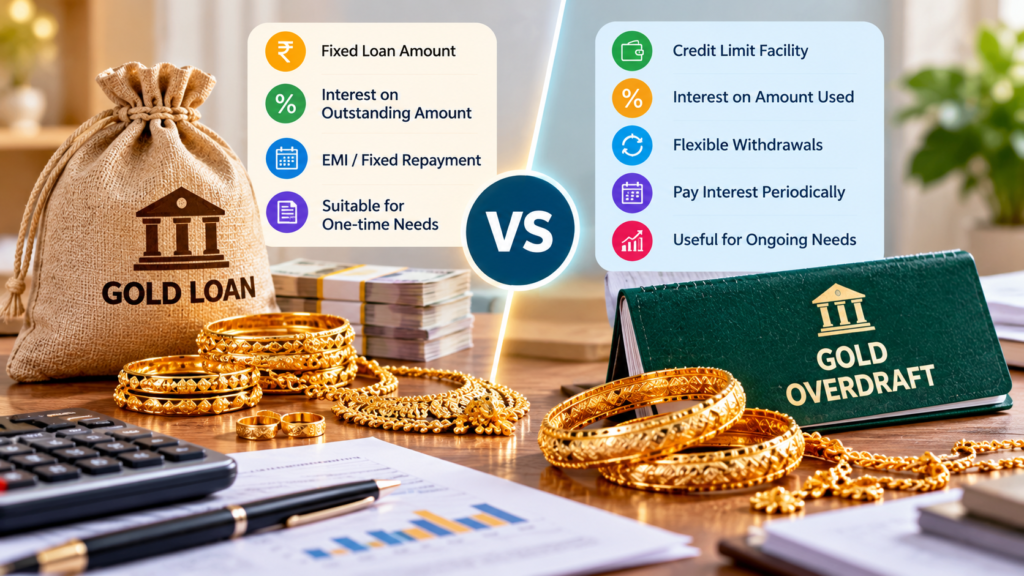
However, not every gold-backed borrowing facility works in the same way. A traditional gold loan usually provides a specified loan amount, while a gold overdraft generally gives you an approved credit limit that you can use when needed.
This is where the gold loan vs gold overdraft comparison becomes important. Both options allow eligible borrowers to access funds by pledging acceptable gold assets, but their interest calculations, repayment arrangements, charges and suitability can differ.
In this guide, we will explain how gold loans and gold overdrafts work in India, compare their major features, look at a simple interest example, and discuss what to check before choosing either option.
What Is a Gold Loan?
A gold loan is a secured loan in which you pledge eligible gold jewellery or other permitted gold items to a bank or eligible lender in exchange for money.
The lender evaluates the eligible gold’s purity, net weight and value, then determines how much it can lend under its applicable policies and regulatory requirements. You receive an agreed loan amount and repay it according to the selected scheme.
Depending on the lender, repayment may be through monthly instalments, a permitted bullet-repayment arrangement, or another available structure.
Key features of a gold loan
- A defined loan amount: You receive the amount approved under the loan agreement.
- Gold as security: Your pledged gold remains with the lender until the applicable release conditions are met.
- Different repayment options: Some lenders offer EMI-based repayment, while others provide different repayment structures.
- Interest and fees: The total cost depends on the interest rate, repayment method, processing fees and other applicable charges.
- A fixed tenure or repayment schedule: The agreement explains when payments are due and when the loan must be repaid.
A gold loan may suit someone who knows approximately how much money is required and prefers a clearly defined borrowing arrangement.
What Is a Gold Overdraft Against Gold?
A gold overdraft is a credit facility secured by eligible gold. Instead of necessarily taking the entire sanctioned amount at once, you receive an approved overdraft limit and can withdraw money within that limit according to the facility’s terms.
For example, a lender may approve an overdraft limit of ₹2 lakh. If the facility permits flexible withdrawals, you might initially use ₹40,000 and access more later if another eligible expense arises.
Under products that charge interest only on the amount used, you would generally pay interest on the utilised amount rather than the entire sanctioned limit. However, the actual calculation, minimum interest, fees and account conditions must be checked in the lender’s agreement.
Key features of a gold overdraft
- Flexible access to funds: Withdraw money when needed, within the approved limit.
- Interest based on utilisation: Some products calculate interest on the amount actually used.
- Potentially reusable credit: You may be able to repay and withdraw again during the facility period, subject to the lender’s rules.
- Periodic interest payments: Many overdraft arrangements require interest to be serviced regularly.
- Specific account conditions: Renewal, minimum utilisation, drawing limits and repayment requirements may apply.
A gold overdraft can be useful when expenses arise at different times or when the exact amount required is uncertain.
Gold Loan vs Gold Overdraft: Key Differences
The biggest difference is how you access the money and how you manage repayment. A regular gold loan is often suitable for a known borrowing requirement, whereas a gold overdraft is designed to provide access to funds within a sanctioned limit.
| Feature | Gold loan | Gold overdraft |
|---|---|---|
| How funds are accessed | Usually disbursed as an approved loan amount | Withdrawn as required within an approved limit |
| Interest calculation | Depends on the loan scheme and outstanding balance | Often based on the utilised amount, depending on the product |
| Repayment | EMI, bullet repayment or another permitted structure | Commonly periodic interest payments plus repayment of principal under the agreement |
| Repeated withdrawals | Usually not the main purpose of a standard term loan | May be allowed within the available limit |
| Best suited for | A specific, known expense | Changing or recurring funding needs |
| Cost considerations | Interest, processing and other applicable fees | Interest on usage, facility fees and other applicable charges |
| Financial discipline | Scheduled repayments can make budgeting easier | Flexible access requires careful control of withdrawals |
| Gold release | After applicable dues and release conditions are satisfied | Depends on closure, outstanding dues and the lender’s release rules |
Important: A lender may offer a gold loan with overdraft features or use different product names for similar facilities. Always compare the actual agreement rather than relying on the product name alone.
Gold Loan Interest Rates vs Gold Overdraft Interest Rates
Interest rates are one of the first things borrowers compare. However, the lowest advertised rate does not always mean the lowest total borrowing cost.
The rate offered may depend on the lender, scheme, loan amount, gold valuation, tenure, repayment method, customer eligibility and prevailing lending terms. Rates can also change over time.
A conventional gold loan may have a competitive rate, while a gold overdraft may offer a different rate in exchange for flexible access to money. Neither option is automatically cheaper in every situation.
How interest works on a gold loan
For an EMI-based loan, the monthly instalment generally includes principal and interest. As the principal is repaid, the outstanding balance usually reduces, affecting subsequent interest calculations.
Other gold loan schemes may collect interest differently. For example, a bullet-repayment arrangement may require principal and interest at maturity or according to the scheme’s stated terms. Borrowers should not assume that every gold loan has the same repayment structure.
How interest works on a gold overdraft
Suppose your lender approves a gold overdraft limit of ₹2 lakh, but you use only ₹50,000. If the product charges interest only on the utilised amount and has no additional minimum-interest requirement, interest would generally be calculated on that ₹50,000 rather than the full ₹2 lakh.
If you later withdraw another ₹30,000, the utilised amount becomes ₹80,000. Your interest cost may increase accordingly.
This can make an overdraft useful for borrowers who need money in stages. But if you use most of the limit for a long period, the interest savings may be smaller than expected.
Do not compare rates without checking the terms
Before applying, ask both lenders for the following information:
- The applicable annual interest rate and whether it is fixed or variable.
- How interest is calculated and how often it is charged.
- Whether interest is charged on the disbursed amount, outstanding balance or utilised overdraft amount.
- Whether minimum interest, commitment fees or maintenance charges apply.
- The total processing fee and applicable taxes.
- The repayment and renewal conditions.
- Any prepayment, foreclosure or account-closure charges.
- The consequences of missing payments or failing to repay at maturity.
For current rates and product terms, consult the lender’s official website or branch. For example, you can review State Bank of India’s personal gold loan information and Federal Bank’s gold overdraft information. These are examples of product information, not a recommendation to choose either lender.
Gold Loan vs Gold Overdraft: Charges You Should Compare
Interest is only one part of the total cost. Charges can differ considerably between lenders and even between two products offered by the same lender.
1. Processing fee
Some lenders charge a fee for processing the application. It may be a percentage of the loan amount or a fixed amount, depending on the scheme.
Check whether the quoted fee includes taxes and whether it is deducted from the disbursed amount or collected separately.
2. Gold valuation or appraisal charges
The lender must assess the eligible gold before determining the loan amount. A valuation or appraisal charge may apply. Ask whether this charge is payable upfront, added to the account or collected in another way.
3. Documentation and statutory charges
Stamp duty and other applicable charges may depend on the lender, transaction and state. Ask for an itemised estimate instead of assuming these costs are included in the advertised interest rate.
4. Renewal charges
If your facility allows renewal, a fee may apply when the loan or overdraft is renewed. Renewal is not necessarily automatic, and approval may depend on the lender’s policy and your account status.
5. Late-payment or overdue charges
Missing a scheduled payment can lead to additional charges or other consequences under the agreement. In an overdraft, failing to service interest can also cause the account to become overdue.
6. Prepayment and foreclosure charges
Some products permit early repayment without a penalty, while others may impose charges in specified circumstances. Check the exact conditions before signing.
7. Charges connected with default
If the borrower does not repay as agreed, the lender may take recovery action and may eventually sell the pledged gold in accordance with applicable law, regulatory requirements and the loan agreement. Understand the notice process and how any surplus or shortfall is handled.
A useful tip: Ask for a written list of all charges and a repayment illustration. Comparing the total rupee cost for the same borrowing amount and period is more helpful than comparing interest rates alone.
Example: How Much Interest Could You Pay?
Let’s compare a simple hypothetical example to understand why the amount you actually use matters.
Assume a lender offers a gold overdraft with an annual interest rate of 12%, calculated on the amount utilised. Assume there are no additional charges or minimum-interest conditions for this illustration.
If you use ₹50,000 for one full year and the balance remains unchanged:
Illustrative interest = ₹50,000 × 12% = ₹6,000 for one year.
Now imagine that the lender has sanctioned a limit of ₹2 lakh, but you use only ₹50,000 throughout the year. Under the stated assumptions, the interest would still be calculated on ₹50,000, not the unused ₹1.5 lakh.
If you used the full ₹2 lakh for a full year at the same rate, the simple-interest illustration would be ₹24,000.
These figures are examples, not actual offers or a comparison of specific lenders. Real interest may be calculated daily or monthly, the utilised balance may change, and additional fees or repayment rules may affect the final cost.
A conventional gold loan cannot be compared fairly using this simple calculation unless its interest rate, outstanding balance and repayment structure are also specified.
Benefits of a Gold Loan
A gold loan may be a practical option when you need a defined amount and have a repayment plan.
1. Suitable for a specific expense
If you know you need ₹75,000 for a planned expense, a conventional loan with a defined disbursement and repayment schedule may be easier to manage than an open credit limit.
2. Structured repayment
An EMI-based scheme can help you plan your monthly budget. You know when payments are due and can track the outstanding loan balance.
3. Access to funds without selling gold
Pledging eligible gold can provide temporary liquidity without permanently selling jewellery. You must still repay the loan to recover your pledged assets.
4. Multiple scheme options
Depending on the lender, you may be able to choose among different repayment methods and tenures. Compare their total cost and repayment obligations before selecting one.
5. Potentially straightforward assessment
Gold-backed lending may not follow exactly the same process as an unsecured personal loan. Nevertheless, lenders have their own identity, eligibility, valuation and documentation requirements.
Benefits of a Gold Overdraft
A gold overdraft may be useful when your funding needs change over time.
1. Withdraw only what you need
If the facility charges interest only on the amount used, you may avoid paying interest on the unused part of your approved limit.
2. Support for irregular expenses
A self-employed person or small business owner may have expenses at different points in the month. Subject to the facility’s rules, an overdraft can provide access to funds when required.
3. Potentially reusable credit
Some facilities allow borrowers to repay part of the amount and draw again within the available limit during the approved period. Confirm whether this feature applies to your product.
4. More flexibility in managing cash flow
An overdraft can be convenient when you cannot predict the exact timing of every expense. However, convenience does not remove the need to repay principal and service interest on time.
5. Less need to borrow the full amount immediately
A sanctioned limit can act as a source of short-term liquidity without requiring you to draw the entire amount on day one. Whether this creates savings depends on the interest calculation and fees.
Gold Loan vs Gold Overdraft: Which Is Better for Different Situations?
The right option depends on how you intend to use the money, how long you expect to borrow and how reliably you can repay it.
Choose a gold loan if you need a fixed amount
A regular gold loan may be suitable when:
- You know the exact amount required.
- You prefer a defined repayment schedule.
- You can afford the agreed EMI or other scheduled payment.
- You want to avoid repeatedly withdrawing money from a credit facility.
- The total cost of the available loan scheme is competitive.
For example, if you need ₹1 lakh to cover a one-time home repair and have enough monthly income for the agreed repayments, a structured gold loan may be easier to budget for.
Consider a gold overdraft if you need flexible access
A gold overdraft may be worth considering when:
- You expect several expenses over a period of time.
- You are unsure exactly how much money you will need.
- The lender allows repeated withdrawals and repayments.
- Interest is calculated on the amount used, on terms that suit your borrowing pattern.
- You can keep track of withdrawals and repay the outstanding amount responsibly.
For example, a small business owner may need ₹25,000 for supplies today and another ₹40,000 a few weeks later. A suitable overdraft may provide more flexibility than borrowing the entire amount at the beginning.
When neither option may be suitable
Think carefully before pledging family jewellery for an expense that is not essential, especially if you have no realistic repayment plan. Compare other affordable funding options where available.
If you are already struggling with debt, taking another loan may worsen the problem. Review your existing obligations and consider speaking with a qualified financial adviser before committing.
Eligibility and Documents Required
Eligibility requirements vary by lender and product. You should check the official scheme details before visiting a branch or starting an online application.
Common requirements may include:
- Identity proof accepted by the lender.
- Address proof, where required.
- PAN or other tax-related information, where applicable to the transaction.
- Eligible gold jewellery or other gold assets permitted under the scheme.
- A completed application and required declarations.
- Additional documentation based on the loan amount, purpose or lender’s policy.
The lender will generally examine the gold’s purity and eligible net weight before deciding the value for lending purposes. The jewellery’s original purchase price, making charges and sentimental value do not necessarily determine how much you can borrow.
Do not assume that every lender accepts gold coins or every form of gold. Check the specific product’s rules.
For general regulatory information, visit the Reserve Bank of India website. You can also read the RBI’s published Directions on Lending Against Gold and Silver Collateral and confirm the latest applicable version and requirements.
Risks of Pledging Gold for a Loan or Overdraft
Gold-backed borrowing can provide useful short-term funds, but it is not risk-free.
Your gold is at risk if you do not repay
The pledged jewellery is security for the loan. If you default, the lender may initiate recovery proceedings and may auction the gold after following applicable requirements and contractual procedures.
Interest can accumulate
An overdraft may feel convenient because funds are available when needed. However, leaving a balance unpaid for a long time can increase the total interest paid.
A large sanctioned limit can encourage overspending
Having access to more money does not mean you need to use it all. Withdraw only what is necessary and maintain a clear repayment plan.
Gold prices can change
Lenders determine eligible borrowing amounts under their valuation methods and applicable rules. Changes in gold prices or other account conditions may affect the lender’s requirements under the agreement.
Missed payments can create further problems
Overdue amounts may lead to additional charges, recovery action or difficulties closing or renewing the facility. Ask the lender what happens if you cannot pay on time.
Before pledging family jewellery, discuss the risks with anyone who has a legitimate interest in the asset and make sure you understand the agreement.
How to Choose the Right Gold Loan or Gold Overdraft
Before making a final decision, use this practical checklist.
- Calculate your actual requirement. Borrow only what you reasonably need.
- Compare annual interest rates. Check whether rates are fixed, variable or scheme-dependent.
- Understand the interest calculation. Ask whether interest applies to the disbursed amount, outstanding balance or utilised overdraft balance.
- Compare all charges. Include processing, valuation, renewal, taxes and closure-related costs.
- Review repayment rules. Confirm the EMI, interest-payment dates, principal repayment deadline and available repayment methods.
- Check the tenure and renewal conditions. Do not assume the lender will automatically extend the facility.
- Ask about default and auction procedures. Understand the steps that may be taken if repayment is delayed.
- Use a realistic budget. Make sure you can repay without depending on uncertain future income.
- Read the final documents. Keep a copy of the sanction letter, terms, receipts and information about your pledged gold.
It can help to request written quotations from two or three regulated lenders and compare them for the same loan amount and expected borrowing period.
Frequently Asked Questions
1. What is the main difference between a gold loan and a gold overdraft?
A conventional gold loan generally provides an approved loan amount with a defined repayment structure. A gold overdraft generally provides a credit limit that can be used as needed. Interest calculation and repayment rules depend on the specific product.
2. Is a gold overdraft cheaper than a gold loan?
Not always. An overdraft may save interest when you use only a small part of the limit and the lender charges interest only on the amount utilised. Fees, minimum-interest rules, rates and the length of borrowing can change the outcome.
3. Do I pay interest on the full sanctioned gold overdraft limit?
Some products charge interest only on the amount utilised, rather than the full sanctioned limit. However, you should confirm the exact calculation, minimum charges and other conditions in the lender’s current terms.
4. Can I withdraw money multiple times from a gold overdraft?
Some overdraft products permit repeated withdrawals and repayments within the approved limit. The facility may have restrictions on withdrawals, account operation, renewal or available balance, so check the product agreement.
5. Can I repay a gold loan early?
Early repayment is permitted under many products, but charges or conditions may apply. Confirm the lender’s current part-payment and foreclosure rules before borrowing.
6. Which option is better for a salaried person?
A gold loan may suit a salaried borrower who needs a specific amount and prefers structured monthly repayments. A gold overdraft may suit someone who needs flexible access to funds. Income alone does not determine which option is better; compare costs and repayment ability.
7. Which option is better for a small business?
A gold overdraft may be useful when business expenses arise at different times and the facility permits flexible withdrawals. A conventional gold loan may be more suitable for a single, clearly defined expense. Compare the terms and borrow only for a manageable purpose.
8. Can I get a gold loan without a high credit score?
Gold-backed loans are secured by pledged assets, but lenders may still apply their own eligibility, identity verification and credit assessment policies. Approval is not guaranteed, so confirm the requirements directly with the lender.
9. What happens if I cannot repay my gold loan?
The lender may contact you about overdue payments and pursue recovery under the agreement and applicable law. If the default continues, the pledged gold may eventually be auctioned after the required procedures. Contact the lender as soon as possible if you expect repayment difficulties.
10. Can I get my gold back before the loan tenure ends?
You may be able to release your gold after settling the applicable outstanding dues and completing the lender’s release procedure. Check whether part-release is allowed and whether any charges apply.
11. Is a gold overdraft the same as a credit card?
No. A gold overdraft is a credit facility secured by pledged gold, whereas a conventional credit card is generally an unsecured revolving credit product. Their eligibility, charges, repayment rules and consequences of default differ.
12. How much can I borrow against my gold?
The amount depends on the lender’s valuation of eligible gold, its purity and net weight, the applicable loan-to-value limit, the scheme and regulatory requirements. Do not assume that you will receive the full market value of your jewellery.
Final Verdict: Gold Loan vs Gold Overdraft
The choice between a gold loan and a gold overdraft comes down to your borrowing needs and repayment habits.
A gold loan may be the better fit when you need a known amount and prefer a defined repayment plan. A gold overdraft may be more useful when you need flexible access to funds and expect to use the money in stages.
Neither option is automatically cheaper or safer for every borrower. Compare the interest calculation, all applicable charges, repayment conditions and the risk to your pledged gold before signing the agreement.
Most importantly, borrow with a clear plan to repay. Gold may be a valuable family asset, so the convenience of quick access to money should always be balanced against the responsibility of protecting it.
SHARING IS CARING 💖