
Aluminum foil is a common kitchen item. People use it to cover baking trays, wrap vegetables, cook fish, protect food from direct heat, and make cleaning up easier. It is convenient, inexpensive, and useful for many everyday cooking tasks.
However, using aluminum foil for every baking recipe may not be the best choice. Depending on the food, temperature, and cooking method, small amounts of aluminum can transfer from the foil into the food. Foil can also affect browning, stick to certain foods, and create unnecessary waste when used for tasks that could be handled by reusable cookware.
Does this mean you should stop using aluminum foil completely? Not necessarily. The key is understanding when foil is suitable, when another material is a better option, and how to use it correctly.
In this guide, we explain the disadvantages of using aluminum foil for baking, what is known about potential health risks, common mistakes to avoid, and practical alternatives for your kitchen.
What Is Aluminum Foil Used for in Baking?
Aluminum foil is a thin sheet of metal commonly used in kitchens for wrapping and covering food. It can help retain moisture, shield the surface of a dish from excessive browning, and make certain cooking tasks more convenient.
For example, people often cover a casserole with foil to prevent the top from browning too quickly. Foil is also used to wrap potatoes or vegetables and to cover leftovers.
Although these uses can be convenient, foil is not the best choice for every recipe. Its suitability depends on the food, the cooking temperature, the oven instructions, and whether the foil could come into contact with an oven’s heating elements.
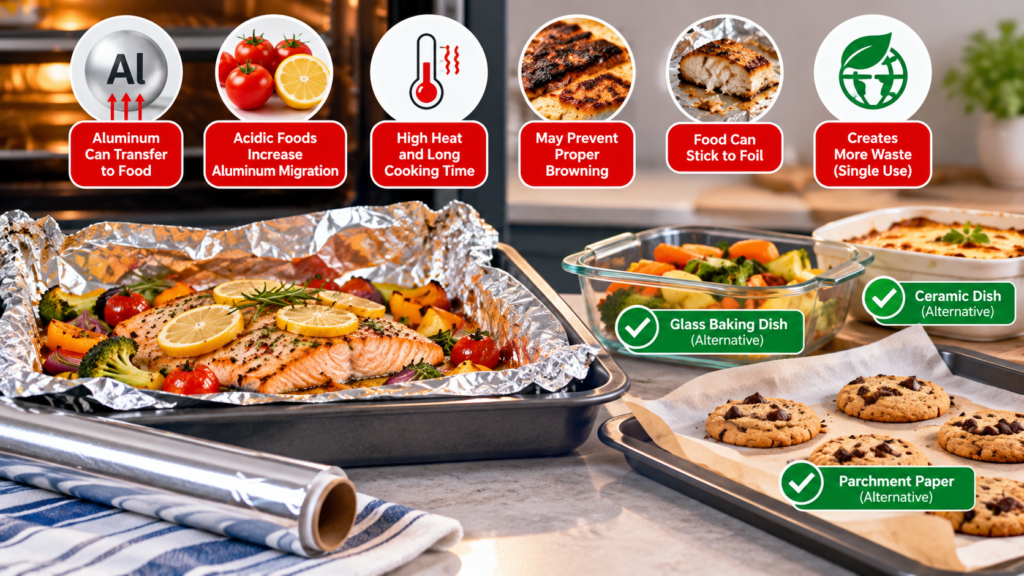
1. Aluminum Can Transfer Into Food
One of the main concerns about using aluminum foil for baking is the possibility of aluminum transferring into food during cooking.
This process is sometimes called aluminum migration. It does not mean that every food baked in foil contains a dangerous amount of aluminum. Rather, the amount transferred can vary depending on several conditions.
Factors that can increase aluminum migration include:
- Acidic ingredients, such as tomatoes, lemon juice, and vinegar.
- Salty foods or recipes containing a high amount of salt.
- Long cooking or storage times in contact with foil.
- Certain temperatures and cooking conditions.
- The composition of the food and how it contacts the foil.
For example, wrapping a lemon-marinated fish fillet tightly in foil for cooking may result in more aluminum transfer than using foil to loosely cover a relatively dry, non-acidic dish.
This is a reason to choose another cooking material for some recipes, not proof that ordinary foil use is always harmful.
2. Acidic Foods Are Not the Best Match for Direct Foil Contact
Acidic ingredients can react with aluminum, increasing the likelihood of aluminum entering the food.
Common examples include:
- Tomato-based sauces.
- Lemon or lime marinades.
- Vinegar-based dishes.
- Foods prepared with acidic fruit juices.
- Recipes containing both acidic ingredients and substantial amounts of salt.
Suppose you are baking fish with lemon juice, tomatoes, and salt. Instead of wrapping the ingredients directly in aluminum foil, you could cook them in an oven-safe glass or ceramic dish.
The alternative should be suitable for the oven temperature and cooking method. A covered baking dish can also help retain moisture without requiring direct contact between the food and foil.
3. High Heat and Long Cooking Times Require Care
Temperature and cooking duration can affect how much aluminum transfers into food. However, there is no single temperature at which all aluminum foil suddenly becomes unsafe.
The food’s composition, the surface area in contact with the foil, moisture, and other conditions also matter.
If a recipe involves prolonged cooking with acidic or salty ingredients, consider using an appropriate oven-safe dish instead of wrapping the food directly in foil.
Always follow the foil manufacturer’s instructions and the oven manufacturer’s guidance. Avoid placing foil where it could touch heating elements or interfere with the oven’s airflow.
4. Aluminum Foil May Affect Food Browning
Foil reflects heat and acts as a barrier between food and the surrounding oven environment. When you cover a dish tightly, steam may become trapped, leaving the surface softer rather than crisp.
This can be useful when you want to keep a casserole moist, but it may be undesirable for foods that need a crisp, browned surface.
For example:
- Roasted vegetables may become softer when covered for too long.
- A pie crust may not brown properly if covered throughout baking.
- Baked potatoes may have softer skin when wrapped in foil.
- Cookies and pastries generally need an appropriate baking tray rather than being placed directly on loose foil.
If you want a golden, crisp finish, bake uncovered when the recipe calls for it. You can also use an oven-safe baking dish or a suitable baking tray.
5. Food Can Stick to Aluminum Foil
Another common inconvenience is food sticking to foil. This may happen with delicate fish, cheese, sugary marinades, or foods that release moisture and then develop a sticky surface.
Trying to remove stuck food can tear the foil and leave small pieces attached to the meal.
To reduce sticking, use a suitable baking dish, a compatible non-stick baking tray, or parchment paper where the recipe and oven instructions permit it.
Do not assume that parchment paper can withstand every oven temperature. Check its packaging, and keep it away from heating elements and open flames.
6. Foil Is Not a Substitute for Every Baking Material
Aluminum foil is flexible, but it does not provide the same performance as every other cooking material.
For example, foil is not ideal for every baking task that requires a stable, reusable surface. It can wrinkle, tear, or shift, and it may not support delicate foods as reliably as a proper baking tray.
A glass or ceramic baking dish can be a better choice for casseroles and many acidic dishes. A metal baking tray is often more suitable for cookies and roasted vegetables. Parchment paper can help reduce sticking on compatible trays.
The best choice depends on the recipe rather than a blanket rule that one material is always better.
7. Aluminum Foil Can Be Damaged or Torn
Because kitchen foil is thin, it can tear when handling heavy food, sharp bones, or food with rough edges. Torn foil may make it difficult to remove a dish cleanly and can leave fragments attached to the food.
Inspect wrapped food before serving, particularly if the foil has torn during cooking.
For dishes that are heavy, saucy, or likely to shift, a stable oven-safe dish is usually more convenient than a thin foil packet.
8. Foil Can Cause Problems if Used Incorrectly in an Oven
Aluminum foil is commonly used in cooking, but its placement matters.
Incorrect use can interfere with airflow or heat distribution in some ovens. Foil placed on the oven floor may trap heat, damage surfaces, or affect the appliance’s performance. Contact with heating elements can also create hazards.
Follow your oven’s manual. Do not line the oven floor or cover vents with foil unless the manufacturer explicitly permits the practice.
Foil should never be allowed to touch an electric heating element. If your oven has specific instructions about foil, follow those instructions instead of a general online tip.
9. Single-Use Foil Creates More Kitchen Waste
Aluminum can be recycled in many places, but local recycling systems differ. Foil that is heavily contaminated with grease or food residue may not be accepted in some collection programmes.
Repeatedly using fresh foil for tasks that could be completed with reusable cookware can increase household waste.
Reusable baking trays, glass dishes, and ceramic cookware can reduce the need for disposable foil in many situations. They also make sense for recipes that are prepared regularly.
If you do use foil, check your local recycling guidance to see whether clean aluminum foil is accepted.
10. Does Aluminum Foil Cause Health Problems?
This is an important question, and the answer needs some context.
Aluminum is naturally present in the environment and can enter the diet through different sources, including food, water, and some food-contact materials. Using aluminum foil can add to dietary exposure under certain cooking conditions.
However, the presence of aluminum in food does not automatically mean that a person will become ill. Health risk depends on the amount of exposure, how often it occurs, and other factors.
The European Food Safety Authority (EFSA) has established a tolerable weekly intake for aluminum from all dietary sources. This is a reference for evaluating exposure, not a line that can be used to declare every meal cooked in foil safe or unsafe.
People with specific medical concerns should ask a qualified healthcare professional for individual advice rather than relying on claims circulating online.
For everyday cooking, a sensible approach is to avoid unnecessary direct foil contact with highly acidic or salty foods, use suitable cookware, and follow official food-safety guidance.
Is Aluminum Foil Safe for Baking?
For many ordinary baking tasks, aluminum foil can be used when the product and oven instructions permit it. It can help cover food, reduce surface browning, or wrap ingredients for cooking.
The concern is not that foil is universally dangerous. It is that certain foods and cooking conditions can increase aluminum transfer, and incorrect foil placement can create oven-related problems.
Here is a practical guide:
| Cooking task | Practical choice |
|---|---|
| Covering a casserole briefly | Foil may be suitable if the oven manual permits it |
| Baking tomato-based dishes | An oven-safe glass or ceramic dish can avoid direct foil contact |
| Cooking lemon-marinated fish | Use a suitable oven-safe dish or another approved method |
| Baking cookies | Use a suitable baking tray, with parchment if appropriate |
| Roasting vegetables | A metal baking tray or oven-safe dish is often convenient |
| Covering a dish to reduce browning | Foil may be suitable when placed correctly |
| Lining the oven floor | Avoid unless the oven manufacturer explicitly allows it |
The safest choice depends on the specific recipe, cookware, and appliance instructions.
Better Alternatives to Aluminum Foil for Baking
You do not need to eliminate foil from your kitchen to make more suitable choices. Instead, keep a few alternatives available for different recipes.
1. Oven-Safe Glass Dishes
Glass baking dishes are useful for casseroles, vegetables, baked pasta, and many dishes containing tomato or lemon-based sauces.
Advantages:
- Suitable for many wet or acidic recipes when the dish is rated for oven use.
- Reusable and easy to clean.
- Allows you to see the food through the sides.
Precautions:
- Use only cookware labelled as oven-safe.
- Avoid sudden temperature changes, which can cause thermal shock.
- Follow the manufacturer’s temperature and handling instructions.
Not every glass container is designed for baking. Ordinary food-storage glass should not automatically be treated as oven-safe.
2. Ceramic Baking Dishes
Oven-safe ceramic dishes are another useful option for casseroles, vegetables, baked pasta, and other dishes that benefit from even, contained cooking.
Advantages:
- Reusable.
- Useful for dishes containing acidic ingredients.
- Available in many shapes and sizes.
Precautions:
- Confirm that the dish is oven-safe.
- Follow the manufacturer’s temperature limits.
- Avoid sudden temperature changes.
Ceramic cookware can be a good replacement for foil when you need a sturdy dish rather than a disposable covering.
3. Parchment Paper
Parchment paper is useful for lining baking trays, helping reduce sticking, and making cleanup easier.
Advantages:
- Useful for cookies, pastries, and many baked vegetables.
- Helps prevent food from sticking to compatible trays.
- Convenient for many low-mess baking tasks.
Precautions:
- Check the maximum temperature printed on the package.
- Keep it away from heating elements and open flames.
- Do not assume that wax paper is a safe substitute for oven parchment.
Parchment paper is not intended for every cooking method, especially methods involving direct flame or temperatures above its specified limit.
4. Reusable Metal Baking Trays
A suitable metal baking tray is often the simplest option for cookies, roasted vegetables, and other foods that benefit from browning.
Advantages:
- Reusable.
- Stable and easy to handle.
- Available in different sizes for different recipes.
Precautions:
- Use a tray suitable for the recipe and oven temperature.
- Follow the manufacturer’s instructions for non-stick coatings.
- Avoid scratching or overheating coated cookware.
5. Silicone Baking Mats
Food-grade silicone baking mats designed for oven use can be useful for cookies and other items baked on a flat tray.
Advantages:
- Reusable.
- Can reduce sticking.
- May reduce the need for disposable tray liners.
Precautions:
- Use only mats rated for the required oven temperature.
- Place the mat on a suitable tray if instructed.
- Do not cut food directly on the mat or use it near a flame.
Silicone mats are not a universal substitute for foil, especially when a recipe requires wrapping food or covering a dish.
Practical Tips for Using Aluminum Foil More Safely
If you choose to keep using aluminum foil, these habits can help you use it more appropriately.
- Avoid direct contact between foil and highly acidic or salty foods during prolonged cooking when another suitable option is available.
- Use oven-safe dishes for recipes with tomato, vinegar, lemon, or other acidic ingredients.
- Follow the foil packaging and oven manufacturer’s instructions.
- Keep foil away from heating elements and avoid lining the oven floor unless explicitly permitted.
- Do not use foil as a substitute for proper cookware when a stable baking surface is needed.
- Inspect foil-wrapped food if the foil tears during cooking.
- Choose reusable cookware when it is more practical.
- Follow local recycling rules for used aluminum foil.
These are practical precautions, not evidence that every use of foil creates a health hazard.
Common Myths About Aluminum Foil
Myth 1: Aluminum foil is always poisonous
This is an overstatement. Aluminum can migrate into food, but exposure varies according to the ingredients and cooking conditions. Ordinary use should be assessed in context rather than described as automatically dangerous.
Myth 2: All food cooked in foil becomes unsafe
Not true. Foil is used in many cooking applications. The type of food, duration of contact, temperature, and correct use all matter.
Myth 3: Parchment paper is always safer for every recipe
No single material is ideal for every task. Parchment paper has temperature limits and is unsuitable for some cooking methods. Choose cookware designed for the intended use.
Myth 4: Replacing foil will automatically make food healthier
Changing the cooking material does not automatically make a meal healthier. Ingredient choices, portion sizes, overall diet, and cooking method also matter.
Frequently Asked Questions (FAQs)
1. What are the disadvantages of using aluminum foil for baking?
Potential disadvantages include aluminum transfer into certain foods, poor browning when food is tightly covered, sticking or tearing, and waste from single-use applications. Incorrect placement in an oven can also create appliance-related problems.
2. Is aluminum foil dangerous when heated in an oven?
Aluminum foil can be used for many oven tasks when the product and appliance instructions permit it. Avoid contact with heating elements and do not line the oven floor unless the manufacturer specifically allows it.
3. Does aluminum foil release aluminum into food?
Small amounts of aluminum can transfer into food, with migration affected by factors such as acidity, salt, temperature, and cooking duration. The amount varies, so it is not accurate to say that every foil-cooked meal contains a harmful amount.
4. Can I bake tomato-based food in aluminum foil?
Because tomato-based foods are acidic, an oven-safe glass or ceramic dish is a practical alternative to direct foil contact, especially for longer cooking periods.
5. Is parchment paper better than aluminum foil for baking?
Parchment paper is often useful for lining baking trays and preventing sticking. Foil is useful for covering or wrapping food. The better choice depends on the recipe, oven temperature, and product instructions.
6. Can aluminum foil cause Alzheimer’s disease?
Research has not established that ordinary household aluminum foil use causes Alzheimer’s disease. Avoid relying on social media claims that make a definite causal connection without reliable scientific evidence.
7. Can I use aluminum foil in an air fryer?
Only if the air-fryer manufacturer permits it and the foil can be secured without blocking airflow or contacting the heating element. Never place loose foil where it could be pulled into a heating component.
8. Can aluminum foil be recycled after baking?
Recycling rules vary by location. Foil may need to be reasonably clean and free of substantial food residue. Check your local recycling programme for accepted materials.
9. Is glass cookware a good alternative to aluminum foil?
Oven-safe glass can be a good choice for casseroles and acidic dishes. Use only glassware designed for oven temperatures and avoid sudden temperature changes.
10. Should I stop using aluminum foil completely?
Most people do not need to eliminate foil entirely based on these concerns. A balanced approach is to use it when suitable, avoid unnecessary direct contact with acidic or salty foods during long cooking, and choose reusable cookware when practical.
Final Thoughts
Aluminum foil is convenient, but it is not the perfect choice for every baking recipe. Its main disadvantages include the possibility of aluminum transfer into certain foods, less effective browning when food is covered, sticking or tearing, and unnecessary single-use waste.
For tomato-based dishes, lemon-marinated foods, and recipes involving long cooking times, an oven-safe glass or ceramic dish may be a more suitable choice. Parchment paper and reusable baking trays can also help with everyday baking.
You do not need to panic or throw away every roll of foil in your kitchen. Understand the conditions that matter, follow your oven and cookware instructions, and choose the material that best suits the recipe.
Disclaimer: This article provides general food and kitchen-safety information, not individual medical advice. For health concerns or questions about personal aluminum exposure, consult a qualified healthcare professional and rely on recognised food-safety authorities.
SHARING IS CARING 💖