
Do you remember the days when homes commonly used traditional 100-watt light bulbs? Today, many households have replaced those old bulbs with modern 9W or 10W LED lights. LEDs are designed to provide useful brightness while consuming much less electricity.
Yet many people still say something interesting: “Our electricity bill seemed lower in the past. We used 100W bulbs back then, but now we use 10W LED bulbs and still pay more.”
At first, this sounds confusing. If a 10W LED consumes much less electricity than a 100W bulb, shouldn’t the electricity bill automatically become lower?
The answer lies in understanding how electricity consumption works. Your electricity bill depends on more than just the bulbs in your home. Electricity rates, the number of appliances you use, how long you run them, and changes in household habits can all make a difference.
In this article, we will compare old 100W bulbs with modern 10W LED bulbs, calculate their electricity costs, and explain why your total bill might still be higher today.
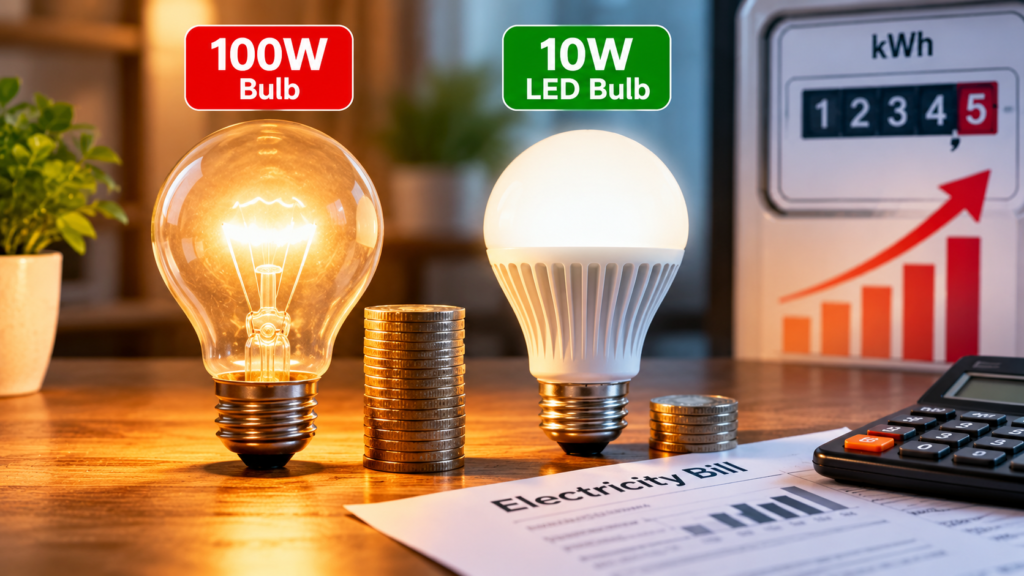
100W Bulb vs 10W LED: What Is the Difference?
The first thing to understand is that watts measure how much electrical power a device uses. A 100W incandescent bulb uses approximately 100 watts while operating, whereas a 10W LED uses approximately 10 watts.
If both bulbs run for the same number of hours, the 100W bulb consumes ten times as much electricity.
| Feature | Traditional 100W incandescent bulb | Modern 10W LED bulb |
|---|---|---|
| Power consumption | 100 watts | 10 watts |
| Electricity use per hour | 0.1 kWh | 0.01 kWh |
| Electricity use in 5 hours | 0.5 kWh | 0.05 kWh |
| Electricity use in 10 hours | 1 kWh | 0.1 kWh |
| Heat produced | Much more | Generally much less |
| Energy efficiency | Low | High |
A kilowatt-hour (kWh) is the standard unit used to measure electrical energy. In India, it is commonly called one electricity unit.
The US Department of Energy explains that LED bulbs use substantially less energy than traditional incandescent bulbs while providing comparable light output when the products are appropriately matched. Read the Department of Energy’s explanation of energy-efficient lighting.
This means that, when comparing bulbs of similar brightness and equal operating time, the LED is normally the more economical choice.
How Much Electricity Does a 100W Bulb Consume?
Let’s use a simple example.
Imagine that your home has one traditional 100W bulb, and you keep it switched on for eight hours every day.
The calculation is:
Electricity consumed = Wattage × Hours used ÷ 1,000
For a 100W bulb:
100 × 8 ÷ 1,000 = 0.8 units per day.
Over 30 days:
0.8 × 30 = 24 units per month.
Now compare that with a 10W LED bulb used for the same eight hours every day.
10 × 8 ÷ 1,000 = 0.08 units per day.
Over 30 days:
0.08 × 30 = 2.4 units per month.
The difference is substantial. The traditional bulb consumes 24 units per month, while the LED consumes just 2.4 units under these assumptions.
That is a saving of 21.6 electricity units per month for one bulb, before considering the rest of your home’s electricity consumption.
How Much Money Can You Save With a 10W LED?
Let’s assume your electricity rate is ₹8 per unit. This is only an illustrative rate; your actual tariff may be different.
| Calculation | 100W bulb | 10W LED |
|---|---|---|
| Monthly electricity use | 24 units | 2.4 units |
| Assumed rate per unit | ₹8 | ₹8 |
| Monthly energy cost | ₹192 | ₹19.20 |
| Annual energy cost | ₹2,304 | ₹230.40 |
Under these assumptions, replacing one 100W incandescent bulb with a 10W LED could reduce the electricity cost for that light by about ₹172.80 per month, or ₹2,073.60 per year.
These figures are estimates based on 8 hours of daily use for 30 days per month, a constant ₹8-per-unit rate, and no additional fixed charges or taxes. Actual savings depend on usage, bulb performance, and your tariff.
The Bureau of Energy Efficiency (BEE), Government of India provides information about energy efficiency and efficient lighting in Indian homes.
Then Why Does Your Electricity Bill Seem Higher Today?
If LEDs use less electricity, why do some households feel that their bills were lower years ago?
There is no single answer for every household. However, several factors can explain the difference.
1. Electricity Rates May Have Changed
One of the first things to check is the price you pay for each electricity unit.
Your bill may be affected by changes in the applicable tariff, fixed charges, fuel-related adjustments where applicable, taxes, or other charges set by your electricity provider and regulator.
Even if your household consumes the same number of units, a higher effective rate can increase the amount you pay.
For example, imagine a household uses 200 units in one billing period.
- At ₹6 per unit, the energy charge would be ₹1,200.
- At ₹8 per unit, the energy charge would be ₹1,600.
That is a ₹400 difference before fixed charges, taxes, subsidies, or other bill adjustments.
This is an illustration, not a claim about the tariff in any particular Indian state. Check your electricity bill and your distribution company’s official tariff schedule to understand the charges that apply to your connection.
2. We Use More Electrical Appliances Today
In the past, some households used fewer electrical appliances. A few lights, fans, a television, and basic kitchen appliances might have accounted for much of their electricity consumption.
Today, many homes use a wider range of devices, including:
- Air conditioners
- Refrigerators and freezers
- Washing machines
- Water heaters or geysers
- Microwaves and induction cooktops
- Desktop computers and televisions
- Water pumps
- Wi-Fi routers and other electronics
- Chargers and standby devices
These appliances do not all consume the same amount of electricity. Their contribution depends on their power rating, efficiency, operating time, and usage patterns.
An air conditioner running for several hours can have a much greater effect on a monthly bill than a single light bulb.
This is why switching to LED lighting can save energy without necessarily reducing the total bill if other electricity use increases.
3. Air Conditioners and Cooling Habits Can Make a Big Difference
Cooling is an important factor for many households, particularly during hot weather.
A family might run an air conditioner for longer hours than before, use multiple air conditioners, or cool more rooms. Those changes can increase electricity consumption considerably.
Even when an air conditioner is energy-efficient, its overall consumption depends on how often it operates, the temperature setting, the outdoor temperature, room insulation, maintenance, and the size of the unit.
For example, replacing several incandescent bulbs with LEDs may save electricity every day. But if air-conditioning use increases enough, those lighting savings may be smaller than the additional electricity consumed by cooling.
The solution is not to stop using necessary appliances. It is to understand which devices account for the largest share of your consumption and manage them sensibly.
4. Fans, Refrigerators, and Other Appliances Run for Long Periods
Some appliances operate for many hours each day.
A refrigerator cycles on and off to maintain its temperature. Fans may run throughout the night, while water pumps, televisions, and other equipment add to the total whenever they are used.
The electricity consumed by an appliance depends on its actual power use and operating time. A device with a relatively modest power rating can still contribute to the bill if it operates for long periods.
If your electricity bill has increased, look at the whole household rather than focusing only on lighting.
5. We May Be Using More Lights Than Before
LED bulbs are economical, but their low operating cost can encourage people to leave more lights switched on.
For example, a household might previously have used one light in a room but now leave several lights on in different rooms, outdoor areas, or decorative fixtures.
Even with low-power LEDs, the total consumption increases as the number of bulbs and hours of use increase.
Suppose ten 10W LED bulbs run for eight hours daily:
10 × 10 × 8 ÷ 1,000 = 0.8 units per day.
That equals 24 units in a 30-day month.
The same ten bulbs consume much less electricity individually than ten 100W incandescent bulbs, but the total still depends on how many lights are switched on and for how long.
6. The Brightness and Number of Bulbs May Have Changed
A watt rating tells you how much power a bulb uses, not how much visible light it produces.
Brightness is commonly measured in lumens. A modern LED can provide useful light output with much less electrical power than an incandescent bulb.
However, not all LEDs provide the same brightness. If you replace one old bulb with an LED that is too dim, you might install additional lights to compensate. That can reduce some of the expected savings.
When choosing a replacement, compare lumens as well as watts. The US Department of Energy’s guide to energy-efficient bulbs explains how light output and power requirements differ between technologies.
7. Seasonal Usage and Billing Periods Can Change the Total
Electricity consumption is rarely identical every month.
During hot months, fans and air conditioners may run for longer periods. In colder weather, households may use heaters or water heaters more frequently. Guests, school holidays, work-from-home arrangements, or changes in family routines can also affect usage.
Billing periods can differ in length as well. A bill covering more days may be higher even when average daily consumption has changed very little.
For a fair comparison, check the number of units consumed and the number of days covered by each bill rather than comparing only the final amount payable.
8. The Total Bill Includes More Than Energy Consumption
Depending on your electricity provider and tariff, the amount payable may include fixed charges, taxes, adjustments, subsidies, or other applicable items.
This means that a reduction in electricity consumption does not always translate into an equally large reduction in the final bill.
Review the bill’s detailed breakdown and compare it with previous bills. If the units have fallen but the amount payable has risen, changes in rates or other charges may help explain the difference.
If the figures are unclear, contact your electricity distribution company using the contact details on its official website or bill.
How to Check Whether Your Electricity Consumption Has Actually Increased
Instead of guessing, you can compare your recent bills.
Step 1: Compare the Number of Units
Find the total units consumed in your current bill and compare them with a previous bill covering a similar number of days.
If the unit consumption is higher, the household has used more metered electricity during that period, subject to meter readings and billing adjustments.
Step 2: Compare the Billing Period
Check the start date, end date, and total number of days. If one bill covers 35 days and another covers 28 days, their totals are not directly comparable.
You can calculate average daily consumption by dividing the billed units by the number of days.
Step 3: Review the Tariff and Other Charges
Compare the applicable rate, fixed charges, taxes, and other line items. Use your provider’s official tariff information for the relevant period.
Step 4: Check Your High-Consumption Appliances
Think about changes in air-conditioning, water heating, refrigeration, cooking, pumping, and other appliance use.
If you want a clearer picture, record the meter reading at consistent times and use an electricity monitor only where it is appropriate and safe.
Step 5: Investigate Unexplained Changes
If consumption rises sharply without an obvious reason, check the meter readings and contact your electricity provider. A qualified electrician can investigate suspected wiring or appliance problems. Do not open electrical panels or attempt unsafe electrical testing yourself.
Simple Ways to Reduce Your Electricity Bill
You do not need to return to old incandescent bulbs to manage electricity costs. In most cases, the more sensible approach is to keep efficient lighting and review the household’s overall electricity use.
Here are practical steps you can take:
- Use efficient LED bulbs. Choose a suitable brightness and buy quality products from reliable sellers.
- Switch off lights when not needed. This is particularly useful in rooms that remain empty for long periods.
- Use air conditioners thoughtfully. Choose a comfortable setting, maintain filters, and avoid cooling unused spaces.
- Choose energy-efficient appliances. Compare efficiency labels and expected running costs before purchasing.
- Avoid unnecessary standby consumption. Switch off equipment that does not need to remain powered, while keeping essential devices connected.
- Use washing machines and other appliances efficiently. Follow the manufacturer’s instructions and choose appropriate settings.
- Compare electricity bills regularly. Track both units consumed and the total amount payable.
- Investigate unusual increases. Check readings, usage patterns, and tariff changes before assuming an appliance is faulty.
For more information about efficient lighting and energy conservation in India, visit the Bureau of Energy Efficiency. For general information about household energy efficiency, the US Department of Energy’s Energy Saver resources are also useful.
Frequently Asked Questions
1. Does a 10W LED consume less electricity than a 100W bulb?
Yes. If both operate at their stated power ratings for the same amount of time, a 10W LED consumes one-tenth as much electricity as a 100W incandescent bulb.
2. Why is my electricity bill higher even after switching to LED bulbs?
Your bill may be higher because of increased appliance use, longer operating hours, changes in electricity rates, seasonal demand, or additional charges. Compare your units consumed and tariff details to identify the likely reason.
3. How many electricity units does a 100W bulb use in a month?
If one 100W bulb operates for eight hours daily for 30 days, it consumes approximately 24 kWh, or 24 electricity units.
4. How many units does a 10W LED use in a month?
If one 10W LED operates for eight hours daily for 30 days, it consumes approximately 2.4 units.
5. Can LED bulbs reduce my total electricity bill?
Yes, LEDs can reduce the portion of electricity used for lighting. The overall reduction depends on how much lighting contributes to your home’s total consumption and whether other electricity use changes.
6. Are all 10W LED bulbs equally bright?
No. Brightness depends on light output, measured in lumens, as well as the bulb’s design and light distribution. Compare lumens and the intended application when selecting a bulb.
7. Should I replace my LED bulbs with old 100W bulbs to save money?
No. A traditional 100W incandescent bulb normally uses substantially more electricity than a suitable 10W LED providing comparable light output. Returning to incandescent bulbs is not a sensible electricity-saving strategy.
8. What should I check first if my electricity bill suddenly increases?
Start by comparing the units consumed, billing period, meter readings, tariff, and detailed charges. Then consider whether your air-conditioning, water heating, or other appliance use has changed. Contact your provider if the increase remains unexplained.
Final Conclusion
The question of why electricity bills seemed lower in the days of 100W bulbs is understandable, but the bulb wattage alone cannot explain a household’s total bill.
A traditional 100W incandescent bulb consumes approximately ten times as much electricity as a 10W LED when both operate for the same number of hours. Replacing old bulbs with suitable LEDs is therefore a practical way to reduce lighting consumption.
If your electricity bill is higher today, the reason may be changing electricity rates, increased use of air conditioners and other appliances, more lighting hours, seasonal demand, or other charges.
The smartest approach is to compare the actual units consumed, review your bill carefully, and focus on the appliances and habits that contribute most to your household’s electricity use.
Remember: A lower-wattage bulb can reduce the electricity used for lighting, but your total bill depends on everything that consumes electricity in your home.
SHARING IS CARING 💖