
Have you ever come across a video showing someone putting a small ball of aluminum foil into a washing machine? At first, it looks like one of those strange household tricks that cannot possibly make a difference. Yet this simple idea has attracted attention from people looking for easier and cheaper ways to do their laundry.
Some people claim that aluminum foil balls help reduce static electricity, prevent clothes from sticking together, and make laundry easier to manage. Others believe the trick can replace fabric softeners or expensive laundry products.
But how much of this is actually true? And is it a good idea to put aluminum foil inside your washing machine?
The answer is more complicated than viral videos suggest. The idea is mainly associated with reducing static cling in a tumble dryer, while the benefits of placing foil balls inside a washing machine are uncertain. There are also practical safety concerns worth understanding before trying this trend.
In this guide, we will explain why people use aluminum foil balls, how the idea is supposed to work, what the potential benefits and risks are, and which alternatives may be more useful for your everyday laundry.
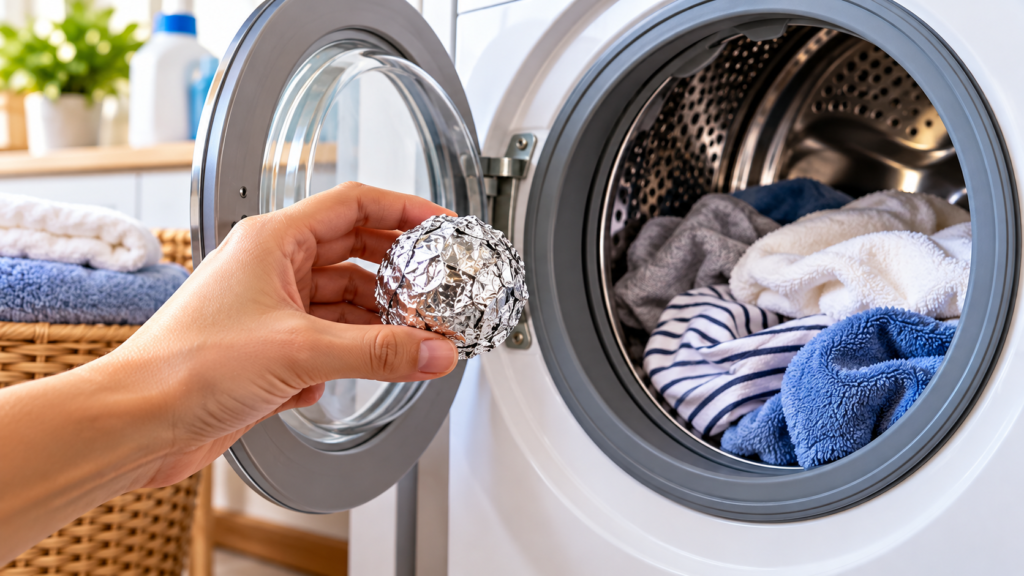
What Is the Aluminum Foil Ball Laundry Hack?
The aluminum foil ball laundry hack involves taking ordinary household aluminum foil, crushing it into a compact ball, and placing it alongside clothes during a laundry cycle.
People usually make the ball by crumpling a sheet of foil and pressing it into a roughly spherical shape. Videos on social media often show one or more foil balls being added directly to a washing machine drum.
The idea comes from the electrical properties of aluminum. Aluminum conducts electricity, which has led people to suggest that a foil ball could help discharge static electricity created when fabrics rub against one another.
The trick is most often discussed as a possible alternative to disposable dryer sheets.
However, there is an important distinction: a washing machine and a tumble dryer perform different jobs and create different conditions. During washing, clothes are surrounded by water for much of the cycle. Static cling is generally more noticeable when fabrics are dry, particularly during tumble drying.
That is why the claimed benefit makes more sense in the context of a dryer than a washing machine. Even in a dryer, the results of using a homemade foil ball should not be treated as guaranteed.
Why Are People Putting Aluminum Foil Balls in the Washing Machine?
There are several reasons this household trick has become popular.
1. They Want to Reduce Static Electricity
Static electricity can make clothes cling to one another or stick to your body. You may notice it when removing synthetic garments from a dryer or when two pieces of clothing cling together after drying.
This happens because friction between fabrics can cause electrical charges to build up. The effect is often more noticeable in dry conditions and with certain synthetic materials.
Because aluminum is a good conductor, some people believe a foil ball can help reduce this buildup.
However, the claim needs context. Static is much less of a problem during a water-filled washing cycle than during dry tumbling. There is not strong evidence that putting a foil ball in a washing machine reliably prevents static cling.
2. They Want an Alternative to Dryer Sheets
Dryer sheets are commonly used to help manage static and improve how clothes feel after drying. Some people would prefer to use fewer disposable products or avoid buying them regularly.
This has encouraged interest in reusable household alternatives, including foil balls.
But a homemade foil ball is not automatically an equivalent replacement. Dryer sheets and fabric conditioners are designed for specific purposes, and aluminum foil does not provide fragrance or the same fabric-conditioning effects.
If you want to reduce static, it is better to choose a method suited to your appliance and follow the manufacturer’s recommendations.
3. They Hope to Save Money
Aluminum foil is widely available, and a small ball may seem cheaper than repeatedly purchasing laundry products.
The appeal is easy to understand. A simple item already found in many kitchens appears to offer a convenient solution to a common household problem.
Still, saving money only makes sense when a method is effective and suitable for the appliance. A low-cost trick with uncertain benefits is not necessarily better than using established laundry practices.
4. They Have Seen the Trick on Social Media
Short videos often make household hacks look simple and convincing. A person adds a foil ball to a load of laundry, removes the clothes, and presents the result as proof that the method works.
The problem is that a video rarely controls for other factors, such as the fabric type, detergent, drying method, humidity, or the condition of the clothes before washing.
A positive result does not establish that the foil ball caused the improvement. The same result might have occurred without it.
That is why it is worth looking beyond the video and understanding the actual purpose of the trick.
How Is the Aluminum Foil Ball Supposed to Work?
The explanation behind the trend is based on electrical conductivity.
Aluminum allows electrical charge to move through it. In theory, a foil ball in a dry tumbling environment might help dissipate some static charge as clothes rub against one another.
Static cling is more relevant during drying because fabrics repeatedly come into contact while moisture levels fall. Synthetic materials such as polyester and nylon can be particularly prone to noticeable static.
A washing machine, however, contains water during much of the washing process. Water and moisture help dissipate electrical charge, so the conditions are different from those in a dry tumble dryer.
This means that even if the proposed mechanism sounds reasonable for a dry environment, it does not establish that a foil ball will improve washing performance.
It is also important to separate a plausible explanation from proven results. The fact that aluminum conducts electricity does not demonstrate that a homemade foil ball will consistently reduce static in laundry.
For further information, see Whirlpool’s guidance on reducing static in a dryer.
Does an Aluminum Foil Ball Actually Work?
The most accurate answer is that the results are uncertain, particularly when the foil ball is placed inside a washing machine.
Let’s look at some common claims.
Claim 1: It Reduces Static Cling
Verdict: The benefit is unproven for washing machines.
The theory is connected to static electricity, which is more commonly a concern during drying. Appliance guidance discusses several approaches to reducing static in a dryer, including separating fabrics and considering appropriate dryer accessories.
However, that does not prove that a foil ball in a washer will produce a noticeable improvement.
Claim 2: It Makes Clothes Softer
Verdict: Do not rely on it for this purpose.
Aluminum foil is not a fabric conditioner. It does not provide the conditioning ingredients used in products specifically designed to make fabrics feel softer.
If your clothes feel rough after washing, consider whether you are using the correct amount of detergent, overloading the machine, or drying the garments according to their care labels.
Claim 3: It Makes Clothes Cleaner
Verdict: There is no good reason to expect it to improve cleaning.
The main cleaning work is done by water, detergent, agitation, and the selected wash programme. A foil ball is not a substitute for detergent and is not an established method for removing stains or disinfecting laundry.
For better results, pretreat suitable stains, sort laundry appropriately, and choose a cycle that matches the fabric and soil level.
Claim 4: It Removes Pet Hair and Lint
Verdict: Do not count on it.
There is no established evidence that a foil ball in a washing machine reliably removes pet hair or lint.
Pet hair can cling to fabrics and collect around the machine’s gasket or filters. Brushing clothes before washing, using a suitable laundry tool, and cleaning the appliance according to its instructions are more practical approaches.
Claim 5: It Replaces Fabric Softener
Verdict: Not completely.
A foil ball does not add fragrance or condition fabric in the same way as products made for those purposes.
If you want to reduce product use, you can explore alternatives recommended for your laundry type and appliance. Remember that fabric softener is not appropriate for every material, including some technical fabrics and towels, so always check garment-care instructions.
Is It Safe to Put Aluminum Foil in a Washing Machine?
This is one of the most important questions to consider before trying the trend.
A tightly compressed foil ball may appear harmless, but that does not mean every homemade ball is suitable for every machine or load of laundry.
Potential concerns include:
- Loose foil pieces: If the ball breaks apart, small pieces may become trapped in parts of the appliance or reach the drainage system.
- Sharp edges: Poorly compressed or torn foil can snag delicate fabrics or loose threads.
- Uncertain compatibility: Washing machines differ in design, and manufacturers may have specific instructions about foreign objects in the drum.
- Unnecessary wear or damage: Repeated use of an unapproved object creates an avoidable risk when the benefit is uncertain.
These are possible concerns, not a prediction that every foil ball will damage a machine. The important point is that the trick has no established washing-machine benefit that clearly justifies introducing an unfamiliar object into the drum.
Our recommendation: Avoid making aluminum foil balls a routine part of your washing-machine cycle. Check your appliance manual and follow its instructions rather than relying on viral videos.
For a related discussion of the safety concerns, read Tom’s Guide’s article on aluminum foil balls in washing machines.
What About Using Aluminum Foil Balls in a Dryer?
The dryer is where the idea is more commonly discussed because static cling often develops during dry tumbling.
However, a plausible explanation is not the same as strong evidence that a homemade foil ball works reliably. You should not assume that an object is safe for your dryer simply because it is made from household foil.
Before placing anything unusual inside an appliance, consult the manufacturer’s instructions. If the manual does not approve foil balls or you cannot confirm that they are suitable for your model, choose a recommended alternative instead.
Whirlpool provides information about static reduction and dryer accessories in its official dryer guidance.
Better Ways to Reduce Static in Clothes
If your main concern is static cling, you do not need to depend on an uncertain internet hack. A few practical changes can help you manage the problem.
1. Avoid Overdrying Clothes
Very dry fabrics can develop more noticeable static. If your dryer has appropriate moisture-sensing settings, consider using them instead of routinely running clothes longer than necessary.
Always follow garment-care instructions and your appliance’s guidance.
2. Separate Different Fabric Types
Synthetic materials can behave differently from cotton and other natural fibres during drying.
Separating garments by fabric type can make it easier to choose suitable drying settings and manage static. Check the labels before mixing different materials in a single load.
3. Avoid Overloading the Dryer
An overloaded dryer can restrict the movement of clothes and affect drying performance.
Follow the capacity guidelines for your machine. Properly sized loads can help clothes tumble more freely and make it easier to manage drying time.
4. Consider Wool Dryer Balls or Other Approved Accessories
Some people use wool dryer balls as an alternative to disposable dryer sheets. Their suitability and performance depend on the product, fabric, and appliance.
Choose accessories designed for your dryer and follow their instructions. Do not assume that wool dryer balls and homemade aluminum foil balls work in the same way.
5. Air-Dry Suitable Garments
Air-drying is a straightforward option for many clothes, provided the garment-care label allows it and the drying conditions are appropriate.
It can also reduce the need for tumble drying. Allow sufficient ventilation and avoid leaving damp laundry in a pile for long periods.
6. Follow Garment-Care Instructions
Different fabrics require different care. Some materials may be damaged by high heat or unsuitable laundry products.
Checking labels and choosing appropriate wash and dry settings is often more useful than experimenting with unverified hacks.
Common Mistakes to Avoid When Trying Laundry Hacks
Laundry tips can be helpful, but not every popular trick deserves a place in your routine.
Here are some mistakes worth avoiding:
- Believing every viral claim: A popular video is not the same as a controlled test.
- Confusing washing with drying: Static cling is more closely associated with dry fabrics than with clothes immersed in wash water.
- Assuming one method suits every fabric: Delicate materials, technical clothing, towels, and everyday cotton garments may have different care requirements.
- Ignoring the appliance manual: An inexpensive household object can still be unsuitable for a particular machine.
- Expecting one trick to solve every laundry problem: Static, stains, odours, lint, and softness are different issues and may require different solutions.
A good household hack should be practical, safe for the intended use, and supported by a reasonable explanation. If the benefits are uncertain, there is no need to force it into your routine.
Frequently Asked Questions
1. Why do people put aluminum foil balls in the washing machine?
People try the hack because they believe aluminum foil may help reduce static cling, based on its electrical conductivity. However, the claimed benefit is more relevant to dry tumbling, and there is little evidence that foil balls improve a washing-machine cycle.
2. Do aluminum foil balls make clothes cleaner?
There is no established evidence that they improve cleaning. Water, detergent, the wash programme, and proper stain treatment play much more important roles in cleaning clothes.
3. Can aluminum foil balls soften clothes?
They should not be considered a fabric-softening product. They do not provide the same conditioning or fragrance as products specifically designed for that purpose.
4. Can aluminum foil balls remove pet hair?
Do not rely on them to remove pet hair. Brushing garments before washing, using suitable laundry tools, and cleaning the appliance as directed are more practical options.
5. Are aluminum foil balls safe for every washing machine?
No universal guarantee can be given. Machine designs and manufacturer instructions vary, and loose foil or sharp edges can create problems. Check the manual and avoid routine use when compatibility and benefits have not been established.
6. Should I put aluminum foil in the dryer instead?
The idea is more commonly associated with reducing static during drying, but its effectiveness is not guaranteed. Check the dryer manufacturer’s instructions before using a homemade foil ball or any unapproved accessory.
7. Can aluminum foil replace dryer sheets?
Not as a complete replacement. Dryer sheets are designed for specific effects, such as reducing static and adding fragrance. Aluminum foil does not provide the same fabric-conditioning or fragrance benefits.
8. Does aluminum foil help remove wrinkles?
There is no good evidence that placing a foil ball in a washing machine is an effective way to remove wrinkles. Appropriate drying settings, promptly removing clothes, and following garment-care instructions are more useful approaches.
9. How many aluminum foil balls should I put in the washing machine?
There is no evidence-based number to recommend for washing-machine use because the benefit is unproven. Rather than experimenting with one or several balls, follow your appliance’s instructions and use established laundry methods.
10. Is the aluminum foil ball laundry hack worth trying?
For a washing machine, the uncertain benefits and possible downsides make it difficult to recommend as a routine practice. If static is the problem, focus on drying methods and accessories that are suitable for your appliance.
Final Verdict: Should You Try the Aluminum Foil Ball Hack?
The aluminum foil ball laundry hack is a good example of how a simple household idea can attract attention online. Its appeal is understandable: people want cleaner, softer clothes and practical ways to save money.
But the details matter.
Aluminum foil is electrically conductive, and static cling is a real laundry problem. That does not prove that putting a foil ball in a washing machine will reduce static, clean clothes better, remove pet hair, or make fabrics softer.
The claimed static benefit is more relevant to tumble drying, and even there, you should follow your appliance manufacturer’s guidance instead of assuming a homemade solution is suitable.
For everyday laundry, the better approach is to choose the correct wash programme, use detergent as directed, avoid overloading the machine, and manage drying conditions carefully.
The bottom line: Before trying a viral laundry hack, ask two questions: Does it actually work, and is it recommended for my appliance? When the evidence is uncertain, a simple, proven laundry routine is often the smarter choice.
Disclaimer: This article provides general household information, not model-specific appliance advice. Always consult your washing machine and dryer manuals for safe use and maintenance.
SHARING IS CARING 💖