
Some structures are simply built to connect two places.
Others become symbols that connect generations.
The Brooklyn Bridge is one of those rare landmarks.
Stretching gracefully across the East River, it links the boroughs of Manhattan and Brooklyn while telling a remarkable story of vision, determination, sacrifice, and human ingenuity. For more than a century, millions of people have crossed this bridge—not just to reach another destination, but to experience a piece of American history.
When the Brooklyn Bridge first opened, many people believed such a massive suspension bridge could never be built. Engineers faced enormous technical challenges, dangerous working conditions, and unexpected setbacks. Yet through perseverance and innovation, an “impossible dream” became one of the world’s most recognized landmarks.
Today, the Brooklyn Bridge is admired not only for its beauty but also for the inspiring lessons behind its creation. It reminds us that every great achievement begins with someone willing to dream beyond what others think is possible.
In this article, we’ll explore the fascinating history of the Brooklyn Bridge, the brilliant minds who built it, its lasting impact on New York City, and the timeless life lessons it offers to anyone pursuing a meaningful goal.
What Is the Brooklyn Bridge?
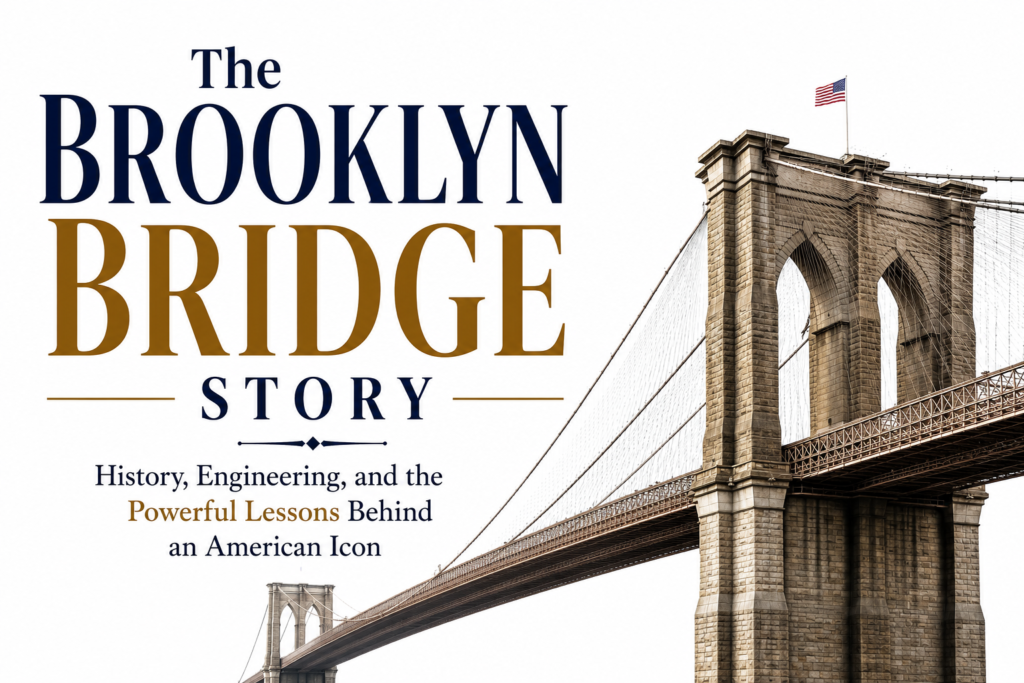
The Brooklyn Bridge is one of the oldest suspension bridges in the United States and one of the most recognizable landmarks in New York City.
Crossing the East River, it connects Manhattan and Brooklyn, allowing pedestrians, cyclists, and vehicles to travel between the two boroughs.
What makes the bridge truly special isn’t only its size or elegant design—it’s the extraordinary story behind its construction.
At the time it was built, many experts believed such a bridge would be impossible to construct safely.
History proved them wrong.
Why the Brooklyn Bridge Became an American Icon
Every city has famous buildings.
Few have structures that symbolize courage and innovation.
The Brooklyn Bridge represents:
- Visionary thinking
- Engineering excellence
- Human perseverance
- Teamwork
- Leadership
- Determination
- Hope for future generations
Its distinctive Gothic-style towers and graceful cables have appeared in countless photographs, films, books, and works of art.
Yet its greatest achievement is not how it looks.
It is what it represents.
A Growing City Needed a Bold Solution
During the 19th century, New York City was growing rapidly.
Thousands of people traveled daily between Manhattan and Brooklyn.
The primary way to cross the East River was by ferry.
Although ferries were useful, they presented many challenges.
Bad weather often delayed travel.
Winter ice sometimes blocked routes.
Heavy fog reduced visibility.
As business and population increased, city leaders realized a permanent connection was becoming essential.
A bridge across the river seemed like the perfect solution.
The problem?
Many believed it couldn’t be built.
John A. Roebling’s Extraordinary Vision
Every remarkable achievement begins with someone willing to imagine what others cannot.
For the Brooklyn Bridge, that visionary was John Augustus Roebling.
Roebling was already respected as an engineer known for designing suspension bridges.
Unlike many people who saw only obstacles, he saw possibilities.
He believed a bridge across the East River could transform transportation, strengthen commerce, and unite communities.
His proposed design was ambitious.
It would become the longest suspension bridge in the world at the time.
Many experts doubted the project.
Some believed the river was too wide.
Others feared the technology wasn’t advanced enough.
Roebling refused to give up.
His confidence inspired others to believe the impossible could become reality.
When Tragedy Struck
Just as construction preparations were beginning, tragedy changed everything.
John Roebling suffered a serious accident while surveying the bridge site.
Despite receiving medical treatment, complications followed, and he passed away before construction truly began.
For many projects, the loss of the chief engineer would have ended the dream.
The Brooklyn Bridge story took a different path.
Rather than allowing the vision to disappear, Roebling’s son stepped forward.
His commitment ensured the project would continue.
This moment reminds us that great dreams often survive because others choose to carry them forward.
A Project Filled with Challenges
Building the bridge was unlike any construction project attempted before.
Workers faced obstacles every day.
Among the greatest challenges were:
- Deep underwater foundations
- Powerful river currents
- Harsh weather
- Limited construction technology
- Dangerous working conditions
- Immense financial pressure
Many problems had no existing solutions.
Engineers often had to invent new techniques while construction was already underway.
Innovation became a necessity rather than a choice.
Building the Foundations
Before the bridge itself could rise into the sky, workers first needed to build strong foundations beneath the river.
This required massive underwater chambers known as caissons.
Workers entered these pressurized spaces to dig through riverbed material until reaching stable ground.
The work demanded extraordinary courage.
Conditions were difficult and often dangerous.
Despite these hardships, crews continued making steady progress.
Every stone placed beneath the water brought the dream one step closer to reality.
Strong foundations remain essential—not only in engineering but also in life.
A Story of Teamwork
Although famous individuals often receive recognition, great achievements always involve countless people working together.
The Brooklyn Bridge was built through the efforts of:
- Engineers
- Architects
- Stone workers
- Ironworkers
- Carpenters
- Surveyors
- Laborers
- Designers
Each person contributed something valuable.
No single individual could have completed the project alone.
The bridge reminds us that extraordinary success is usually the result of collaboration rather than individual brilliance.
More Than Steel and Stone
At first glance, the Brooklyn Bridge appears to be a remarkable engineering accomplishment.
Look more closely, however, and it represents something deeper.
It symbolizes:
- Hope during uncertainty.
- Confidence despite criticism.
- Persistence after setbacks.
- Innovation when existing methods failed.
- Belief in a better future.
These ideas continue inspiring visitors more than a century after the bridge first opened.
A Real-Life Example: Building Success One Step at a Time
Imagine a young entrepreneur starting a small business from a spare bedroom.
Friends question the idea.
Money is limited.
Progress feels slow.
Every day brings another challenge.
Instead of giving up, the entrepreneur focuses on solving one problem at a time.
Months become years.
Eventually, the small business grows into a successful company.
Looking back, people admire the final result.
Few notice the countless small decisions, setbacks, and improvements that made success possible.
The Brooklyn Bridge tells the same story.
Great achievements rarely happen all at once.
They are built through patience, resilience, and consistent effort.
Lessons from the Beginning of the Brooklyn Bridge
Even before construction was complete, the bridge had already taught valuable lessons.
1. Great Dreams Often Sound Impossible
Every groundbreaking idea is usually questioned before it succeeds.
2. Strong Foundations Matter
Whether building bridges, businesses, or relationships, lasting success begins with a solid foundation.
3. Challenges Are Part of Every Meaningful Journey
Obstacles do not mean you are on the wrong path.
Often, they are proof that your goal is worth pursuing.
4. Teamwork Multiplies Success
No great achievement happens entirely alone.
Learning to work with others creates stronger outcomes.
5. Vision Inspires Action
Before others believe in your dream, you must believe in it yourself.
Every remarkable accomplishment begins with imagination.
Why the Story Still Matters Today
More than a century after its completion, the Brooklyn Bridge continues inspiring millions of visitors every year.
People walk across it to enjoy stunning views of New York City.
Photographers capture its timeless beauty.
Engineers admire its innovative design.
Travelers appreciate its historical importance.
Motivational speakers use its story to illustrate perseverance.
The bridge remains a living reminder that determination can transform impossible ideas into lasting achievements.
An Engineering Marvel That Changed the World
When construction of the Brooklyn Bridge began, engineers were attempting something many people believed was impossible.
The bridge would become one of the longest suspension bridges ever built at that time.
It wasn’t simply another transportation project.
It became a symbol of human innovation.
The design combined beauty with strength.
Massive stone towers rose high above the East River while thousands of steel-wire cables carried the enormous weight of the bridge.
This engineering achievement influenced bridge construction around the world and demonstrated what could be accomplished through careful planning, scientific thinking, and determination.
Even today, engineers continue to admire the Brooklyn Bridge for its remarkable design.
The Remarkable Leadership of Emily Roebling
One of the most inspiring chapters in the Brooklyn Bridge story belongs to Emily Warren Roebling.
After John Roebling passed away and his son, Washington Roebling, became seriously ill during construction, many believed the project would fail.
Instead, Emily stepped forward.
Although she was not officially trained as an engineer when the project began, she studied mathematics, engineering, bridge construction, materials, and project management so she could assist her husband and communicate with the engineering team.
She attended meetings.
She carried technical information.
She supervised important aspects of the project.
She became the vital connection between the chief engineer and the construction crews.
Her dedication helped ensure that construction continued despite enormous difficulties.
Today, Emily Roebling is remembered as one of the great leaders behind the success of the Brooklyn Bridge.
The Dangerous Work Beneath the River
Constructing the bridge required workers to spend long hours inside large pressurized chambers called caissons.
These chambers allowed workers to dig below the riverbed and build massive foundations.
The work was physically demanding.
Conditions were hot.
Visibility was limited.
The air pressure created risks that were not fully understood at the time.
Many workers became ill after leaving the caissons too quickly.
Today, this condition is known as decompression sickness, sometimes called “the bends.”
Despite these dangers, the workers continued building one of history’s greatest engineering achievements.
Their courage deserves lasting recognition.
Innovation Through Adversity
The Brooklyn Bridge project constantly faced unexpected problems.
Materials had to be transported across busy waterways.
Weather delayed construction.
Engineering methods had to be improved while work continued.
Rather than abandoning the project, engineers found creative solutions.
Every obstacle became an opportunity to innovate.
This ability to adapt remains one of the bridge’s greatest lessons.
Success often depends not on avoiding problems but on solving them.
The Bridge Finally Opens
After years of planning, sacrifice, and construction, the Brooklyn Bridge officially opened to the public.
People from across New York gathered to witness the historic moment.
Thousands crossed the bridge during its first day.
For many, it represented more than a new transportation route.
It symbolized progress.
It represented hope.
It proved that bold ideas could become reality.
The bridge quickly became one of the busiest and most admired landmarks in America.
Its opening marked the beginning of a new chapter in New York City’s history.
How the Brooklyn Bridge Changed New York City
The bridge dramatically transformed daily life.
Travel between Manhattan and Brooklyn became faster and more reliable.
Businesses expanded.
Communities grew.
Trade increased.
Economic opportunities multiplied.
The bridge encouraged the continued growth of New York into one of the world’s greatest cities.
Sometimes one project changes far more than transportation.
It changes the future of an entire region.
Fascinating Facts About the Brooklyn Bridge
The Brooklyn Bridge remains full of interesting stories.
Some fascinating facts include:
- It was one of the first bridges to use steel-wire suspension cables on such a large scale.
- At the time of its opening, it was the longest suspension bridge in the world.
- Millions of people cross the bridge every year.
- The bridge has appeared in countless movies, books, paintings, and photographs.
- It remains one of New York City’s most photographed landmarks.
- Both pedestrians and cyclists enjoy a dedicated elevated walkway offering spectacular skyline views.
These facts highlight why the bridge continues attracting visitors from around the world.
A Favorite Destination for Travelers
Today, walking across the Brooklyn Bridge is one of the most popular experiences in New York City.
Visitors enjoy:
- Stunning skyline views.
- Historic architecture.
- Beautiful sunrise and sunset photography.
- Walking between two iconic boroughs.
- Nearby parks and waterfront areas.
- Easy access to restaurants, museums, and neighborhoods.
The bridge offers more than transportation.
It creates memories.
Many travelers consider it one of the highlights of their visit.
The Bridge as a Symbol of Hope
Throughout history, the Brooklyn Bridge has represented much more than engineering.
Artists see beauty.
Photographers see perfect composition.
Writers see inspiration.
Entrepreneurs see perseverance.
Students see determination.
Every visitor discovers a different meaning.
Perhaps that explains why the bridge continues inspiring people after so many generations.
Its message remains timeless.
Great achievements begin with great courage.
Leadership Lessons from Emily Roebling
Emily Roebling’s contribution teaches valuable leadership principles.
1. Leadership Is About Responsibility
She accepted responsibility during one of the project’s most difficult periods.
2. Learning Creates Opportunity
Rather than saying, “I don’t know enough,” she chose to learn.
Knowledge became her greatest strength.
3. Quiet Leadership Can Be Powerful
Emily rarely sought recognition.
She focused on helping the project succeed.
True leaders often serve others instead of seeking attention.
4. Perseverance Changes History
Her determination helped complete one of America’s greatest engineering landmarks.
Sometimes persistence becomes a person’s greatest achievement.
A Real-Life Example
Imagine a young manager suddenly placed in charge of an important company project after unexpected circumstances.
The project is behind schedule.
Employees feel uncertain.
Clients are losing confidence.
Instead of giving up, the manager studies every detail, asks experienced colleagues for advice, communicates clearly, and solves one problem at a time.
Months later, the project succeeds.
Many people praise the final result.
Few realize how much quiet leadership made that success possible.
Emily Roebling’s story follows this same principle.
Leadership is often demonstrated through calm action during difficult moments.
Why the Brooklyn Bridge Still Inspires Millions
The bridge continues attracting millions of visitors because it represents universal values.
It reminds us that:
- Vision creates progress.
- Innovation solves difficult problems.
- Teamwork multiplies success.
- Courage overcomes fear.
- Persistence turns dreams into reality.
These lessons remain just as meaningful today as they were more than a century ago.
Why the Brooklyn Bridge Continues to Inspire the World
More than a century after its completion, the Brooklyn Bridge remains one of the most admired landmarks on Earth.
Every day, thousands of people walk across it.
Some are tourists experiencing New York City for the first time.
Some are photographers searching for the perfect sunrise.
Others are local residents simply traveling between Manhattan and Brooklyn.
Yet almost everyone pauses for a moment to admire what stands before them.
The bridge reminds us that extraordinary achievements can outlive the people who create them.
Its towers, cables, and stone arches continue telling a story that inspires every new generation.
A Symbol of Human Determination
Throughout history, humanity has achieved remarkable things because people refused to accept limitations.
The Brooklyn Bridge represents that spirit perfectly.
When many experts believed crossing the East River with a suspension bridge was impossible, a small group of visionaries chose to believe otherwise.
They faced criticism.
They faced tragedy.
They faced technical problems never encountered before.
Still, they continued.
That determination transformed an impossible idea into one of America’s greatest landmarks.
The bridge reminds us that today’s impossible dream may become tomorrow’s greatest achievement.
Why Great Dreams Require Patience
Modern society often celebrates quick success.
People want immediate results.
Instant recognition.
Fast progress.
The Brooklyn Bridge teaches a different lesson.
It was not completed in weeks or months.
It required years of planning, engineering, construction, testing, and sacrifice.
Every stone had to be placed carefully.
Every cable had to be secured precisely.
Every decision influenced the bridge’s future.
The same principle applies to meaningful success in life.
Strong businesses.
Successful careers.
Healthy relationships.
Personal growth.
None are built overnight.
They require patience and consistency.
Building Your Own Bridge
Most people will never build a suspension bridge.
But everyone builds something.
Some build careers.
Others build families.
Teachers build future generations.
Entrepreneurs build companies.
Students build knowledge.
Artists build creativity.
The Brooklyn Bridge reminds us that every worthwhile goal begins with a strong foundation.
Without planning, preparation, and persistence, lasting success becomes difficult.
The bridge encourages us to think beyond today’s challenges and focus on creating something meaningful for the future.
Leadership That Changed History
John Roebling provided the vision.
Washington Roebling continued the engineering.
Emily Roebling demonstrated extraordinary leadership when circumstances became difficult.
Together, they teach us an important lesson:
Leadership is rarely about personal recognition.
It is about responsibility.
Great leaders inspire confidence during uncertain times.
They continue solving problems when others lose hope.
They help people believe that success remains possible.
Whether leading a family, business, classroom, or community, these qualities remain timeless.
A Real-Life Example
Imagine a small town planning to build its first public library.
Many people argue the project is too expensive.
Others believe nobody will use it.
A few community leaders continue working.
They organize volunteers.
Raise funds.
Develop plans.
Years later, the library becomes one of the town’s most valuable institutions.
Children discover books.
Students prepare for exams.
Adults learn new skills.
The building becomes far more important than anyone originally imagined.
The Brooklyn Bridge tells the same story.
Great projects often create benefits that future generations enjoy.
Lessons for Entrepreneurs
Business owners can learn valuable lessons from the Brooklyn Bridge.
Think Long-Term
The bridge was designed to serve people for generations.
Successful businesses also focus on long-term value rather than short-term gains.
Solve Real Problems
The bridge existed because people needed a safer, more reliable way to cross the river.
Great businesses succeed by solving meaningful problems.
Adapt to Challenges
Construction required constant innovation.
Successful entrepreneurs also adapt when circumstances change.
Build Strong Foundations
A company’s culture, reputation, and customer trust become its strongest foundation.
Without them, long-term success becomes difficult.
Lessons for Students
Students can also apply the bridge’s story.
Study Consistently
Knowledge grows through daily effort.
Stay Curious
Learning creates opportunities.
Accept Difficult Challenges
Growth happens outside your comfort zone.
Believe in Yourself
Confidence often appears before visible success.
Lessons for Families
The Brooklyn Bridge also teaches valuable family lessons.
Families become stronger when they:
- Support one another.
- Work together.
- Solve problems calmly.
- Celebrate progress.
- Remain united during difficult times.
Strong relationships, like strong bridges, require trust and consistent care.
The Legacy of the Brooklyn Bridge
Some buildings disappear with time.
The Brooklyn Bridge continues growing in significance.
It has become:
- A National Historic Landmark.
- A symbol of New York City.
- An engineering masterpiece.
- A favorite destination for travelers.
- A source of artistic inspiration.
- A lesson in perseverance.
Its influence extends far beyond architecture.
It has inspired books, films, paintings, photographs, and motivational speeches around the world.
Very few structures leave such a lasting impact.
Why Millions Continue Visiting
Visitors come for many reasons.
Some appreciate history.
Others admire architecture.
Photographers enjoy spectacular skyline views.
Families create lifelong memories.
Couples enjoy romantic evening walks.
Runners begin their mornings crossing its elevated pathway.
Cyclists enjoy scenic routes between boroughs.
Everyone experiences something different.
That universal appeal explains why the Brooklyn Bridge remains one of New York City’s most beloved attractions.
Life Lessons from the Brooklyn Bridge
The story behind the bridge offers lessons that apply to every stage of life.
1. Dream Bigger Than Your Fears
Many remarkable achievements begin with ideas that others consider impossible.
Believe in your vision.
2. Strong Foundations Create Lasting Success
Preparation matters.
Whether building a bridge or building a career, success depends on strong fundamentals.
3. Perseverance Overcomes Obstacles
Every worthwhile goal includes setbacks.
Persistence often matters more than talent.
4. Teamwork Makes Great Things Possible
The Brooklyn Bridge was not built by one person.
It required thousands working together.
Collaboration creates extraordinary results.
5. Never Stop Learning
Emily Roebling proved that continuous learning prepares us for unexpected opportunities.
Knowledge creates confidence.
6. Leadership Is Service
Great leaders focus on helping others succeed.
Their legacy benefits future generations.
7. Every Challenge Contains Opportunity
The greatest innovations often emerge from difficult circumstances.
View obstacles as opportunities to grow.
8. Leave a Positive Legacy
The Brooklyn Bridge continues serving people more than a century after its completion.
Aim to create something that improves life for others.
Final Thoughts
The Brooklyn Bridge is much more than an engineering masterpiece.
It is a powerful reminder of what humanity can accomplish through courage, vision, teamwork, and determination.
Every cable represents commitment.
Every stone reflects careful planning.
Every tower symbolizes hope.
Its story encourages each of us to pursue goals that seem difficult today because tomorrow’s greatest achievements often begin as yesterday’s impossible dreams.
Whether you are building a career, starting a business, raising a family, pursuing education, or simply trying to become a better version of yourself, remember the lessons of the Brooklyn Bridge:
Believe in your vision.
Prepare carefully.
Work consistently.
Support others.
Never give up when challenges appear.
Because the strongest bridges—and the strongest lives—are built one step, one decision, and one day at a time.
The Brooklyn Bridge continues standing as proof that determination can transform bold ideas into timeless achievements.
And perhaps that is its greatest lesson of all.
Frequently Asked Questions (FAQs)
1. What is the Brooklyn Bridge famous for?
The Brooklyn Bridge is famous for connecting Manhattan and Brooklyn across the East River. It is celebrated for its groundbreaking engineering, historic significance, and iconic design, making it one of the most recognizable landmarks in New York City.
2. When was the Brooklyn Bridge completed?
The Brooklyn Bridge officially opened to the public on May 24, 1883, after years of planning and construction.
3. Who designed the Brooklyn Bridge?
The bridge was designed by John Augustus Roebling, whose vision laid the foundation for one of the greatest engineering achievements of the 19th century.
4. Who completed the Brooklyn Bridge after John Roebling?
After John Roebling’s death, his son Washington Roebling became the chief engineer. When Washington became seriously ill, Emily Warren Roebling played a crucial leadership role in helping oversee the project’s completion.
5. Why is the Brooklyn Bridge considered an engineering marvel?
It was one of the first large-scale suspension bridges to use steel-wire cables, and its innovative design influenced bridge construction around the world.
6. How long is the Brooklyn Bridge?
The Brooklyn Bridge is approximately 1,595 feet (486 meters) long between its two main towers, with a total length of about 5,989 feet (1,825 meters) including approaches.
7. Can people walk across the Brooklyn Bridge?
Yes. The bridge has a dedicated pedestrian walkway where visitors can enjoy panoramic views of the New York City skyline, the East River, and nearby landmarks.
8. Is the Brooklyn Bridge free to visit?
Yes. Walking or cycling across the Brooklyn Bridge is free and is one of the most popular experiences for visitors to New York City.
9. Why is Emily Roebling important in the bridge’s history?
Emily Roebling played a vital role in managing communication, engineering coordination, and project supervision when her husband, Washington Roebling, became unable to oversee daily construction due to illness.
10. How long did it take to build the Brooklyn Bridge?
Construction took approximately 14 years, reflecting the project’s complexity and the engineering challenges of the era.
11. What are the best times to visit the Brooklyn Bridge?
Many visitors enjoy the bridge:
- Early morning for fewer crowds.
- Sunrise for photography.
- Sunset for spectacular skyline views.
- Evening for illuminated city scenery.
12. Why does the Brooklyn Bridge continue to inspire people?
Its story represents perseverance, innovation, teamwork, leadership, and the belief that seemingly impossible dreams can become reality through dedication and hard work.
13. What can entrepreneurs learn from the Brooklyn Bridge?
Entrepreneurs can learn the importance of long-term vision, strong foundations, adaptability, teamwork, and solving meaningful problems.
14. What life lessons does the Brooklyn Bridge teach?
The bridge teaches valuable lessons about patience, resilience, courage, leadership, collaboration, continuous learning, and never giving up on ambitious goals.
15. Why should every traveler visit the Brooklyn Bridge?
Beyond its architectural beauty, the bridge offers unforgettable skyline views, fascinating history, and a chance to experience one of America’s most iconic landmarks while reflecting on the inspiring story behind its construction.
SHARING IS CARING 💖