
Introduction
In a world that constantly tells us to want more, achieve more, and own more, it’s easy to forget one simple truth: happiness doesn’t come from having everything—it comes from appreciating what you already have.
Many people spend their lives chasing the next big thing—more money, better possessions, or higher status—believing that these will bring lasting joy. Yet, even after achieving these goals, they often feel empty or unsatisfied.
Why? Because happiness is not found in accumulation—it is found in gratitude.
Gratitude is the ability to recognize and appreciate the value of what is already present in your life. It shifts your focus from what is missing to what is meaningful. And once you develop this mindset, everything changes.
What Is Gratitude?
Gratitude is more than just saying “thank you.” It is a deep sense of appreciation for life—both the big and small moments.
It means:
- Valuing what you have instead of complaining about what you don’t
- Finding joy in simple things
- Acknowledging the people and experiences that enrich your life
- Being present in the moment
Gratitude is not about ignoring your problems—it’s about choosing not to let them control your happiness.
The Meaning Behind “Appreciate What You Have”
The message behind this idea is simple but powerful:
When you stop focusing on what’s missing, you start enjoying what’s already there.
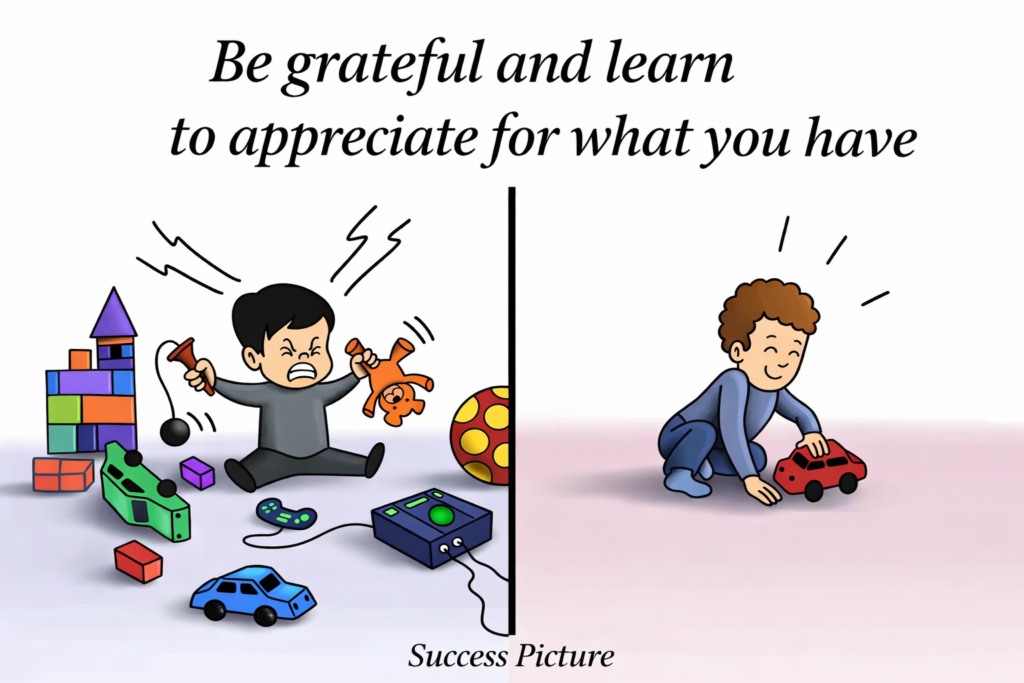
In the image, one child is surrounded by many toys but feels frustrated and overwhelmed. The other child, with just a simple toy, is calm and happy.
This reflects a deep truth about life:
- More does not always mean better
- Simplicity often brings peace
- Contentment is a choice, not a condition
Why Gratitude Leads to True Happiness
1. It Shifts Your Focus
Gratitude changes your perspective. Instead of constantly thinking about what you lack, you begin to notice what you already have.
This shift reduces stress, anxiety, and dissatisfaction.
2. It Brings Inner Peace
When you appreciate your current life, you stop chasing happiness outside yourself. You feel more grounded and at peace.
3. It Reduces Comparison
One of the biggest sources of unhappiness is comparison. Gratitude helps you focus on your own journey instead of measuring yourself against others.
4. It Improves Relationships
When you appreciate people, they feel valued. This strengthens relationships and builds deeper emotional connections.
5. It Increases Positivity
Grateful people tend to be more optimistic. They see opportunities instead of obstacles and solutions instead of problems.
Real-Life Example of Gratitude in Action
Imagine two people:
- One has a high-paying job but constantly complains about stress, long hours, and what they don’t have.
- The other has a modest lifestyle but appreciates their family, health, and daily experiences.
Who do you think is happier?
Most likely, the second person.
This shows that happiness is not determined by external conditions—it is shaped by internal mindset.
How to Practice Gratitude Daily
1. Start a Gratitude Journal
Write down 3 things you are grateful for every day. They can be small—like a good meal or a peaceful moment.
2. Focus on the Present
Stop worrying about the future or regretting the past. Appreciate what is happening right now.
3. Express Appreciation
Tell people you value them. A simple “thank you” can make a big difference.
4. Limit Comparison
Avoid constantly comparing your life to others, especially on social media.
5. Find Joy in Simple Things
Happiness often comes from small moments—a walk, a conversation, or quiet time.
Common Mistakes That Block Gratitude
- Always wanting more
- Comparing your life with others
- Ignoring small blessings
- Taking things for granted
- Focusing only on problems
Avoiding these habits can help you develop a stronger gratitude mindset.
Benefits of Living a Grateful Life
- Better mental health
- Reduced stress and anxiety
- Stronger relationships
- Increased happiness
- Greater life satisfaction
Gratitude doesn’t change your circumstances—it changes how you experience them.
Gratitude vs Materialism
Materialism tells you:
“You’ll be happy when you have more.”
Gratitude tells you:
“You’re already happy when you appreciate what you have.”
This simple shift can completely transform your life.
How Gratitude Helps in Difficult Times
Gratitude is not just for good moments—it is most powerful during hard times.
Even in challenges, you can find something to appreciate:
- Lessons learned
- Strength gained
- Support received
This doesn’t mean ignoring pain—it means finding meaning within it.
READ MORE…
- How to Stay Kind Without Becoming Weak
- If Someone Avoids You, Respect the Distance and Move On
- Win the War in Your Mind, Win in Life
- Some Goodbyes Are the Beginning of Your Growth
- The Eagle Mindset: Rise Above Every Excuse
Long-Term Impact of Gratitude
Over time, gratitude becomes a habit. And when it does:
- You become more positive
- You handle stress better
- You enjoy life more deeply
- You build stronger connections
It becomes a part of who you are.
Conclusion
Gratitude is one of the simplest yet most powerful ways to improve your life.
You don’t need more to be happy—you need to see more in what you already have.
When you stop chasing everything and start appreciating something, life becomes lighter, calmer, and more meaningful.
Remember:
Happiness is not about having everything. It’s about appreciating everything you have.
Start today. Look around. There is always something to be grateful for.
SHARING IS CARING 💖