
Introduction: Two People, One Problem, Two Completely Different Outcomes
Imagine two people facing the same challenge.
Both lose their jobs unexpectedly.
The first person spends every day asking:
“Why did this happen to me?”
“This is unfair.”
“My life is ruined.”
Weeks pass, and the problem continues to grow in his mind.
The second person also feels disappointed.
But after allowing himself time to process the situation, he asks different questions:
“What can I learn from this?”
“What opportunities might exist?”
“What should I do next?”
Months later, their lives look completely different.
The first person remains trapped by frustration.
The second person has learned new skills, explored opportunities, and regained confidence.
The difference was not intelligence.
It was not luck.
It was mindset.
One person focused entirely on the problem.
The other focused on solutions.
This simple shift in thinking often determines whether challenges become obstacles or opportunities.
Life is full of problems.
No one escapes disappointment, setbacks, mistakes, or uncertainty.
But the people who learn to focus on solutions rather than problems frequently experience greater success, happiness, and personal growth.
Why the Human Brain Naturally Focuses on Problems
The human brain evolved to notice danger.
Thousands of years ago, paying attention to threats helped people survive.
Because of this, our minds naturally focus on:
Risks.
Mistakes.
Difficulties.
Problems.
This tendency still exists today.
A person may receive ten compliments and one criticism.
The criticism often remains in their thoughts.
Someone may experience many positive events and one problem.
The problem usually receives most of their attention.
The brain’s protective system sometimes causes people to become trapped inside negative thinking.
Recognizing this tendency is important because awareness creates choice.
You may not control every problem, but you can choose where your attention goes.
Real-Life Example: Thomas Edison and Failure
Thomas Edison is often remembered as one of history’s greatest inventors.
However, his journey included countless unsuccessful attempts while developing the electric light bulb.
Many people would have viewed each failed experiment as evidence of defeat.
Edison chose a different perspective.
He reportedly viewed his attempts as learning experiences that showed him what did not work.
Instead of becoming trapped by the problem, he focused on finding solutions.
Eventually, his persistence changed the world.
His story demonstrates an important lesson:
Problems often contain information that leads to solutions.
The challenge is learning how to look for it.
The Difference Between Problem Thinking and Solution Thinking
Problem-focused thinking sounds like:
“This always happens to me.”
“Nothing will improve.”
“I can’t do anything.”
“Everything is ruined.”
Solution-focused thinking sounds different:
“What can I control?”
“What can I learn?”
“What are my options?”
“What is the next step?”
Notice something important.
Solution-focused thinking does not ignore reality.
It simply directs attention toward action.
Problems often create stress because they seem overwhelming.
Solutions create hope because they create movement.
Even small actions make people feel more empowered.
Why Complaining Rarely Solves Anything
Everyone complains occasionally.
Expressing frustration can be healthy.
However, constantly repeating problems without taking action often increases suffering.
Imagine carrying a heavy backpack.
The more attention you give the weight without putting it down or adjusting it, the heavier it feels.
Problems behave similarly.
Endless worrying rarely creates solutions.
Instead, it often creates:
Stress.
Anxiety.
Mental exhaustion.
Helplessness.
This does not mean pretending problems do not exist.
It means refusing to live inside them.
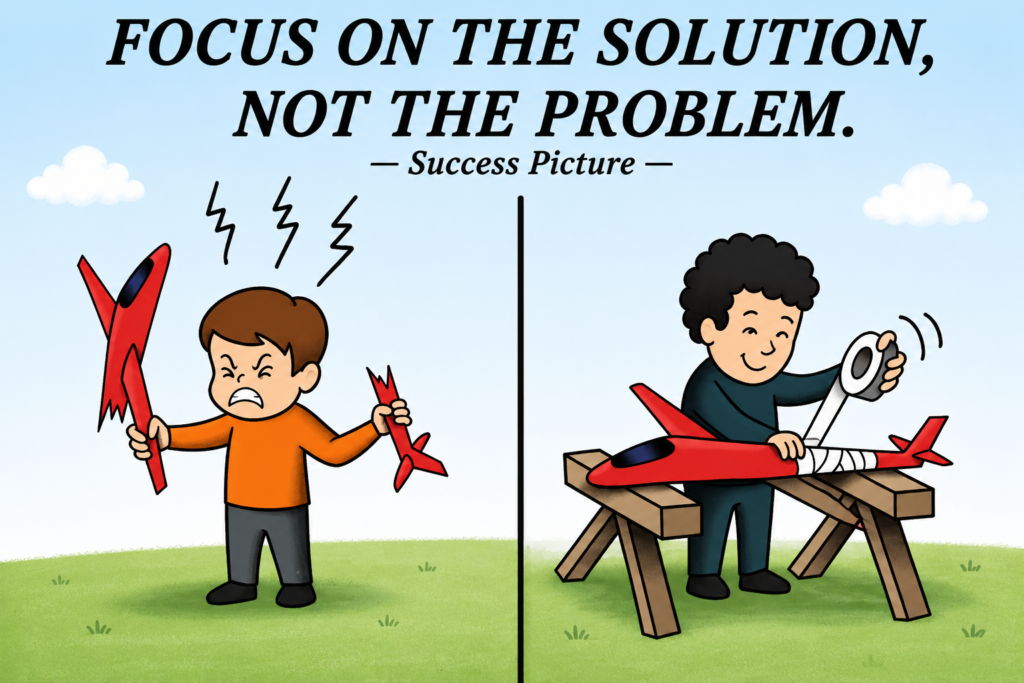
Real-Life Example: The Broken Airplane Toy
Imagine two children receiving the same toy airplane.
After playing, both accidentally break one of the wings.
The first child becomes angry.
He throws the toy aside and repeatedly says:
“It’s ruined.”
The second child becomes curious.
He looks for tape.
He tries different ideas.
Eventually, he repairs the toy and continues playing.
Both children had the same problem.
Their outcomes differed because of how they responded.
This lesson remains true throughout adulthood.
Challenges often reveal our mindset.
Why Solutions Create Confidence
Confidence rarely comes from avoiding problems.
Confidence often develops by solving them.
Every challenge overcome creates evidence.
The mind begins believing:
“I can handle difficult situations.”
“I can adapt.”
“I can learn.”
This belief becomes resilience.
People who consistently search for solutions develop trust in themselves.
They understand that life may become difficult, but they also know they possess the ability to respond.
Problems Are Often Opportunities in Disguise
Many positive experiences begin with problems.
Businesses are often created because someone notices a problem and develops a solution.
Inventions exist because people encountered difficulties.
Personal growth frequently begins after failure.
Challenges encourage learning.
Discomfort encourages change.
Loss often creates gratitude.
Disappointment creates wisdom.
Without problems, many of life’s greatest improvements would never occur.
Problems often become invitations to grow.
Real-Life Example: Losing a Job and Finding Purpose
Imagine someone losing a stable job after many years.
Initially, the experience feels devastating.
Fear develops.
Uncertainty appears.
After several months, the individual decides to learn new skills.
Eventually, they begin a completely different career.
Years later, they look back and say:
“Losing that job changed my life for the better.”
At the time, the experience looked entirely negative.
Later, it became an opportunity.
Many people share similar stories.
Sometimes life’s difficulties redirect people toward possibilities they would never have explored otherwise.
Why Solution-Focused People Are Often Happier
Happiness does not come from having no problems.
Every person faces challenges.
Instead, happiness often depends on how people relate to difficulties.
Solution-focused individuals usually:
Feel more in control.
Experience less helplessness.
Take meaningful action.
Learn continuously.
Adapt more easily.
Their attention remains on possibilities rather than limitations.
This perspective creates optimism and emotional resilience.
The Relationship Between Solutions and Personal Growth
Growth occurs when people move through challenges rather than around them.
Problems teach:
Patience.
Creativity.
Resilience.
Problem-solving.
Adaptability.
Confidence.
Without difficulties, many important strengths remain undeveloped.
Imagine muscles that are never used.
They become weaker.
Human character works similarly.
Challenges often strengthen qualities that comfort never demands.
Why Focusing on What You Can Control Matters
Many problems involve circumstances beyond our control.
Other people’s opinions.
Economic changes.
Unexpected events.
Past mistakes.
Weather.
A solution-oriented mindset asks:
“What remains within my influence?”
Your actions.
Your attitude.
Your effort.
Your decisions.
Your response.
Focusing on controllable factors reduces anxiety and increases effectiveness.
Energy stops flowing toward frustration and begins moving toward action.
Practical Ways to Become More Solution-Oriented
Pause Before Reacting
Emotions are natural.
Give yourself time to think clearly.
Ask Better Questions
Instead of asking:
“Why me?”
Try asking:
“What can I do next?”
Break Problems Into Smaller Parts
Large challenges become manageable when divided into smaller steps.
Focus on Progress
Small actions often create significant results over time.
Learn from Difficult Experiences
Every challenge contains lessons.
Stay Curious
Solutions often appear when people remain open-minded and creative.
The Power of One Small Step
Many people become overwhelmed because they believe solutions require enormous actions.
Often they do not.
One phone call.
One conversation.
One application.
One new habit.
One decision.
One lesson learned.
Small actions create momentum.
Momentum creates progress.
Progress creates confidence.
Confidence creates transformation.
Major life changes frequently begin with small solution-focused choices.
Success Is Built Through Problem-Solving
Every successful person encounters difficulties.
Athletes face setbacks.
Entrepreneurs face failures.
Students face obstacles.
Leaders face criticism.
The difference is not the absence of problems.
The difference is how they respond.
Successful people develop the habit of asking:
“What can I do?”
That question changes everything.
It transforms helplessness into action.
Action creates possibilities.
Possibilities create progress.
Conclusion: Your Attention Shapes Your Life
Problems are unavoidable.
Challenges are part of being human.
Things will break.
Plans will fail.
Unexpected difficulties will appear.
You cannot always choose your circumstances.
But you can choose your focus.
You can spend your energy replaying problems.
Or you can spend your energy searching for solutions.
One approach creates frustration.
The other creates growth.
The truth is simple:
The quality of your life often depends less on the problems you face and more on how you respond to them.
Every challenge carries two invitations.
The first invites you to remain stuck.
The second invites you to learn, adapt, and grow.
Choose the second invitation.
Because the people who focus on solutions rather than problems often discover something remarkable:
Problems may interrupt life, but solutions change it.
And sometimes, the smallest shift in mindset becomes the beginning of extraordinary success, happiness, and personal growth.
SHARING IS CARING 💖