
Introduction
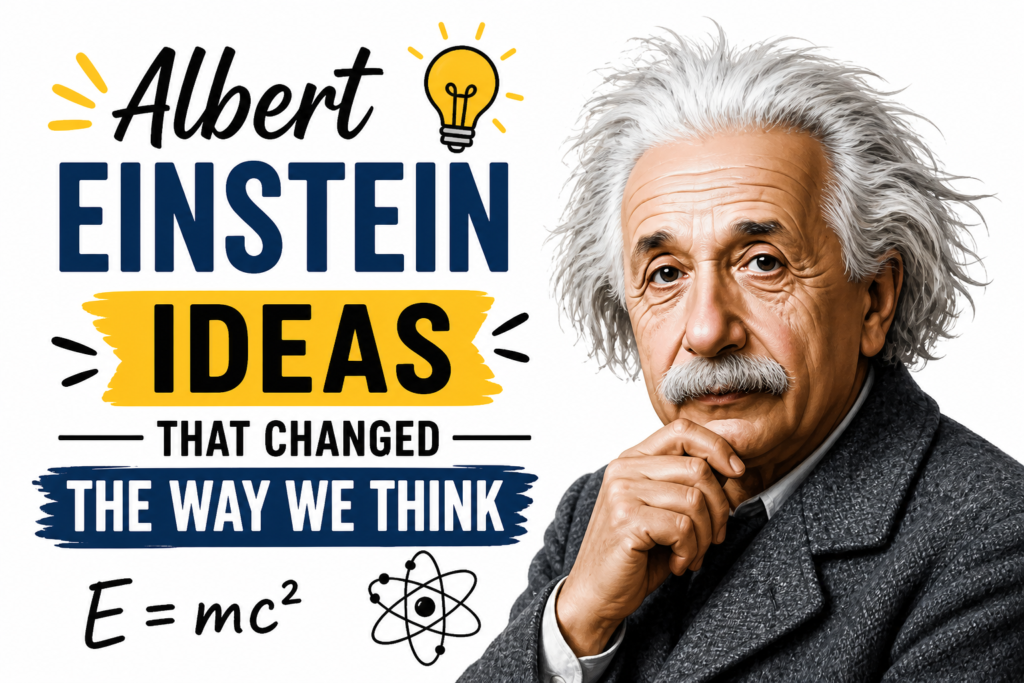
Few individuals have transformed human thinking as profoundly as Albert Einstein. His ideas didn’t just revolutionize physics—they reshaped how we understand reality, time, space, energy, and even creativity itself.
Before Einstein, the universe was seen as predictable and mechanical. After Einstein, it became dynamic, interconnected, and full of surprising possibilities. His work went beyond equations—it changed the way humanity thinks about problems, imagination, and innovation.
In this detailed, blog , we’ll explore Albert Einstein’s most powerful ideas, explain them in simple terms, and connect them to real-life thinking and modern applications. Whether you’re a student, entrepreneur, or lifelong learner, these insights can reshape your mindset.
1. The Power of Imagination Over Knowledge
Einstein believed that imagination is more important than knowledge. While knowledge is limited to what we already know, imagination allows us to explore possibilities beyond current understanding.
🔍 What This Means
Knowledge helps you solve existing problems. Imagination helps you create new possibilities.
🌍 Real-Life Example
Innovators like tech founders and creators often imagine solutions before they exist. Every smartphone, app, or invention started as imagination.
💡 Lesson
Don’t just learn—think beyond what exists.
2. Curiosity Drives Discovery
Einstein was not the top student in traditional schooling, but he had endless curiosity. He questioned everything.
🔍 What This Means
Curiosity is more valuable than memorization.
🌍 Real-Life Example
Students who ask “why” understand concepts deeper than those who only memorize answers.
💡 Lesson
Stay curious. Questions lead to breakthroughs.
3. Thinking Differently Leads to Innovation
Einstein didn’t follow conventional thinking. He challenged accepted beliefs about space and time.
🔍 What This Means
Progress happens when you question existing ideas.
🌍 Real-Life Example
Many successful entrepreneurs succeed by doing things differently from others.
💡 Lesson
Don’t fear being different—innovation requires it.
4. Simplicity Is the Key to Understanding
Einstein believed complex ideas should be explained simply.
🔍 What This Means
If you can’t explain something simply, you don’t fully understand it.
🌍 Real-Life Example
Teachers who simplify concepts help students learn faster.
💡 Lesson
Focus on clarity, not complexity.
5. Time Is Not Absolute
Einstein’s theory of relativity showed that time is not fixed—it changes depending on speed and gravity.
🔍 What This Means
Time is flexible, not constant.
🌍 Real-Life Example
GPS technology works accurately because it accounts for time differences based on Einstein’s theory.
💡 Lesson
Reality is more complex than it appears—stay open-minded.
6. Everything Is Connected
Einstein showed that space and time are interconnected.
🔍 What This Means
Nothing exists in isolation—everything affects something else.
🌍 Real-Life Example
Your habits affect your health, productivity, and success.
💡 Lesson
Understand connections in life and decisions.
7. Failure Is Part of Success
Einstein faced rejection and challenges throughout his career.
🔍 What This Means
Failure is a learning process, not the end.
🌍 Real-Life Example
Many successful people fail multiple times before achieving success.
💡 Lesson
Keep going—failure builds knowledge.
8. Creativity Requires Freedom
Einstein valued independent thinking over rigid rules.
🔍 What This Means
Creativity grows in open environments.
🌍 Real-Life Example
Creative industries thrive where people are free to experiment.
💡 Lesson
Give yourself space to think creatively.
9. Focus Leads to Mastery
Einstein spent years focused on solving complex problems.
🔍 What This Means
Deep focus leads to breakthroughs.
🌍 Real-Life Example
Professionals who focus on one skill often become experts.
💡 Lesson
Avoid distractions—focus deeply.
10. Knowledge Comes from Experience
Einstein believed true learning comes from experience, not just theory.
🔍 What This Means
Practical application is essential.
🌍 Real-Life Example
Hands-on practice improves skills faster than theory alone.
💡 Lesson
Learn by doing.
11. Question Everything
Einstein challenged established scientific beliefs.
🔍 What This Means
Progress begins with questioning.
🌍 Real-Life Example
Critical thinking helps solve real-world problems.
💡 Lesson
Don’t accept everything blindly.
12. Persistence Creates Breakthroughs
Einstein worked for years on theories before gaining recognition.
🔍 What This Means
Success takes time and persistence.
🌍 Real-Life Example
Long-term projects require patience.
💡 Lesson
Stay consistent.
13. Mistakes Are Valuable
Einstein saw mistakes as part of discovery.
🔍 What This Means
Errors help you learn.
🌍 Real-Life Example
Trial and error leads to improvement.
💡 Lesson
Don’t fear mistakes.
14. Think Beyond Limits
Einstein imagined things beyond existing science.
🔍 What This Means
Limitless thinking leads to innovation.
🌍 Real-Life Example
Breakthrough inventions come from bold thinking.
💡 Lesson
Expand your mindset.
15. Passion Drives Excellence
Einstein loved physics deeply.
🔍 What This Means
Passion fuels dedication.
🌍 Real-Life Example
People who love their work perform better.
💡 Lesson
Follow your passion.
READ MORE…
- Discipline Is Choosing What You Want Most Over What You Want Now
- 20 Quotes About Life Struggles That Build Strength, Resilience, and Real Success IN 2026-2027
- Sometimes Stepping Back Is the Strongest Move You Can Make
- 30 Quotes About Life and Choices: Powerful Lessons to Shape Your Future IN 2026-2027
- If Your Life Isn’t Up and Down, You’re Not Really Living: The Truth About Growth and Struggle
Why Einstein’s Ideas Still Matter Today
Einstein’s thinking influences:
- Technology (GPS, nuclear energy)
- Science and research
- Problem-solving approaches
- Creative industries
His ideas continue to shape modern life.
How to Apply Einstein’s Thinking in Daily Life
✔ Be Curious
Ask questions daily
✔ Think Differently
Avoid following the crowd
✔ Focus Deeply
Work without distractions
✔ Stay Persistent
Don’t quit early
✔ Use Imagination
Think beyond limits
Final Thoughts
Albert Einstein didn’t just change science—he changed the way we think.
His ideas remind us that success is not about memorizing facts but about thinking differently, staying curious, and never stopping learning.
If you apply even a few of these lessons, you can improve your mindset, creativity, and approach to life.
SHARING IS CARING 💖