
Introduction: Why Are We Always Running?
Take a look around.
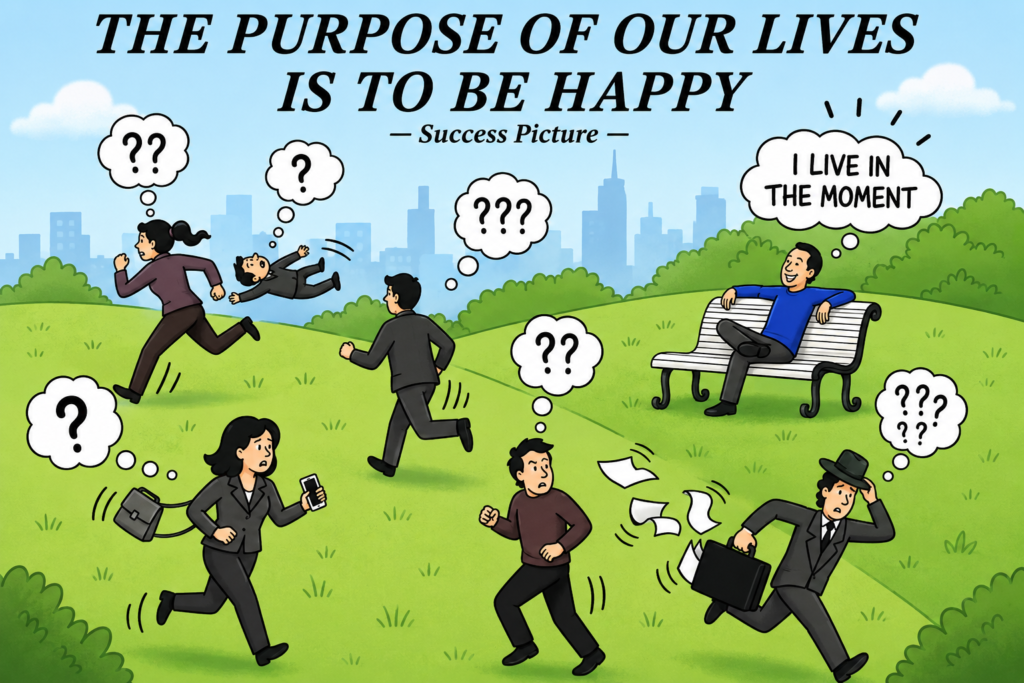
People are rushing everywhere.
Students are worried about exams.
Professionals are chasing promotions.
Entrepreneurs are pursuing bigger goals.
Parents are planning for their children’s future.
Retirees worry about their health and savings.
Everyone seems to be running.
Yet if you stop and ask a simple question—
“Are you happy?”
Many people hesitate.
Some smile politely.
Others say:
“I’ll be happy when I get that job.”
“I’ll be happy when I earn more money.”
“I’ll be happy when I buy a house.”
“I’ll be happy when things become easier.”
The strange thing about happiness is that we often place it somewhere in the future.
We treat happiness like a destination.
We believe that one more achievement, one more possession, or one more success will finally bring lasting joy.
But life repeatedly teaches us something different.
Happiness is rarely found in the future.
It is often hidden inside the present moment.
The purpose of life is not merely to survive, accumulate possessions, or constantly chase the next goal.
The purpose of life is to experience life fully.
And that begins by learning to be present.
The Modern World Has Made Us Experts at Worrying
Human beings have always worried about the future.
But modern life has intensified this tendency.
Technology keeps us connected every minute.
News updates arrive constantly.
Social media shows endless comparisons.
Work follows people home.
Even moments meant for relaxation are often interrupted by notifications.
As a result, many people spend their lives mentally somewhere else.
They are physically present but psychologically absent.
They eat while checking emails.
Talk with family while scrolling through phones.
Take vacations while worrying about work.
Attend celebrations while thinking about tomorrow.
The present moment quietly passes by unnoticed.
Real-Life Example: The Busy Executive
Imagine a successful executive.
For twenty years, he works tirelessly.
Long hours.
Constant travel.
Late-night meetings.
Every sacrifice is made for a better future.
One day, while looking through old photographs, he notices something.
His children are adults.
His parents have grown older.
Friends have moved away.
Years have passed.
He achieved many goals.
But he missed countless ordinary moments.
He realizes something painful:
He spent years preparing to enjoy life later and forgot to experience life while it was happening.
Stories like this happen every day.
Success means little if people never feel present enough to enjoy it.
Why We Keep Chasing More
Human beings are naturally ambitious.
Goals motivate progress.
Dreams inspire action.
Ambition itself is not the problem.
The problem begins when happiness becomes permanently attached to future achievements.
The mind says:
“Just one more accomplishment.”
“Just one more purchase.”
“Just one more promotion.”
Unfortunately, satisfaction often lasts only briefly.
Soon another goal appears.
This cycle continues indefinitely.
Psychologists sometimes refer to this tendency as adaptation.
People quickly become accustomed to achievements and return to their previous levels of happiness.
This explains why some individuals who appear extremely successful still feel dissatisfied.
They never learned how to appreciate the present.
Happiness Lives in Ordinary Moments
Many people expect happiness to arrive through extraordinary experiences.
Winning awards.
Buying expensive possessions.
Achieving major milestones.
These experiences certainly bring excitement.
However, some of life’s deepest happiness comes from ordinary moments:
A meaningful conversation.
A walk in nature.
Watching the rain.
Laughing with friends.
Sharing dinner with family.
Reading a book.
Sitting peacefully under a tree.
The problem is not that these moments are rare.
The problem is that we often fail to notice them.
We become so focused on reaching tomorrow that we overlook today.
The Child Who Enjoyed the Rain
Imagine a child playing outside during rainfall.
The child laughs.
Jumps in puddles.
Feels excited.
Nearby stands an adult.
The adult worries:
Traffic.
Deadlines.
Emails.
Responsibilities.
The rain is exactly the same.
Yet the experiences are completely different.
The child is present.
The adult is mentally somewhere else.
Children often teach an important lesson:
Happiness frequently comes from complete presence rather than perfect circumstances.
Why Living in the Present Matters
The present moment is where life actually happens.
Yesterday exists as memory.
Tomorrow exists as possibility.
Only today exists as experience.
Many people postpone joy because they believe happiness should wait until circumstances improve.
But life remains uncertain.
The perfect moment rarely arrives.
If happiness is always postponed, years can pass surprisingly quickly.
People suddenly realize they spent decades preparing to live instead of actually living.
The Cost of Constant Busyness
Being busy has almost become a badge of honor.
People proudly say:
“I’ve been so busy.”
“I haven’t had time for myself.”
“I barely sleep.”
Hard work has value.
Responsibility matters.
However, endless busyness often comes with hidden costs.
Stress increases.
Relationships suffer.
Creativity declines.
Mental health deteriorates.
Simple joys disappear.
Many people eventually discover that productivity and happiness are not identical.
A full schedule does not automatically create a fulfilling life.
Real-Life Example: The Retired Worker
Imagine a man who spends forty years working.
He repeatedly says:
“I’ll enjoy life after retirement.”
Finally, retirement arrives.
For the first time, he slows down.
He drinks tea peacefully.
Spends time with family.
Watches sunsets.
Walks in the park.
One day he says:
“I forgot how beautiful ordinary life can be.”
The beauty existed all along.
He simply never paused long enough to experience it.
Happiness Is More About Attention Than Possessions
Research repeatedly suggests that meaningful experiences contribute greatly to long-term happiness.
People often remember:
Trips with loved ones.
Conversations.
Acts of kindness.
Moments of laughter.
Unexpected adventures.
Few people cherish memories of ordinary purchases years later.
This reveals something important.
Happiness often depends less on what we possess and more on what we pay attention to.
Attention transforms ordinary moments into meaningful experiences.
The Power of Gratitude
Gratitude naturally brings attention back to the present moment.
When people appreciate what already exists, they become more aware of life’s simple gifts.
A healthy body.
Fresh air.
Food on the table.
People who care.
Opportunities to learn.
Nature.
The ability to begin again.
Gratitude does not remove challenges.
It simply reminds us that even difficult lives contain blessings.
Appreciation creates contentment.
Contentment creates peace.
Peace creates happiness.
Why Nature Makes People Feel Happier
Have you noticed how peaceful people often feel near nature?
Watching the ocean.
Walking through forests.
Sitting in parks.
Observing sunsets.
Nature encourages presence.
Trees do not rush.
Clouds do not hurry.
Birds do not worry about next week.
Nature quietly invites people to slow down.
Sometimes the simplest way to reconnect with happiness is simply to spend time fully present in the natural world.
The Fear of Missing Out on Life
Ironically, many people fear missing opportunities.
Yet while constantly chasing more experiences, they miss the one thing they already have:
This moment.
The present moment may appear ordinary.
But eventually, today’s ordinary moments become tomorrow’s treasured memories.
The coffee shared with a friend.
The conversation with a parent.
The laughter of a child.
The peaceful evening walk.
One day, these simple moments may become the memories we miss the most.
Practical Ways to Live More in the Present
Slow Down
You do not need to rush through every moment.
Reduce Unnecessary Distractions
Allow yourself periods of quiet.
Spend Time in Nature
Nature encourages mindfulness.
Practice Gratitude
Notice simple blessings.
Give Full Attention to People
Listen completely.
Be present.
Enjoy Ordinary Experiences
Not every beautiful moment needs to be extraordinary.
Happiness often hides inside simplicity.
Success and Happiness Are Not Enemies
Living in the present does not mean abandoning goals.
Dreams still matter.
Ambition still matters.
Growth still matters.
The lesson is different.
Pursue goals without postponing happiness.
Work hard while still enjoying life.
Prepare for tomorrow while appreciating today.
Success becomes far more meaningful when people remain present enough to experience it.
The Greatest Wealth
Imagine two people.
One has enormous wealth but constantly worries.
The other has fewer possessions but appreciates everyday experiences.
Which person is richer?
The answer is not entirely financial.
Real wealth often includes:
Peace of mind.
Meaningful relationships.
Gratitude.
Health.
Time.
Presence.
The ability to appreciate life as it unfolds.
These qualities create happiness that possessions alone cannot guarantee.
Conclusion: Life Is Happening Right Now
The world will always encourage you to chase something.
More money.
More success.
More recognition.
More possessions.
Some pursuits are worthwhile.
But never become so busy creating a future that you forget to experience the present.
Life is happening right now.
This conversation.
This breath.
This sunrise.
This laugh.
This walk.
This ordinary day.
The purpose of life is not simply to survive long enough to reach the next milestone.
The purpose of life is to be fully alive.
To appreciate.
To connect.
To experience.
To love.
To learn.
To be present.
Because happiness rarely arrives one day in the distant future.
More often, it quietly waits inside this moment, asking only one thing from us:
To slow down long enough to notice it.
SHARING IS CARING 💖