
Introduction: The Nation That Refused to Give Up
History is filled with stories of individuals overcoming adversity.
But few stories are as inspiring as the story of an entire nation rising from devastation to become one of the world’s most successful countries.
Today, Japan is known for:
- Advanced technology
- World-class infrastructure
- Economic strength
- Innovation
- Exceptional education
- Discipline and efficiency
However, modern Japan was not built overnight.
The country experienced war, destruction, economic hardship, and uncertainty.
Yet through determination, hard work, and a commitment to continuous improvement, Japan transformed itself into a global powerhouse.
The Japan Success Story is more than a tale of economic growth.
It is a lesson in resilience, vision, discipline, and national unity.
This is the remarkable journey of how Japan rose from ruins to become a global power.

Japan Before the Second World War
Before World War II, Japan had already established itself as an important nation in Asia.
Following the Meiji Restoration of 1868, Japan rapidly modernized.
The country adopted new technologies, expanded its industries, and strengthened its military.
Within a few decades, Japan emerged as a major regional power.
Its industrial growth surprised much of the world.
However, increasing military ambitions eventually led Japan into conflicts that would dramatically alter its future.
The Devastation of World War II
The end of World War II in 1945 marked one of the darkest periods in Japanese history.
Cities were heavily damaged.
Factories were destroyed.
Infrastructure was shattered.
The economy collapsed.
Millions of people faced uncertainty.
The destruction of Hiroshima and Nagasaki remains among the most tragic events in human history.
At that moment, many believed Japan’s future looked hopeless.
Few imagined that within a generation, the country would become one of the strongest economies in the world.
Yet adversity often reveals the true character of a nation.
Japan chose rebuilding over despair.
Starting Again from Almost Nothing
Following the war, Japan faced enormous challenges.
The country lacked resources.
Production capacity had been severely damaged.
Many families struggled to rebuild their lives.
Yet something remarkable happened.
Instead of focusing solely on what had been lost, Japan focused on what could still be built.
Government leaders, businesses, educators, and citizens worked together toward a shared vision.
This collective mindset became one of the foundations of modern Japan’s success.
The Power of National Unity
One reason behind Japan’s remarkable recovery was unity.
People understood that rebuilding the country required cooperation.
Rather than waiting for solutions, citizens became part of the solution.
Workers, engineers, teachers, entrepreneurs, and government officials all contributed to national reconstruction.
This sense of shared responsibility accelerated progress.
The lesson remains relevant today:
Nations become stronger when individuals work toward common goals.
Education: The Foundation of Japan’s Future
Japan recognized that long-term success depended on education.
As a result, the country invested heavily in schools, universities, and technical training.
Education became more than a system.
It became a national priority.
Students were encouraged to develop:
- Discipline
- Responsibility
- Teamwork
- Problem-solving skills
- Respect for learning
This investment created a highly skilled workforce capable of driving innovation and economic growth.
Today, Japan’s education system continues to rank among the world’s most respected.
The Japanese Work Ethic
One of the most discussed aspects of Japanese success is its work culture.
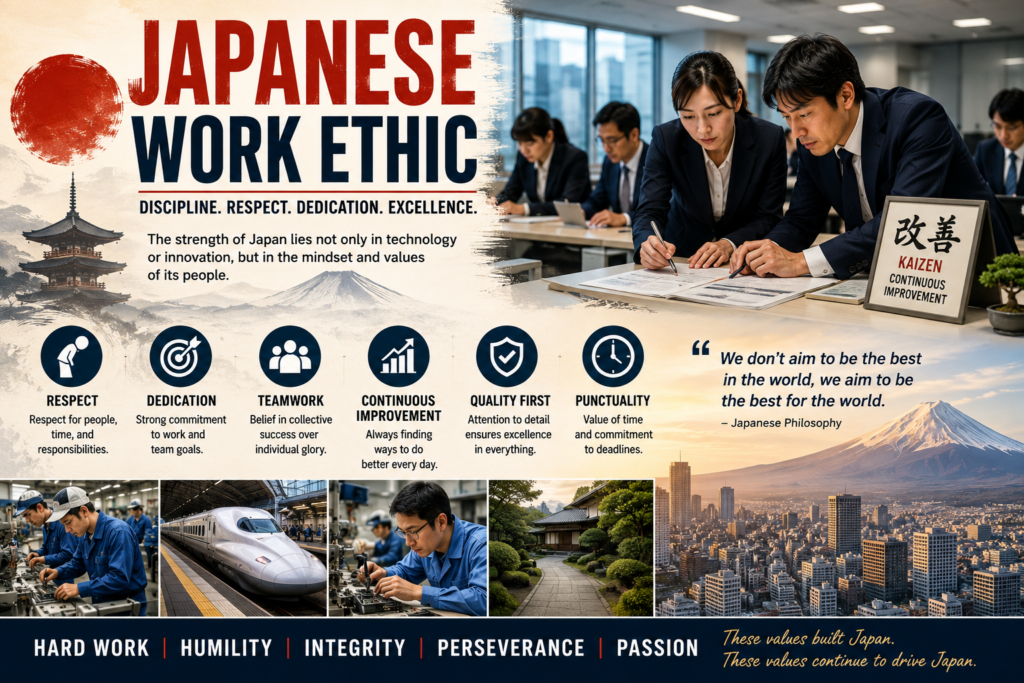
Japanese workers became known for:
- Dedication
- Reliability
- Precision
- Commitment to quality
Businesses embraced the philosophy that every task should be performed to the highest possible standard.
This mindset helped Japanese products earn a reputation for excellence around the world.
The emphasis on quality became a key factor in Japan’s rise.
Kaizen: The Philosophy of Continuous Improvement
A concept that played a major role in Japan’s development is Kaizen.
Kaizen means continuous improvement.
Rather than seeking dramatic overnight changes, Kaizen encourages small improvements every day.
The philosophy can be applied to:
- Businesses
- Manufacturing
- Education
- Personal development
Japanese companies adopted this principle extensively.
Over time, small improvements created extraordinary results.
The lesson is powerful:
Success often comes from consistent progress rather than sudden breakthroughs.
The Economic Miracle
Perhaps the most remarkable chapter in Japan’s success story is its economic transformation.
During the 1950s, 1960s, and 1970s, Japan experienced extraordinary economic growth.
Economists eventually referred to this period as the Japanese Economic Miracle.
Industrial production increased rapidly.
Exports expanded worldwide.
New industries emerged.
Living standards improved dramatically.
Japan transformed from a recovering nation into one of the largest economies on Earth.
This growth attracted global attention and admiration.
Building World-Class Industries
Japan focused on sectors that could compete internationally.
The country invested heavily in:
- Manufacturing
- Electronics
- Automotive production
- Engineering
- Research and development
These investments created globally respected industries.
Rather than competing on low prices alone, Japanese companies emphasized quality and reliability.
This strategy proved incredibly successful.
Toyota: A Symbol of Japanese Excellence
One company that perfectly represents Japan’s success story is Toyota.
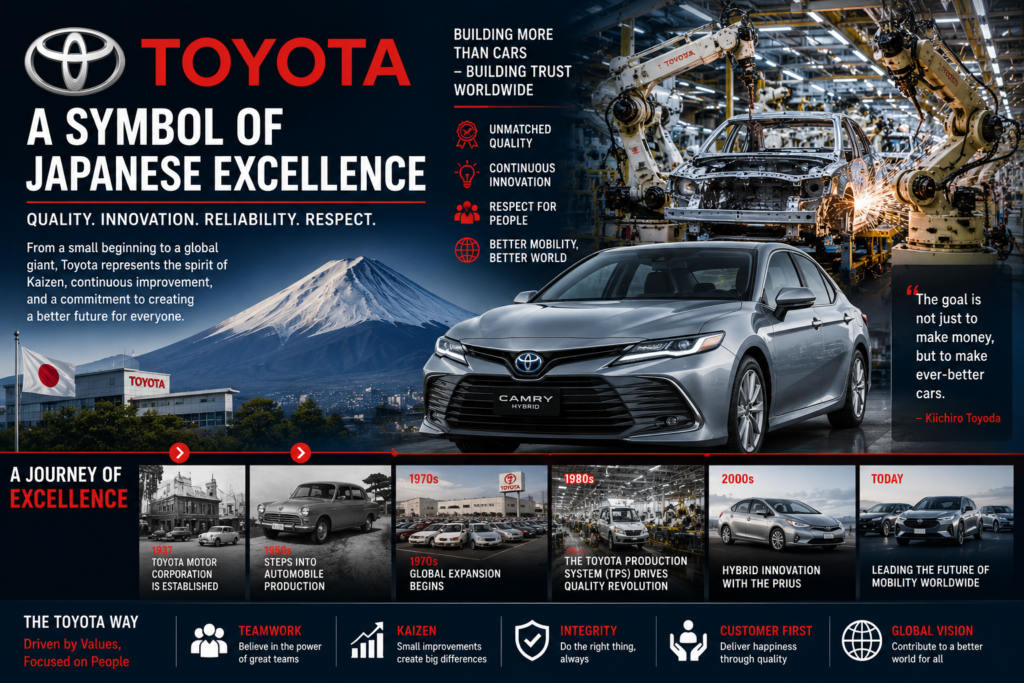
What began as a relatively small manufacturer eventually became one of the most successful automobile companies in history.
Toyota’s focus on:
- Efficiency
- Quality control
- Innovation
- Continuous improvement
helped revolutionize manufacturing worldwide.
Today, Toyota vehicles are sold across the globe.
The company’s success reflects many of the values that contributed to Japan’s rise.
Sony and the Innovation Revolution
Another important example is Sony.
After the war, Sony started as a small company with limited resources.
Its founders believed that innovation could help Japan compete internationally.
Their vision proved correct.
Sony introduced groundbreaking products that transformed consumer electronics.
The company’s success demonstrated that Japanese businesses could lead global innovation rather than simply follow others.
The Rise of Japanese Technology
As the decades passed, Japan became synonymous with technological advancement.
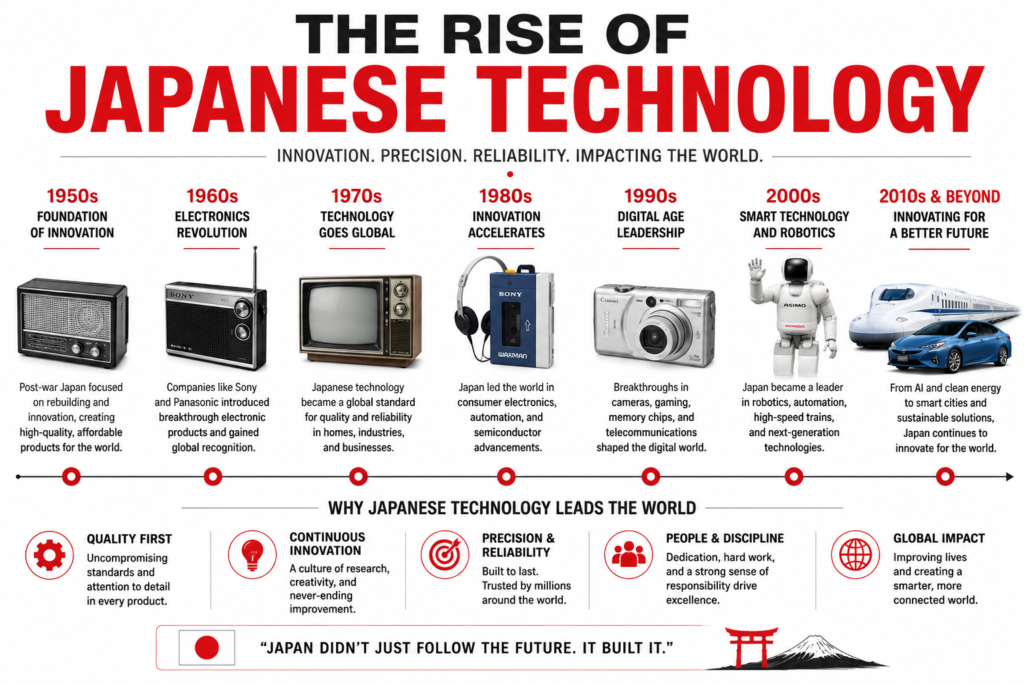
The country produced innovations in:
- Electronics
- Robotics
- Cameras
- Gaming
- Telecommunications
- Industrial machinery
Japanese engineers earned global respect for their creativity and precision.
Companies such as Sony, Panasonic, Canon, and others helped establish Japan as a technology leader.
Innovation became one of the defining characteristics of modern Japan.
Infrastructure That Impressed the World
Japan’s commitment to excellence extended beyond business.
The country invested heavily in infrastructure.
Roads, bridges, airports, and urban transportation systems were developed to world-class standards.
Perhaps no symbol represents Japanese infrastructure better than the famous high-speed rail network.
The introduction of the Shinkansen, often called the Bullet Train, revolutionized transportation.
Its speed, reliability, and safety became admired worldwide.
The system demonstrated Japan’s ability to combine innovation with practical solutions.
Turning Scarcity into Strength
Unlike many large countries, Japan possesses limited natural resources.
Instead of viewing this as a weakness, the country adapted.
Japan focused on developing:
- Human capital
- Technical expertise
- Innovation
- Efficiency
This strategy proved that knowledge and creativity can often be more valuable than natural resources.
The country’s success challenged traditional assumptions about economic development.
The Importance of Discipline
One characteristic frequently associated with Japan is discipline.
Whether in schools, workplaces, or public spaces, discipline plays a significant role in daily life.
This cultural value contributes to:
- Clean cities
- Efficient services
- Reliable transportation
- Strong workplace performance
Discipline does not guarantee success by itself.
However, when combined with education, innovation, and hard work, it becomes a powerful advantage.
Respect for Craftsmanship
Japan also developed a deep appreciation for craftsmanship.
Whether producing automobiles, electronics, tools, or traditional art, Japanese professionals often pursue mastery.
This attention to detail helped create products known for quality and reliability.
Consumers around the world learned to trust Japanese brands.
That trust became one of the nation’s most valuable assets.
Building Global Trust
By consistently delivering quality products and services, Japan earned international respect.
Trust became a competitive advantage.
Businesses, investors, and consumers increasingly viewed Japanese products as dependable.
This reputation strengthened the country’s global influence and economic success.
The rise of Japan demonstrates that trust is not built through marketing alone.
It is earned through years of consistent performance.
Japan’s Cultural Influence Across the World
While Japan became an economic powerhouse, its influence extended far beyond business and technology.
Over the decades, Japanese culture gained worldwide popularity.
Today, millions of people around the globe enjoy:
- Japanese cuisine
- Anime
- Manga
- Fashion
- Literature
- Traditional arts
Japan successfully demonstrated that cultural influence can be just as powerful as economic strength.
Its unique ability to preserve tradition while embracing modernity became one of its greatest strengths.
The Global Rise of Anime and Entertainment
One of Japan’s most successful exports has been entertainment.
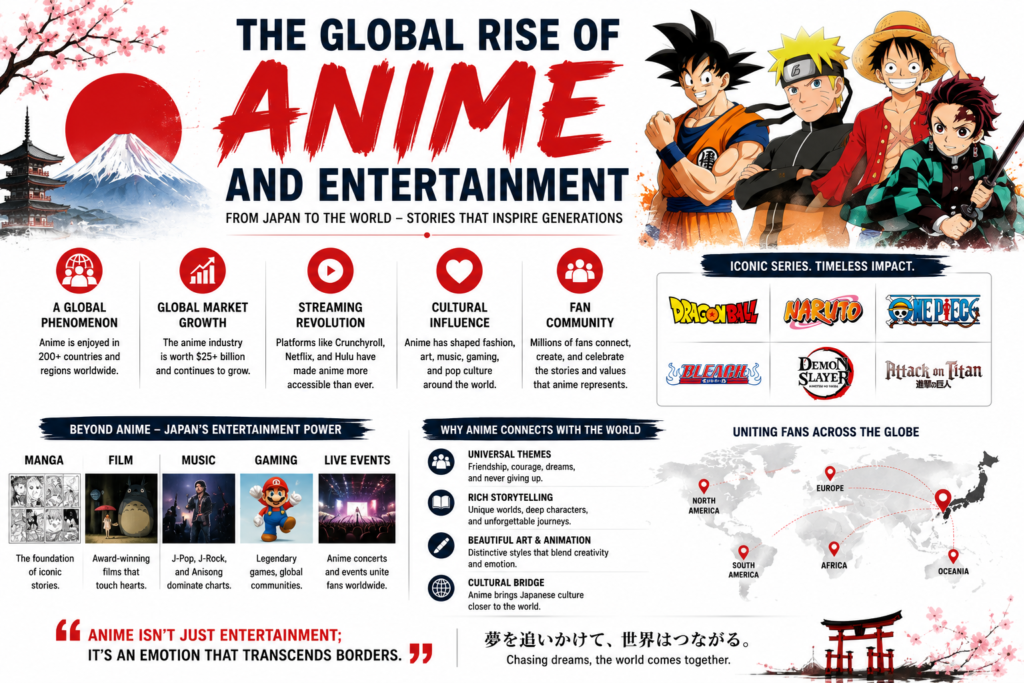
What began as a domestic industry eventually became a worldwide phenomenon.
Anime series and films introduced global audiences to Japanese storytelling, creativity, and artistic excellence.
Entire generations have grown up watching Japanese animation.
The industry’s success generated billions of dollars while strengthening Japan’s global cultural presence.
More importantly, it showed how creativity can become an economic and diplomatic asset.
Innovation Beyond Technology
When people think about Japanese innovation, they often think of electronics and automobiles.
However, innovation in Japan extends much further.
Japanese companies have pioneered advances in:
- Healthcare
- Robotics
- Manufacturing
- Renewable energy
- Transportation
- Consumer products
This commitment to innovation allowed Japan to remain competitive even as global markets evolved.
Rather than relying on past achievements, the country continuously searched for new opportunities.
Becoming a Global Leader in Robotics
Japan has long been recognized as one of the world’s leaders in robotics.
Engineers and researchers developed technologies that transformed manufacturing and automation.
Today, Japanese robotics are used in:
- Factories
- Hospitals
- Research facilities
- Logistics operations
- Public services
These innovations help address labor shortages while increasing productivity.
The robotics sector demonstrates Japan’s ability to anticipate future challenges and develop practical solutions.
The Power of Adaptability
One lesson from Japan’s success story is the importance of adaptation.
The world changes constantly.
Technologies evolve.
Markets shift.
Consumer preferences change.
Countries that refuse to adapt often struggle.
Japan repeatedly demonstrated an ability to evolve with changing circumstances.
This flexibility played a crucial role in its long-term success.
Overcoming Natural Disasters
Japan’s resilience has been tested not only by war but also by nature.
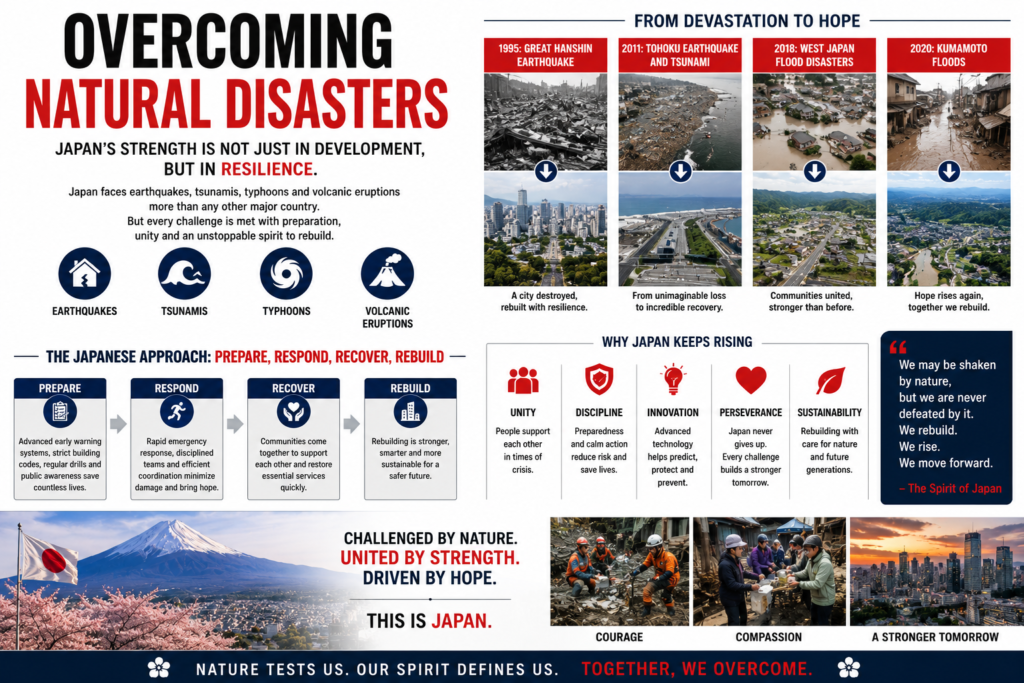
The country experiences:
- Earthquakes
- Tsunamis
- Typhoons
- Volcanic activity
Many of these events caused significant damage.
Yet each time, Japan rebuilt.
A Remarkable Example of Resilience
Following major disasters, communities often worked together to restore infrastructure, reopen businesses, and support affected families.
The speed and efficiency of recovery frequently impressed observers worldwide.
This resilience became one of the defining characteristics of modern Japan.
The lesson is simple:
Success is not avoiding challenges.
Success is responding effectively when challenges occur.
The Importance of Long-Term Thinking
Many countries focus heavily on short-term results.
Japan often emphasizes long-term planning.
Businesses invest in research.
Governments invest in infrastructure.
Educational institutions invest in future generations.
This long-term mindset contributed significantly to national development.
Rather than seeking quick victories, Japan focused on sustainable progress.
Over time, these decisions produced extraordinary outcomes.
Environmental Responsibility and Sustainability
As environmental concerns increased globally, Japan invested in sustainable technologies and energy-efficient solutions.
The country became known for:
- Energy-efficient manufacturing
- Public transportation systems
- Waste management practices
- Green technologies
These initiatives demonstrate how economic growth and environmental responsibility can coexist.
Japan continues searching for ways to balance development with sustainability.
The Japanese Approach to Quality
One reason Japanese products earned worldwide respect is the nation’s commitment to quality.
In many industries, quality became a cultural expectation rather than simply a business objective.
Employees were encouraged to identify problems and suggest improvements.
Organizations continuously refined processes.
This focus on excellence created products and services trusted around the world.
The success of Japanese brands illustrates the value of maintaining high standards consistently.
Challenges Along the Way
Japan’s journey was not without difficulties.
The country faced:
- Economic slowdowns
- Financial challenges
- Demographic changes
- Aging population concerns
- Global competition
However, these obstacles did not erase previous achievements.
Instead, they encouraged further innovation and adaptation.
The ability to confront challenges honestly and search for solutions remains one of Japan’s strengths.
Lessons the World Can Learn from Japan
The Japanese success story offers valuable lessons for individuals, businesses, and nations.
1. Education Creates Opportunity
Japan’s investment in education laid the foundation for long-term growth.
Knowledge remains one of the most powerful tools for progress.
2. Discipline Matters
Success often depends on consistency rather than occasional effort.
Japan’s culture of discipline helped create reliable institutions and businesses.
3. Small Improvements Create Big Results
The philosophy of Kaizen teaches that continuous improvement can transform outcomes over time.
4. Quality Builds Trust
People remember organizations that consistently deliver excellence.
Trust becomes a valuable competitive advantage.
5. Resilience Determines Success
Every nation faces challenges.
The difference lies in how those challenges are addressed.
Japan repeatedly demonstrated the power of resilience.
Japan’s Position in the Modern World
Today, Japan remains one of the most influential countries on Earth.
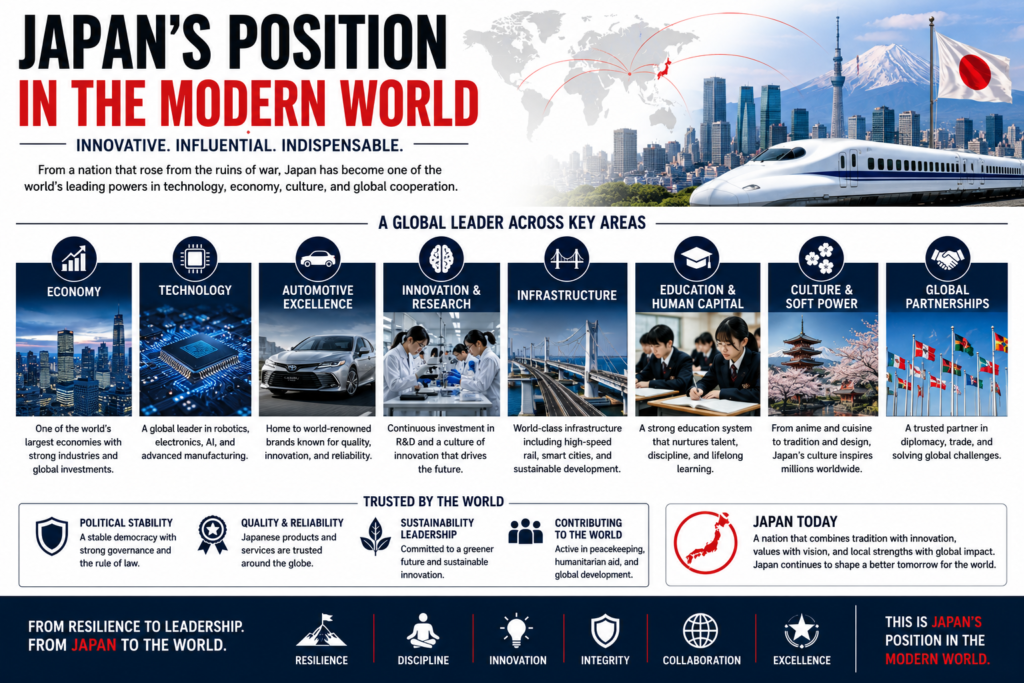
The nation continues to lead in:
- Technology
- Manufacturing
- Robotics
- Infrastructure
- Research
- Innovation
Japanese companies operate globally.
Japanese products are trusted worldwide.
Japanese culture continues to inspire millions.
The country has earned a reputation for excellence through decades of consistent performance.
Why Japan’s Story Matters Today
The modern world faces numerous challenges.
Economic uncertainty, technological disruption, environmental concerns, and global competition affect nations everywhere.
Japan’s journey provides valuable insights into overcoming adversity.
Its success demonstrates that:
- Hard work matters.
- Education matters.
- Innovation matters.
- Discipline matters.
- Resilience matters.
Most importantly, it shows that setbacks do not determine the future.
Determination does.
The Human Side of Japan’s Success
When people discuss economic growth and technological advancement, they often focus on numbers.
But Japan’s success is ultimately a human story.
It is the story of workers rebuilding factories.
Teachers educating future generations.
Engineers developing new technologies.
Entrepreneurs creating businesses.
Families sacrificing for a better future.
Millions of ordinary people contributed to an extraordinary national achievement.
Their efforts transformed a nation and inspired the world.
Conclusion: From Ruins to Global Power
The Japan Success Story is one of the most remarkable examples of resilience, determination, and transformation in modern history.
After experiencing devastation during World War II, many doubted whether Japan could recover.
Yet through hard work, education, innovation, discipline, and national unity, the country achieved what once seemed impossible.
Japan transformed itself from a nation struggling to rebuild into one of the world’s leading economies and innovators.
Its influence now extends across technology, manufacturing, culture, transportation, and global business.
The lessons from Japan remain relevant today.
Success is not determined by where you start.
It is determined by how you respond to challenges.
Japan chose progress over despair.
Innovation over limitation.
Discipline over excuses.
And resilience over surrender.
That is why Japan’s rise continues to inspire people around the world.
Its journey proves that even after the darkest moments, remarkable success is possible.
For nations, businesses, and individuals alike, Japan’s story serves as a powerful reminder:
Great achievements are built one step, one improvement, and one determined effort at a time.
SHARING IS CARING 💖