
Introduction
What if the biggest obstacle standing between you and the life you want is not a lack of talent, money, or opportunity?
What if it is fear?
Fear has a remarkable ability to disguise itself. Sometimes it appears as procrastination. Other times it looks like self-doubt, perfectionism, or the excuse that “the timing isn’t right.”
Many people spend years trying to avoid fear. They build their lives around comfort zones and safe choices. Yet the irony is that the things we fear most often contain the greatest opportunities for growth.
The fear of public speaking may hide your future leadership potential.
The fear of failure may be standing between you and your dream business.
The fear of rejection may be preventing meaningful relationships and opportunities.
Success often begins when we stop running from our fears and start turning them into goals.
Instead of asking, “How can I avoid this?” we begin asking, “How can I overcome this?”
That simple shift can transform your future.
Why Fear Exists
Fear is not your enemy.
In fact, fear evolved to protect us from danger. Thousands of years ago, fear helped humans survive threats in the wild.
Today, however, many of our fears are psychological rather than physical.
We fear:
- Public speaking
- Failure
- Criticism
- Rejection
- Change
- Uncertainty
- Taking risks
- Starting over
These fears rarely threaten our survival, but they often limit our potential.
The purpose of fear is not always to stop you. Sometimes it simply signals that you are approaching something important.
The Hidden Cost of Avoiding Fear
Avoiding fear may provide temporary relief, but it often creates long-term regret.
Imagine someone who dreams of starting a business but never tries because they fear failure.
Imagine a talented professional who never applies for leadership roles because they fear rejection.
Imagine a student who avoids speaking in public and misses opportunities to grow their confidence.
The pain of avoidance can last much longer than the discomfort of facing fear.
Years later, many people regret the chances they never took more than the mistakes they made.
Fear can steal opportunities quietly.
Not through dramatic failures, but through missed possibilities.
Why Your Biggest Fear Often Points Toward Growth
Think about the areas of your life where you feel the most resistance.
Those areas frequently contain your greatest opportunities for improvement.
For example:
Fear of Public Speaking
This fear may indicate an opportunity to improve communication, leadership, and confidence.
Fear of Failure
This fear may point toward a goal worth pursuing.
Fear of Rejection
This fear may be preventing relationships, networking opportunities, and personal growth.
Fear of Change
This fear may be keeping you stuck in situations that no longer serve you.
Growth usually lives on the other side of discomfort.
That is why successful people learn to view fear differently.
They stop seeing fear as a stop sign and begin seeing it as a direction sign.
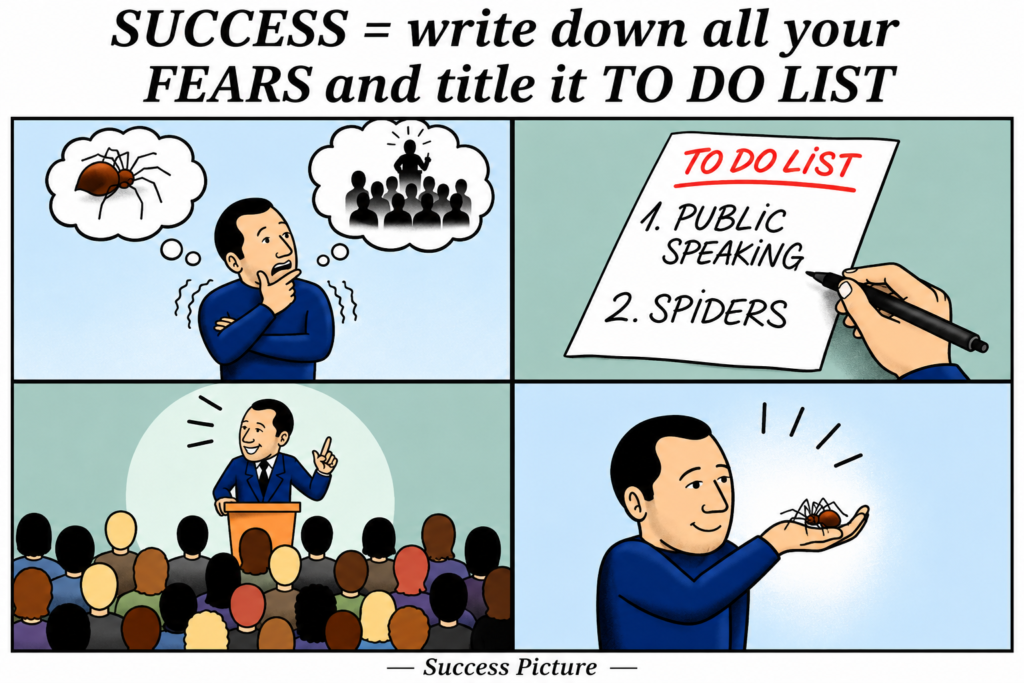
Turn Fear Into a To-Do List
One of the most powerful exercises for personal growth is simple:
Write down your fears.
Then turn each fear into an action step.
For example:
| Fear | Goal |
|---|---|
| Fear of public speaking | Join a speaking group and give one presentation |
| Fear of rejection | Start one new conversation daily |
| Fear of failure | Launch the project you’ve been delaying |
| Fear of criticism | Publish your work online |
| Fear of networking | Attend one professional event per month |
The moment fear becomes a goal, you move from avoidance to action.
This shift changes everything.
Confidence Is Built, Not Born
Many people believe confident individuals were simply born that way.
The truth is different.
Confidence is usually the result of repeated action.
Nobody starts as an expert speaker.
Nobody begins life as a fearless entrepreneur.
Nobody enters a new challenge with complete certainty.
Confidence grows through experience.
Every time you face a fear, your brain learns an important lesson:
“I survived.”
Eventually, fear loses its power.
What once seemed impossible begins to feel normal.
The Science Behind Exposure and Growth
Psychologists often use a method called gradual exposure to help people overcome fears.
The principle is simple:
Repeated exposure reduces anxiety.
The first presentation feels terrifying.
The tenth presentation feels manageable.
The fiftieth presentation feels natural.
The same principle applies to many fears in life.
The more you face them, the less control they have over you.
Action weakens fear.
Avoidance strengthens it.
Real-Life Examples of Fear Leading to Success
The Entrepreneur
Many successful business owners were initially afraid of losing money, being criticized, or failing publicly.
Their success came not because they lacked fear but because they acted despite it.
The Speaker
Countless professional speakers once feared standing in front of a crowd.
They became confident through practice and repetition.
The Athlete
Athletes regularly face fear of failure, pressure, and public judgment.
Their growth comes from stepping onto the field despite uncertainty.
The Everyday Hero
Sometimes the most inspiring examples are ordinary people who decide to do difficult things:
- Changing careers
- Returning to school
- Starting a fitness journey
- Leaving unhealthy situations
- Pursuing lifelong dreams
Each act of courage builds momentum.
Practical Steps to Conquer Fear
1. Identify Your Top Three Fears
Write them down honestly.
Awareness is the first step toward growth.
2. Break Fear Into Smaller Challenges
Large fears become manageable when divided into smaller actions.
3. Focus on Progress, Not Perfection
You do not need to be fearless.
You only need to move forward.
4. Expect Discomfort
Feeling nervous does not mean you are failing.
It often means you are growing.
5. Celebrate Small Wins
Every courageous action deserves recognition.
Small victories build long-term confidence.
6. Stop Waiting to Feel Ready
Most people never feel completely prepared.
Action often creates readiness.
What Happens When You Face Your Fears
When you consistently confront your fears, several things begin to happen:
- Confidence increases
- Self-respect grows
- New opportunities appear
- Resilience develops
- Anxiety decreases
- Personal growth accelerates
Most importantly, you gain evidence that you are capable of more than you once believed.
That realization can change your entire life.
ALSO READ…
- Happiness Is Not About Position—It’s About Perspective
- How Social Media Likes Became Today’s Emotional Currency
- The Powerful Lesson About Friendship and Money Most People Learn Too Late
- Why Money Should Be a Tool, Not a Prison
- How You See Yourself Shapes Your Entire Life
The Relationship Between Courage and Success
Success does not belong exclusively to the most talented people.
It often belongs to those willing to do what others avoid.
Every achievement requires courage.
Applying for the job.
Starting the business.
Speaking in public.
Learning a new skill.
Taking responsibility.
Making difficult decisions.
Success rewards action, and courage makes action possible.
Conclusion
Fear will always exist in some form.
The goal is not to eliminate fear completely.
The goal is to prevent fear from controlling your decisions.
The most successful and confident people are not fearless. They simply choose action over avoidance.
Take a moment today and write down the things that scare you.
Then transform that list into a roadmap for growth.
Because your greatest opportunities are often hidden behind your greatest fears.
The life you want may be waiting on the other side of one courageous decision.
Turn your fears into goals.
Then start checking them off—one by one.
SHARING IS CARING 💖