
Have you ever found yourself stuck in a pointless argument that left you frustrated, drained, and wondering why you even bothered? Most people have experienced this situation at some point in their lives.
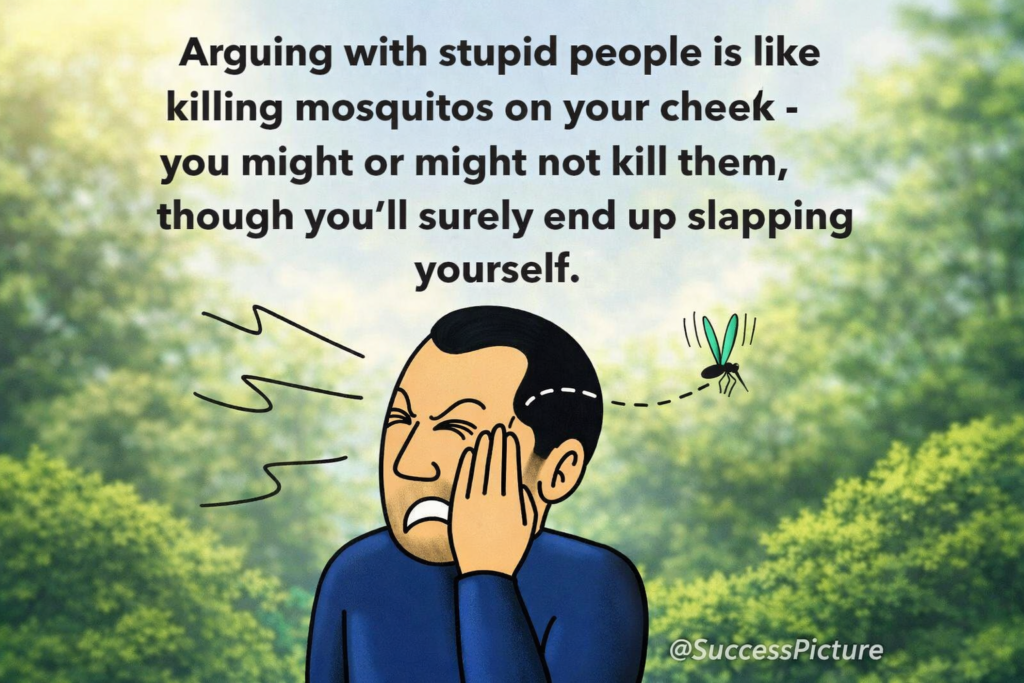
The image above delivers a powerful and humorous life lesson through a simple metaphor:
“Arguing with stupid people is like killing mosquitoes on your cheek—you might or might not kill them, but you’ll surely end up slapping yourself.”
At first glance, this quote may sound funny, but its message carries deep wisdom about communication, emotional control, and protecting your mental peace.
In today’s world—especially online—arguments happen everywhere. Social media debates, workplace disagreements, and everyday conversations can quickly turn into unproductive conflicts. Many people feel the urge to respond, defend their opinions, or prove someone wrong.
But the truth is that not every argument is worth having.
Sometimes the smartest move is simply walking away.
In this article, we will explore why arguing with unreasonable people is often pointless, how unnecessary conflicts drain your energy, and why learning when not to argue is one of the most valuable life skills you can develop.
Understanding the Meaning Behind the Quote
The mosquito metaphor is surprisingly accurate.
When a mosquito lands on your cheek, you might instinctively try to slap it. But when you do, there’s a chance you might miss and end up hurting yourself more than the mosquito.
Arguing with people who refuse to listen works the same way.
Instead of solving anything, the argument usually leads to:
- Frustration
- Anger
- Stress
- Wasted time
- Damaged relationships
In many cases, both sides leave the conversation feeling worse.
The key lesson is simple:
Some arguments only hurt you, not the other person.
Why Some People Are Impossible to Argue With
One reason arguments become pointless is that not everyone is interested in learning or understanding.
Many people argue for reasons such as:
- Defending their ego
- Proving themselves right
- Seeking attention
- Winning a debate rather than finding truth
When someone enters a conversation with the goal of winning rather than understanding, productive discussion becomes almost impossible.
Logic rarely changes the mind of someone who has already decided they are right.
The Psychology of Unproductive Arguments
Psychologists have studied why people often refuse to change their opinions even when presented with evidence.
One important concept is confirmation bias.
Confirmation bias means people tend to favor information that supports their existing beliefs while ignoring information that contradicts them.
This explains why arguments often feel like talking to a wall.
Instead of listening, the other person is simply waiting for their turn to respond.
In such situations, continuing the argument usually achieves nothing.
The Hidden Cost of Arguing
Many people underestimate how much energy arguments consume.
Arguments can drain you emotionally, mentally, and even physically.
Some of the hidden costs include:
Emotional Stress
Arguments often trigger anger, frustration, and anxiety.
These emotions can linger long after the conversation ends.
Wasted Time
Time spent arguing could have been used for productive activities like learning, working, or relaxing.
Damaged Relationships
Repeated arguments can create resentment and weaken personal or professional relationships.
Reduced Focus
After a heated argument, it can be difficult to concentrate on important tasks.
For these reasons, learning to avoid unnecessary arguments protects your mental well-being.
Social Media: The Modern Battlefield of Arguments
In the digital age, arguments have become more common than ever.
Social media platforms are filled with debates about politics, opinions, lifestyles, and trending topics.
Unfortunately, many of these debates turn into hostile arguments rather than constructive conversations.
The anonymity of the internet often encourages people to behave more aggressively than they would in real life.
People feel less accountable for their words, which leads to endless online conflicts.
The smartest users understand that not every comment deserves a response.
Sometimes ignoring negativity is the best choice.
The Difference Between Healthy Debate and Pointless Arguments
Not all disagreements are bad.
Healthy debate can be beneficial when both sides are open to learning.
A productive discussion usually involves:
- Respectful communication
- Willingness to listen
- Openness to new perspectives
- Focus on understanding rather than winning
However, arguments become pointless when:
- One or both sides refuse to listen
- Personal insults replace logical discussion
- The goal becomes proving someone wrong instead of finding truth
Recognizing this difference helps you choose which conversations deserve your time.
Emotional Intelligence: Knowing When to Walk Away
One of the most powerful skills in life is emotional intelligence.
Emotional intelligence involves understanding and managing your emotions while responding wisely to others.
People with strong emotional intelligence know when to engage in discussion and when to disengage.
Instead of reacting impulsively, they ask themselves questions like:
- Is this conversation productive?
- Is the other person open to discussion?
- Is continuing this argument worth my time and energy?
If the answer is no, they simply walk away.
Walking away is not weakness—it is wisdom.
Successful People Avoid Energy Drains
Many successful individuals protect their energy carefully.
They understand that focus and productivity require mental clarity.
Instead of engaging in unnecessary conflicts, they prioritize:
- Personal growth
- Meaningful conversations
- Productive work
- Positive relationships
By avoiding pointless arguments, they preserve their energy for goals that truly matter.
The Power of Silence
Sometimes silence is more powerful than words.
When someone tries to provoke an argument, responding calmly—or not responding at all—often ends the conflict quickly.
Silence can:
- De-escalate tension
- Prevent emotional reactions
- Demonstrate maturity
- Protect your peace of mind
Not every criticism requires a defense.
Not every opinion requires a response.
ALSO READ…
- 20 Hard Work Quotes for Career Success to Keep You Motivated Every Day
- 25 Quotes About Success Without Shortcuts That Inspire Real Growth
- The Hidden Truth About Success: Why Self-Respect Matters More Than Blind Approval
- Too Much Trust Might Kill You: The Hidden Danger of Blind Trust in Life and Business
- We Are Too Connected: How Digital Overload Is Quietly Controlling Your Life
How to Handle Difficult People Without Arguing
While avoiding arguments is ideal, difficult people still exist.
Here are several strategies to deal with them without escalating conflict.
1. Stay Calm
Anger often fuels arguments.
Remaining calm helps prevent emotional reactions that worsen the situation.
2. Listen Without Reacting
Sometimes people just want to be heard.
Listening calmly without immediate disagreement can reduce tension.
3. Set Boundaries
If someone repeatedly tries to provoke arguments, clearly communicate your boundaries.
You can say things like:
“I’d rather not debate this right now.”
4. Change the Topic
Redirecting the conversation to a neutral subject can end an argument before it escalates.
5. Walk Away
If the conversation becomes hostile or pointless, simply leave.
Protecting your peace is more important than winning an argument.
Protecting Your Mental Peace
Your mental peace is one of your most valuable resources.
Arguments that serve no purpose only disturb that peace.
By choosing which conversations deserve your attention, you gain control over your emotional energy.
Remember:
You don’t need to prove your intelligence in every discussion.
Sometimes the smartest people say the least.
The Wisdom of Letting Go
Life becomes significantly easier when you stop trying to correct everyone.
Not every person is ready to understand your perspective.
Not every disagreement needs resolution.
Letting go of unnecessary arguments frees you to focus on:
- Personal goals
- Healthy relationships
- Learning and growth
- Happiness and peace
This shift in mindset can dramatically improve your quality of life.
Final Thoughts
The mosquito metaphor in the image captures a powerful truth about human behavior.
Arguing with people who refuse to listen rarely leads to positive outcomes.
Instead, it often leaves you frustrated and emotionally drained.
Learning when to disengage from pointless arguments is not only wise—it is essential for protecting your peace and maintaining focus on what truly matters.
The next time you find yourself drawn into a meaningless debate, remember the lesson from the image:
Sometimes the best response is no response at all.
By choosing your battles wisely, you preserve your energy, maintain your mental clarity, and invest your time in things that genuinely improve your life.
SHARING IS CARING 🥰