
Choosing a geyser may seem like a simple decision until you start comparing gas and electric models. One person might recommend a gas geyser because it heats water quickly, while another might prefer an electric geyser because it feels more convenient for everyday use.
Then come the bigger questions: Which one costs less to operate? Is a gas geyser harmful to your health? Can an electric geyser cause an electric shock? And which option is better for an Indian household?
The truth is that both types can be useful, but they work differently and have different safety requirements. A gas geyser heats water by burning fuel, such as LPG or piped natural gas, while an electric geyser uses an electrical heating element. Your final choice depends on your family’s hot-water needs, local fuel and electricity prices, installation conditions, and maintenance requirements.
In this guide, we will compare gas geysers and electric geysers in simple language so you can understand the advantages, disadvantages, running costs, health concerns, and safety precautions before buying one.
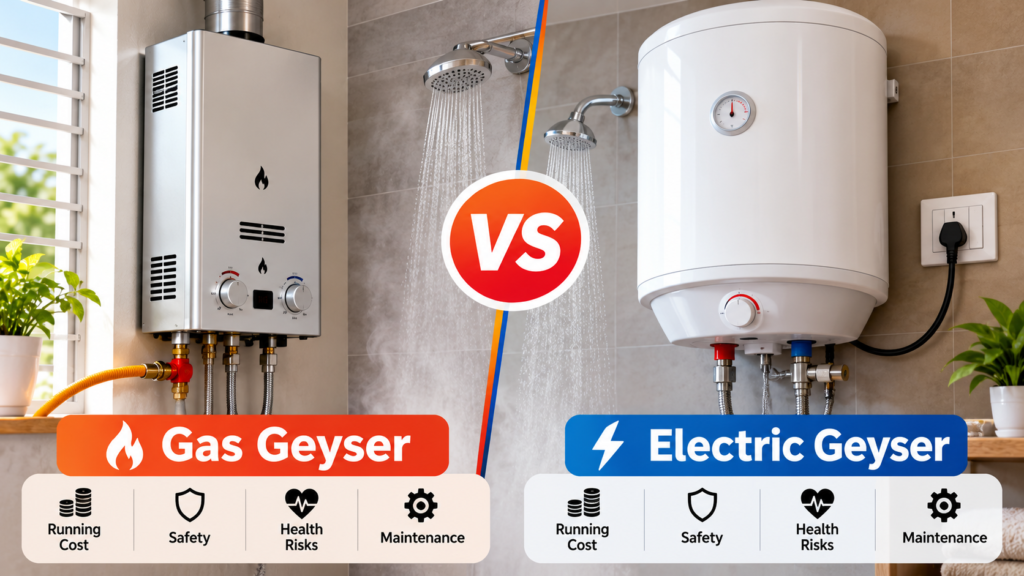
What Is a Gas Geyser?
A gas geyser is a water-heating appliance that uses fuel to heat water. Depending on the model, it may run on liquefied petroleum gas (LPG) or piped natural gas (PNG).
Many household gas geysers are instantaneous water heaters. They heat water as it flows through the appliance instead of storing a large quantity of hot water in a tank.
When you open the hot-water tap, the appliance activates according to its design and heats the passing water. The exact operation depends on the model and its ignition system.
Advantages of a Gas Geyser
1. It can heat water quickly.
An appropriately sized gas geyser can provide hot water quickly when the appliance is operating correctly and the water flow is within its rated capacity.
2. It does not rely on a large electric heating element.
The main heat comes from burning gas. Some models still require batteries or an electrical supply for ignition, controls, or other functions, so they should not all be described as completely electricity-free.
3. It can be useful for frequent hot-water demand.
A correctly sized instantaneous unit may suit households that need repeated hot-water use without waiting for a storage tank to reheat. Its actual performance depends on the required temperature rise, water flow, fuel supply, and appliance capacity.
4. It may have lower running costs in some locations.
Gas can be economical where the fuel price is favourable and the appliance operates efficiently. However, you must compare the cost of useful hot water rather than assuming gas is always cheaper than electricity.
Disadvantages of a Gas Geyser
- It requires a suitable and reliable gas supply.
- Installation must meet the manufacturer’s ventilation, exhaust, and clearance requirements.
- Poor combustion or faulty installation can create a risk of carbon monoxide exposure.
- Gas connections, burners, and exhaust arrangements require appropriate inspection and maintenance.
- LPG cylinder replacement or gas delivery may be inconvenient for some households.
A gas geyser should never be selected on running cost alone. Safe installation and suitable ventilation are essential.
What Is an Electric Geyser?
An electric geyser uses electricity to heat water. Common household models include storage water heaters, which keep hot water in an insulated tank, and instantaneous models, which heat water as it flows through the appliance.
Storage geysers are widely used in Indian homes, particularly for bathing and household hot-water needs. Their capacity may be chosen according to the number of people using hot water and how much is needed at one time.
Advantages of an Electric Geyser
1. It does not burn fuel to heat water.
An electric geyser does not have a gas burner, so it avoids combustion-related carbon monoxide production at the appliance.
2. It is often convenient for everyday use.
Once correctly installed, an electric storage geyser can be straightforward to operate. Many models include thermostats and safety controls, although features vary.
3. It can be suitable for apartments.
Where a suitable electrical connection is available and the installation meets local requirements, an electric geyser may be a practical choice without the need for a household gas connection.
4. Storage models can keep water hot for later use.
An insulated tank stores heated water. The appliance will use additional electricity as necessary to maintain its temperature, depending on insulation, thermostat settings, and usage.
Disadvantages of an Electric Geyser
- It can increase electricity consumption, especially with frequent or prolonged use.
- Storage models need time to heat a tank of water.
- Heat is gradually lost from stored water, even when it is not being used.
- Incorrect wiring, poor earthing, damaged components, or missing safety protection can create electrical hazards.
- The initial purchase and installation cost depends on the model, capacity, and electrical work required.
An electric geyser is not automatically risk-free. It must be properly installed and maintained, especially because water and electricity are present in the same appliance.
Gas Geyser vs Electric Geyser: Main Differences
| Feature | Gas geyser | Electric geyser |
|---|---|---|
| Energy source | LPG or PNG, depending on model | Electricity |
| Heating method | Burns fuel to heat water | Uses an electrical heating element |
| Hot-water delivery | Often instantaneous | Instantaneous or stored in a tank |
| Carbon monoxide risk | Possible if combustion or exhaust is faulty | No combustion-related CO production at the appliance |
| Main safety concerns | Gas leaks, combustion, ventilation and exhaust | Electric shock, faulty wiring, leakage and overheating |
| Running cost | Depends on fuel price and efficiency | Depends on electricity tariff and efficiency |
| Installation | Requires suitable gas supply and approved location | Requires suitable wiring, earthing and electrical protection |
| Maintenance | Burner, gas connections and exhaust may need servicing | Heating element, thermostat, tank and safety components may need servicing |
| Best fit | Homes with a suitable gas supply and safe installation conditions | Homes with suitable electrical infrastructure and hot-water needs |
Neither option wins in every category. The right choice depends on the appliance design, installation quality, local energy costs, and the way your family uses hot water.
Gas Geyser vs Electric Geyser: Which Is More Economical?
Running cost is one of the biggest reasons people compare these appliances. However, the answer cannot be determined simply by looking at the price of an LPG cylinder or the number of watts printed on an electric geyser.
You need to compare how much useful hot water each appliance produces and how much energy it consumes to do so.
How Much Electricity Does an Electric Geyser Use?
Electric geysers are commonly rated in kilowatts (kW). The electricity they consume depends on the heating element’s power, the time it operates, heat losses, and how much hot water your household uses.
For example, imagine a 2,000-watt (2 kW) electric geyser whose heating element operates for a total of one hour during a day.
Electricity consumption:
2 kW × 1 hour = 2 kWh, or 2 electricity units.
If the applicable energy rate is ₹8 per unit, the energy cost for that amount of operation would be:
2 × ₹8 = ₹16.
If the same amount of operation occurred every day for 30 days, the illustrative energy cost would be ₹480 per month.
This is an example, not a prediction of your actual bill. A storage geyser’s heating element does not necessarily run continuously for the entire time the appliance is switched on. Actual consumption depends on water temperature, incoming water temperature, tank insulation, usage, and thermostat operation.
How Much Does a Gas Geyser Cost to Run?
A gas geyser’s cost depends on the fuel it consumes, the amount of hot water required, and the price you pay for LPG or PNG.
To compare it fairly with an electric geyser, consider:
- The gas consumed to heat a given quantity of water.
- The actual price per unit of gas or the effective cost of LPG.
- The appliance’s efficiency and rated performance.
- The incoming water temperature and desired hot-water temperature.
- Any recurring maintenance or servicing costs.
Gas prices vary by location and supply arrangement, so there is no single running-cost figure that applies to every Indian household.
Which One Is Cheaper?
A gas geyser may have a lower running cost in some circumstances, while an electric geyser may be more economical in others. The result depends on fuel and electricity prices, appliance efficiency, and household usage.
For a fair comparison, check the prices from your local LPG or PNG supplier and your electricity provider. Then compare the energy needed to produce a similar amount of hot water.
Also consider the purchase price, installation, maintenance, and expected service life. A small difference in running cost may not justify choosing an appliance that is unsuitable for your home or more difficult to install safely.
Is a Gas Geyser Harmful to Your Health?
This is a particularly important question, especially when a gas geyser is installed near a bathroom.
A correctly selected, installed, ventilated, and maintained gas appliance can be used safely according to its instructions. However, a gas geyser burns fuel, and that introduces risks that an electric geyser does not have in the same way.
The Risk of Carbon Monoxide
Carbon monoxide (CO) is a poisonous gas that can be produced when fuels do not burn properly. It is colourless and odourless, so you cannot rely on smell to detect its presence.
Faulty appliances, poor installation, blocked exhausts, and inadequate ventilation can increase the risk of exposure.
Possible symptoms of carbon monoxide poisoning include:
- Headache
- Dizziness
- Nausea or vomiting
- Weakness and unusual tiredness
- Confusion
- Shortness of breath
- Chest pain in more serious cases
These symptoms can resemble common illnesses, so suspected exposure should be taken seriously.
The NHS guide to carbon monoxide poisoning explains the risks, symptoms, and precautions associated with fuel-burning appliances.
Can a Gas Geyser Be Installed Inside a Bathroom?
Do not assume that a gas geyser is safe to install inside a bathroom simply because it fits on the wall.
Installation requirements depend on the appliance type, manufacturer instructions, applicable standards, and local rules. In particular, gas geysers that burn LPG must not be placed in enclosed bathrooms where combustion gases can accumulate. India’s Department of Consumer Affairs has published comparative testing guidance warning that gas water heaters are unsafe inside bathrooms because of carbon monoxide emissions. Read the Consumer Affairs comparative test report.
Have the appliance installed in a location specifically approved for that model, with the required ventilation and exhaust arrangement. Do not rely on an ordinary exhaust fan as a substitute for the manufacturer’s specified flue or ventilation system.
If a gas geyser is already installed in a poorly ventilated bathroom or its exhaust arrangement is uncertain, stop using it until a qualified professional has assessed the installation.
What Should You Do If You Suspect Carbon Monoxide Exposure?
Leave the affected area and get into fresh air. Seek urgent medical assistance if anyone develops symptoms or may have been exposed. Do not re-enter the area or restart the appliance until it has been checked and declared safe.
Never ignore recurring headaches, dizziness, or nausea that occur when a gas appliance is operating.
Is an Electric Geyser Safer Than a Gas Geyser?
An electric geyser avoids the combustion-related carbon monoxide risk associated with a gas burner, which can be an important advantage in homes where safe gas installation and exhaust arrangements are difficult.
However, that does not mean every electric geyser is automatically safe.
Electrical Shock and Leakage Risks
An electric geyser uses electricity near water. Faulty wiring, inadequate earthing, damaged insulation, or unsuitable electrical protection can create a risk of electric shock.
To reduce this risk:
- Have the appliance installed by a qualified electrician or authorised installer.
- Ensure that earthing and suitable protective devices are provided according to local electrical requirements.
- Use a properly rated circuit and wiring for the appliance’s power demand.
- Never ignore a tingling sensation, damaged cable, burning smell, or repeated electrical tripping.
- Have a qualified professional investigate any suspected electrical fault.
The Bureau of Indian Standards (BIS) lists relevant Indian safety standards for domestic water-heating appliances. When buying an electric geyser, check applicable certification and safety requirements for the particular product.
Overheating and Pressure
Storage water heaters heat water inside a tank, so suitable temperature and pressure controls are important. Safety components must be installed and maintained according to the manufacturer’s instructions.
Never bypass a thermostat, pressure-relief device, or other safety mechanism. If the appliance leaks, overheats, makes unusual noises, or repeatedly trips an electrical safety device, have it inspected rather than continuing to use it.
Which Geyser Is Better for an Indian Home?
The answer depends on your home and how you use hot water.
Choose an Electric Geyser If…
An electric geyser may be a good fit if:
- Your home has a suitable electrical supply.
- You prefer to avoid a combustion appliance.
- You want a storage model that keeps hot water available for routine use.
- You live in an apartment where a suitable gas installation is not practical.
- You can install the appliance with proper wiring, earthing, and safety protection.
Select the tank capacity according to your household’s requirements. A larger tank is not automatically better because it may cost more and can have greater standing heat losses.
Consider a Gas Geyser If…
A gas geyser may be suitable if:
- You have a reliable LPG or PNG supply.
- The model is approved for your intended installation location.
- Proper ventilation and exhaust arrangements can be provided.
- You have access to qualified installation and servicing.
- Your hot-water demand and local fuel prices make it a practical choice.
Do not choose a gas geyser for an enclosed bathroom simply because it heats water quickly. Safety and approved installation conditions come first.
What If Your Family Uses a Lot of Hot Water?
Consider how many people need hot water, whether they use it at the same time, and whether you prefer stored or on-demand heating.
A storage electric geyser may suit a household with predictable bathing routines. An appropriately sized instantaneous gas geyser may suit some households with frequent demand, provided the installation is safe and approved.
Neither option should be selected solely on the basis of the number of family members. Water flow, temperature rise, appliance capacity, and usage patterns also matter.
Important Safety Tips for Gas and Electric Geysers
Whichever appliance you choose, regular care and safe installation are essential.
Gas Geyser Safety Checklist
- Use an approved appliance and a qualified installer.
- Follow the manufacturer’s location, clearance, ventilation, and exhaust requirements.
- Keep air vents and exhaust outlets clear.
- Have the gas connections and burner inspected as recommended.
- Do not ignore signs of poor combustion, soot, unusual operation, or a damaged exhaust.
- Never use a gas geyser in a location prohibited by the manufacturer or applicable safety guidance.
If you smell gas, avoid flames and do not operate electrical switches in the affected area. Leave the area and contact your gas supplier or emergency service from a safe location.
Electric Geyser Safety Checklist
- Use a suitable electrical circuit installed by a qualified professional.
- Ensure proper earthing and appropriate electrical protection.
- Check for leaks, damaged cables, unusual smells, or repeated tripping.
- Follow the manufacturer’s instructions for temperature settings and maintenance.
- Never attempt repairs while the appliance is energised.
- Do not bypass safety controls or use a damaged appliance.
These precautions are not optional extras. They are part of choosing and maintaining a water heater responsibly.
Frequently Asked Questions
1. Which is better, a gas geyser or an electric geyser?
Neither is best for every home. Gas geysers may suit homes with a reliable fuel supply and an approved, well-ventilated installation. Electric geysers may suit homes with appropriate electrical infrastructure where avoiding combustion is a priority.
2. Is a gas geyser dangerous for health?
A gas geyser can pose a serious health risk if fuel combustion is faulty or exhaust gases accumulate. Carbon monoxide is especially dangerous because it has no smell or colour. Correct installation, ventilation, and maintenance are essential.
3. Is an electric geyser completely safe?
No appliance is completely risk-free. Electric geysers can cause electric shock or other hazards if improperly installed, damaged, or poorly maintained. Correct earthing, suitable electrical protection, and professional installation are important.
4. Which geyser consumes less electricity?
A gas geyser generally uses fuel as its main heat source, although some models also require electricity or batteries for controls and ignition. An electric geyser uses electricity to heat water. Comparing total running costs requires considering the local price of gas, electricity consumption, and appliance efficiency.
5. Which geyser is cheaper to run in India?
It depends on local LPG or PNG prices, the electricity tariff, the amount of hot water used, and the efficiency of the particular appliances. Compare actual fuel consumption and electricity use instead of assuming that one type is always cheaper.
6. Can I install a gas geyser inside my bathroom?
Do not install one inside an enclosed bathroom unless the exact appliance and installation are explicitly approved for that location under the manufacturer’s instructions and applicable rules. Many conventional gas geysers are unsuitable for bathroom installation because of combustion-gas and carbon monoxide risks. Seek qualified professional advice before installation.
7. Does an electric geyser increase the electricity bill?
Yes, it adds to electricity consumption when its heating element operates. The amount depends on the geyser’s power rating, water temperature, quantity of hot water used, insulation, and electricity tariff.
8. Which geyser is better for a family of four?
Either type may work, depending on hot-water demand and installation conditions. Consider the required capacity or flow rate, the number of simultaneous users, local energy prices, and safety requirements before choosing.
9. Which type heats water faster?
An instantaneous gas geyser can heat water as it flows through the appliance, while a storage electric geyser usually needs time to heat the stored water. Actual performance depends on appliance capacity, incoming water temperature, desired temperature, and water flow.
10. How often should a geyser be serviced?
Follow the manufacturer’s maintenance schedule. Gas appliances need suitable checks of burners, gas connections, and exhaust arrangements. Electric storage geysers may require inspection of safety controls, the heating element, tank, and other components, depending on the model and local water conditions.
Final Verdict: Gas Geyser vs Electric Geyser
When comparing a gas geyser vs an electric geyser, it is important to look beyond the purchase price and advertised heating speed.
A gas geyser can be convenient and may offer favourable running costs in some homes, but combustion safety, ventilation, and exhaust installation are critical. An electric geyser avoids combustion-related carbon monoxide production at the appliance, but it needs proper electrical installation and protection against electrical faults.
For many households, the most sensible choice is the appliance that can be installed safely, meets the family’s hot-water needs, and offers a reasonable total cost over its service life.
Before buying, compare the model specifications, local energy rates, installation requirements, warranty, and maintenance needs. If you are unsure whether your bathroom or electrical system is suitable, get advice from a qualified installer rather than taking a risk.
The bottom line: Choose a geyser based on safety first, suitability second, and running cost third. A correctly installed and maintained appliance is more important than choosing gas or electricity based on price alone.
Disclaimer: This article provides general educational information. Installation requirements vary by appliance and location. Always follow the manufacturer’s instructions and applicable local safety requirements, and use qualified professionals for gas and electrical work.
SHARING IS CARING 💖