
Can a government employee buy a car or bike in their spouse’s name? Is it compulsory for a government servant to register a vehicle in their own name? Does an employee need permission from their department before purchasing a new vehicle?
These are common questions among Central Government employees, State Government employees, teachers, police personnel, railway employees, and other public servants in India.
Government employees can generally purchase cars, motorcycles, scooters, and other personal vehicles, subject to the rules applicable to their service. However, buying a vehicle, registering it in someone’s name, obtaining departmental permission, and reporting the transaction are separate matters.
In this guide, we explain the main rules, when departmental intimation may be required, whether a vehicle can be purchased in a family member’s name, and what employees should check before buying a vehicle in 2026.
Important: This article provides general information. The exact requirements depend on the employee’s service, department, applicable conduct rules, and the circumstances of the purchase.
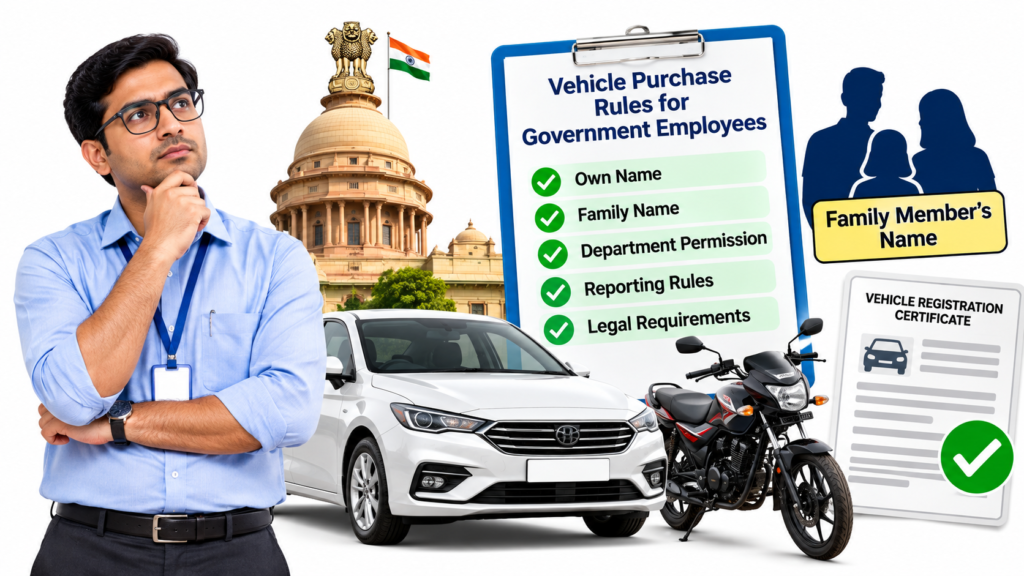
1. Can a Government Employee Buy a Vehicle in India?
Yes, government employees can generally purchase personal vehicles for their own use or family use. There is no blanket prohibition under the Central Civil Services (Conduct) Rules, 1964, against an eligible government employee purchasing a car, motorcycle, or scooter.
However, the employee may have to follow the applicable rules concerning financial transactions, departmental reporting, official dealings, and any vehicle-related loan or advance.
For Central Government employees covered by the Central Civil Services (Conduct) Rules, Rule 18(3) addresses transactions involving movable property. Motor vehicles are commonly treated as movable property for these purposes.
Employees should consult their department’s latest instructions before completing a purchase, particularly when the vehicle is expensive or the seller has official dealings with them.
Official reference: Central Civil Services (Conduct) Rules, 1964.
2. Is It Compulsory to Buy a Vehicle in the Government Employee’s Own Name?
A government employee should not assume that the vehicle must always be purchased or registered in their own name simply because they work for the government.
The vehicle’s registration and the employee’s service-conduct obligations are separate questions. The applicable transport laws determine registration requirements, while the employee’s conduct rules may require reporting a transaction even if the vehicle is acquired in a family member’s name.
For employees covered by Rule 18(3) of the Central Civil Services (Conduct) Rules, the provision expressly refers to transactions in movable property made in the employee’s own name or in the name of a member of their family.
Therefore, putting a vehicle in a family member’s name does not automatically remove the employee’s reporting obligations.
Before deciding whose name should appear on the registration certificate, check the applicable rules and make sure the ownership, payment source, insurance, and registration details are accurate.
3. Can a Government Employee Buy a Car in Their Wife’s or Husband’s Name?
A government employee may generally purchase a vehicle for a spouse, subject to applicable law and service rules. However, the transaction should be genuine and properly documented.
Consider these points before purchasing a vehicle in a spouse’s name:
- Payment source: Keep records showing who paid for the vehicle and where the funds came from.
- Registration: Ensure the registration certificate correctly identifies the registered owner.
- Insurance: Provide accurate information to the insurer about ownership and vehicle use.
- Departmental reporting: Check whether the employee must report the transaction under the applicable conduct rules.
- Official dealings: Additional restrictions or prior approval may apply when the seller has official dealings with the employee.
Under Rule 18(3) of the Central Civil Services (Conduct) Rules, transactions in movable property in the name of a family member are covered by the reporting provision when the specified value threshold is exceeded.
The exact definition of “family member” and the relevant procedures should be checked against the rules applicable to the employee.
4. Does a Government Employee Need Departmental Permission to Buy a Car or Bike?
Not every vehicle purchase requires prior permission. For Central Government employees covered by Rule 18(3), the general rule is to report a qualifying movable-property transaction within one month.
However, the same rule states that prior sanction of the prescribed authority must be obtained when the transaction is with a person having official dealings with the employee.
This distinction is important:
- Ordinary purchase: A qualifying transaction may require reporting after the transaction rather than advance permission.
- Purchase involving a person with official dealings: Prior sanction may be required under the applicable provision.
- Department-specific rules: Additional instructions, forms, or approval requirements may apply.
- Vehicle advances or loans: Separate rules may apply if the employee uses a government advance, department-linked facility, or another special financing arrangement.
Do not treat this general explanation as permission to proceed without checking your department’s instructions. If you are unsure whether the seller has official dealings with you or your office, consult your vigilance, administration, or establishment section before making the purchase.
5. What Is the Vehicle Purchase Reporting Rule Under CCS Conduct Rules?
Rule 18(3) of the Central Civil Services (Conduct) Rules, 1964, deals with transactions involving movable property.
For employees covered by this provision, a transaction must generally be reported to the prescribed authority within one month if the value of the movable property exceeds two months’ basic pay.
The rule also requires prior sanction when the transaction is with a person having official dealings with the employee.
A car or motorcycle may fall within this provision. The reporting obligation should therefore be checked before assuming that no action is required after purchasing a vehicle.
Example
Suppose a covered Central Government employee has a basic pay of ₹40,000 per month and purchases a car for ₹8,00,000.
Two months’ basic pay would be ₹80,000. The vehicle’s value exceeds that threshold, so the employee would generally need to report the transaction within one month under Rule 18(3), subject to the applicable rules and circumstances.
This is only an illustration of the threshold. It is not a determination of any individual employee’s legal obligations.
Official reference: CCS (Conduct) Rules — Rule 18.
6. Which Documents May Be Required for Vehicle Purchase Intimation?
If departmental intimation or permission is required, the employee should ask their establishment or administration section for the prescribed form and supporting documents.
Depending on the department’s procedure, the following information may be requested:
- Employee’s name, designation, department, and pay details
- Vehicle make and model
- Vehicle purchase price
- Proposed or actual purchase date
- Name and details of the seller or dealer
- Mode of acquisition, such as purchase or another arrangement
- Source of funds or financing details, if required
- Vehicle registration details, when available
- Details of any relevant prior sanction or reporting
The exact list may vary. Do not assume that every department requires the same attachments.
Keep a copy of the submitted form, acknowledgement, approval, or other relevant correspondence for your records.
7. Can a Government Employee Buy a Vehicle Without Informing the Department?
The answer depends on the employee’s applicable rules and the value and circumstances of the transaction.
For a Central Government employee covered by Rule 18(3), a qualifying movable-property transaction exceeding two months’ basic pay generally has to be reported within one month. Prior sanction is required in the circumstances specified in that rule.
A lower-value transaction may fall outside this particular reporting threshold, but other applicable rules or departmental instructions may still matter.
Employees should not assume that every car or bike purchase is exempt from reporting. They should check the relevant rule, calculate the applicable threshold using their basic pay, and confirm the procedure with their department.
8. Are the Same Vehicle Purchase Rules Applicable to State Government Employees?
Not necessarily.
Central Government employees covered by the CCS (Conduct) Rules are subject to those rules. State Government employees may be governed by their respective State Civil Services Conduct Rules, departmental regulations, or service-specific instructions.
Employees in services such as the All India Services may also be covered by separate conduct rules.
Consequently, a reporting threshold, form, deadline, or permission requirement applicable to one category of employee should not automatically be applied to every government servant in India.
Before buying a vehicle, check the latest conduct rules for your state or service and ask your department’s administration section if any requirement is unclear.
9. What If the Vehicle Is Purchased Using a Bank Loan?
Buying a vehicle through a bank loan does not automatically remove any reporting requirement that otherwise applies to the transaction.
The employee should check the applicable conduct rules and any separate departmental requirements relating to loans, advances, or financial declarations.
Keep the relevant records, such as the purchase invoice, loan documents, payment proof, and registration certificate. Submit any required intimation or permission request using the department’s prescribed procedure.
If a government vehicle advance or another special financing facility is involved, review the conditions of that facility separately.
10. What Can Happen If a Government Employee Fails to Follow the Rules?
If an employee fails to comply with an applicable reporting or permission requirement, the matter may be examined under the relevant service and conduct rules.
The consequences depend on the facts, the rule that applies, and the employee’s service. A missed intimation deadline does not automatically mean that the same penalty will apply in every case.
If you discover that you should have reported a vehicle purchase but did not do so, contact your administration or vigilance section promptly and ask how to regularise the position. Keep the original transaction documents and provide accurate information.
Do not submit false declarations or conceal the source of funds.
11. Practical Checklist Before Buying a Vehicle
Before purchasing a car, motorcycle, or scooter, a government employee should:
- Identify the conduct rules applicable to their service.
- Check whether the vehicle transaction crosses the relevant reporting threshold.
- Confirm whether advance permission is necessary in the circumstances.
- Ask the department for the current form and submission procedure.
- Keep the invoice, payment proof, loan documents, and registration records.
- Ensure that the registered ownership and insurance details are accurate.
- Retain proof of any departmental intimation or approval.
Taking these steps can help prevent avoidable administrative problems after the purchase.
Frequently Asked Questions (FAQs)
1. Is it compulsory for a government employee to buy a car in their own name?
There is no blanket rule in the CCS (Conduct) Rules requiring every vehicle to be registered in the employee’s own name. Registration requirements and service-conduct obligations are separate matters. The employee must follow the rules applicable to their service and the actual transaction.
2. Can a government employee buy a bike in their wife’s or husband’s name?
A vehicle may generally be purchased for a spouse, subject to applicable law and service rules. A family member’s name does not automatically exempt a covered employee from transaction-reporting obligations.
3. What is the vehicle purchase reporting threshold under Rule 18(3)?
For a Central Government employee covered by the rule, a movable-property transaction exceeding two months’ basic pay generally must be reported within one month. Prior sanction is required when the transaction is with a person having official dealings with the employee.
4. Is prior departmental permission always necessary before buying a car?
No, not under the general reporting provision of Rule 18(3) in every case. The rule distinguishes ordinary reporting from transactions requiring prior sanction. Department-specific requirements may also apply.
5. Do State Government employees follow the same rules?
Not necessarily. State employees should consult their state’s conduct rules and departmental instructions. Different services can have different requirements.
6. Does buying a vehicle with a bank loan change the reporting requirement?
A bank loan does not automatically remove a reporting requirement that otherwise applies. Check the relevant conduct rules and any separate financing or departmental conditions.
7. Where can a Central Government employee check the applicable rules?
Start with the Department of Personnel and Training (DoPT) and the applicable CCS (Conduct) Rules. Your department’s establishment or administration section can clarify the correct form, deadline, and approval process.
Conclusion
Government employees in India can generally purchase cars, motorcycles, and other personal vehicles, but they must comply with the rules applicable to their service.
There is no universal requirement under the CCS (Conduct) Rules that every vehicle must be registered in the employee’s own name. However, covered Central Government employees must pay attention to Rule 18(3), which generally requires reporting qualifying movable-property transactions exceeding two months’ basic pay within one month and requires prior sanction in specified circumstances involving persons with official dealings.
Before completing a purchase, verify the applicable conduct rules, document the transaction accurately, and consult your department if you are uncertain. This is the safest way to understand your obligations without relying on general advice that may not apply to your service.
SHARING IS CARING 💖