
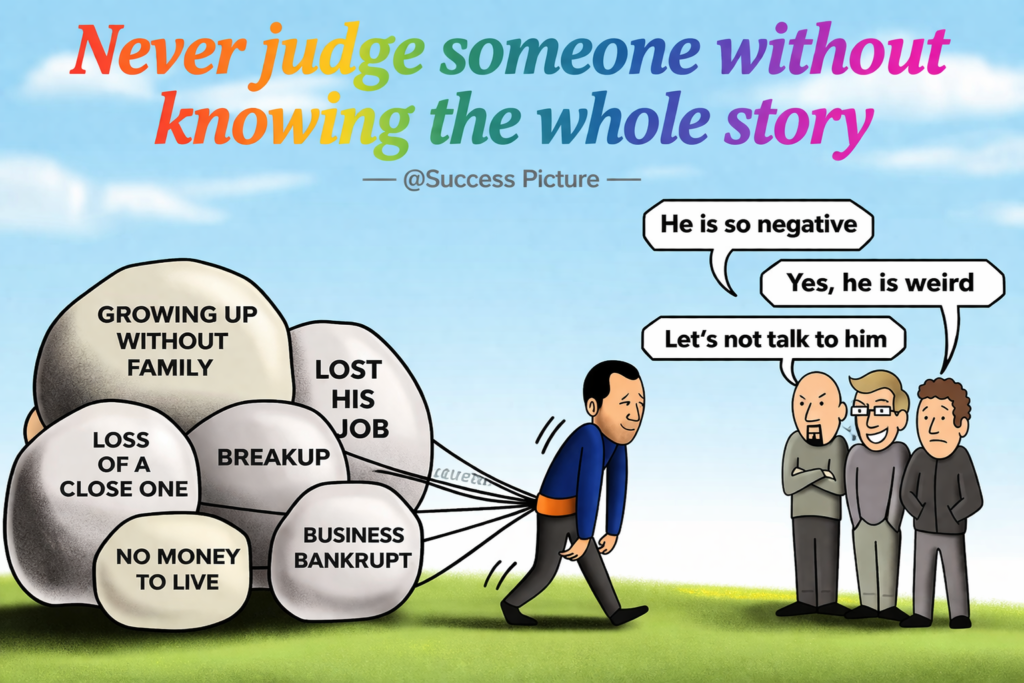
In a world where opinions are formed in seconds and social media encourages instant reactions, it has become easier than ever to judge people without understanding what they are truly going through. The powerful message in your image reminds us of an important life lesson: never judge someone without knowing the whole story.
What looks like negativity, distance, strange behavior, or silence on the outside may actually be the visible result of invisible pain. Behind every person’s actions, there may be years of struggle, heartbreak, financial hardship, emotional wounds, or loss that others simply cannot see.
The image beautifully illustrates this truth. A man appears tired and emotionally heavy while others label him as “negative” or “weird.” Yet behind him are massive hidden burdens—growing up without family, losing a job, going through a breakup, losing a loved one, facing bankruptcy, and having no money to survive.
This is more than a quote. It is a reminder to choose empathy over assumptions.
In this article, we’ll explore why people judge too quickly, the unseen struggles many carry, how empathy improves relationships, and practical ways to become a more understanding human being.
Why People Judge Too Quickly
Judgment often happens because the human brain likes shortcuts.
Instead of understanding complex situations, people often create simple labels:
- rude
- lazy
- negative
- weird
- unsuccessful
- difficult
- antisocial
These labels may feel convenient, but they are often far from the truth.
A person who seems angry may be grieving.
A person who seems distant may be overwhelmed.
A person who seems unmotivated may be silently depressed.
A person who seems negative may be fighting battles they never talk about.
Quick judgment creates false stories in our mind.
The problem is not observation—the problem is assuming we know everything from what we see.
The Hidden Weight People Carry
The stones shown in the image symbolize burdens many people silently carry every day.
These burdens are often invisible:
- childhood trauma
- family problems
- financial stress
- emotional pain
- heartbreak
- unemployment
- loneliness
- grief
- mental exhaustion
- failed businesses
- personal disappointments
Most people do not openly talk about these struggles.
Some smile while breaking inside.
Some work while grieving.
Some socialize while feeling deeply alone.
The strongest-looking people may be carrying the heaviest emotional weight.
This is why empathy matters.
The Truth Behind “Negative” Behavior
People often label others as negative because they focus on what is visible.
But behavior is usually a symptom, not the root problem.
Someone who lost a job may appear frustrated.
Someone facing bankruptcy may look hopeless.
Someone who grew up without family may struggle with trust.
Someone who recently went through a breakup may seem emotionally unavailable.
The visible behavior is often the final expression of a much deeper experience.
Instead of asking:
“Why are they acting like this?”
A better question is:
“What might they be going through?”
This simple shift changes judgment into compassion.
Why Empathy Is More Powerful Than Assumption
Empathy means trying to understand another person’s emotions, struggles, and experiences without immediately labeling them.
It allows us to see the human behind the behavior.
Empathy improves:
- friendships
- marriages
- workplace communication
- leadership
- parenting
- community trust
- emotional intelligence
When you lead with empathy, people feel safe, understood, and respected.
This builds stronger personal and professional relationships.
Social Media Has Increased Instant Judgment
In the USA and across the world, digital culture has made instant judgment more common.
People judge others based on:
- one post
- one comment
- one photo
- one short interaction
- one bad moment
- one misunderstanding
Social media rarely shows the full story.
It shows highlights, reactions, and fragments—not the emotional context behind someone’s life.
This is why many online arguments happen so quickly. People react to the visible surface without understanding the deeper reality.
The lesson from your image is incredibly relevant today.
Everyone Is Fighting a Battle You Cannot See
One of the most powerful truths in life is this:
every person you meet is fighting a battle you know nothing about.
The cashier who seems distracted may be worried about bills.
The coworker who seems rude may be dealing with family loss.
The friend who stopped replying may be mentally exhausted.
The stranger who seems cold may have trust issues from past pain.
When you remember this, your heart becomes softer.
Instead of anger, you choose patience.
Instead of labels, you choose questions.
Instead of rejection, you choose kindness.
The Cost of Judging People
Judgment damages more than relationships.
It can:
- isolate hurting people
- worsen emotional pain
- increase loneliness
- create workplace toxicity
- damage trust
- destroy friendships
- harm mental health
- push people further into silence
Sometimes a person who is already carrying emotional weight feels even heavier because of the labels others place on them.
Words matter.
Assumptions can become emotional wounds.
How to Practice Understanding Instead of Judgment
Becoming less judgmental is a daily mindset practice.
Here are powerful ways to build empathy:
1. Pause Before Reacting
Not every behavior needs an instant conclusion.
Give yourself time to ask:
“What else could explain this?”
This simple pause reduces emotional reactions.
2. Ask Questions Instead of Assuming
Healthy curiosity creates understanding.
Try:
- “Are you okay?”
- “Is something bothering you?”
- “How have you been lately?”
Sometimes people simply need someone to notice.
3. Remember Your Own Hard Days
Think about moments when people misunderstood you.
Remember how painful it felt.
Use that memory to become kinder to others.
4. Separate Behavior from Identity
A bad moment does not define a person.
Someone can be struggling without being a bad human.
Focus on the situation, not the label.
5. Offer Compassion
Even if you don’t know the full story, kindness is always safe.
A little patience can make someone’s day lighter.
The Workplace Lesson: Don’t Judge Performance Too Fast
This lesson is especially important in professional settings across the USA.
Managers, leaders, and coworkers often judge performance without understanding personal struggles.
An employee who suddenly becomes less productive may be dealing with:
- family emergencies
- mental fatigue
- financial pressure
- health issues
- emotional burnout
The best leaders ask questions before making assumptions.
This builds trust and improves team morale.
How This Mindset Improves Your Life
When you stop judging quickly, your own life becomes better too.
You become:
- calmer
- wiser
- emotionally stronger
- more patient
- more respected
- a better communicator
- a better friend
- a stronger leader
Empathy is not weakness.
It is emotional maturity.
People naturally trust those who make them feel seen instead of judged.
Teach This Lesson to Children Early
One of the best life lessons parents can teach is empathy.
Children should learn that:
- not everyone’s pain is visible
- people behave differently for reasons
- kindness matters
- judging hurts
- understanding helps
This creates emotionally intelligent adults.
The image message is powerful for family values, schools, and personal development content.
The Deeper Truth About Human Behavior
Human behavior is often the result of accumulated life experiences.
The person in your image is not weak.
He is carrying years of invisible stones:
- pain
- rejection
- grief
- money struggles
- emotional loss
- life failures
People on the outside only see the walk.
They do not see the weight.
That is the entire lesson.
Never confuse visible behavior with the full truth of someone’s life.
ALSO READ…
- Push Yourself First: The Real Secret to Achieving Your Dreams
- The Reality of Society: Why Hard Work Alone Isn’t Always Enough
- Your Mindset Is Your Strength or Your Weakness: The Hidden Power Within
- Work Today, Win Tomorrow: The Discipline That Builds Extraordinary Success
- Clean Your Mind: Why Leaving a Negative Environment Is the First Step to Success
Final Thoughts: Choose Compassion Over Labels
The next time someone seems negative, distant, strange, or emotionally heavy, remember this image.
Behind what you see may be:
- grief
- family wounds
- heartbreak
- survival stress
- financial hardship
- loneliness
- trauma
You may never know the whole story.
That is exactly why judgment should be replaced with compassion.
Never judge someone without knowing the whole story.
A little understanding can lighten someone’s invisible load.
And in today’s world, that kindness matters more than ever.
SHARING IS CARING 💖