
Life is a journey filled with decisions—some simple, others incredibly complex. From choosing a career path to navigating relationships, managing finances, or deciding whom to trust, the choices we make shape the direction of our lives.
One powerful concept captures the essence of balanced decision-making:
“Your heart and your brain together have to be pilots of your life.”
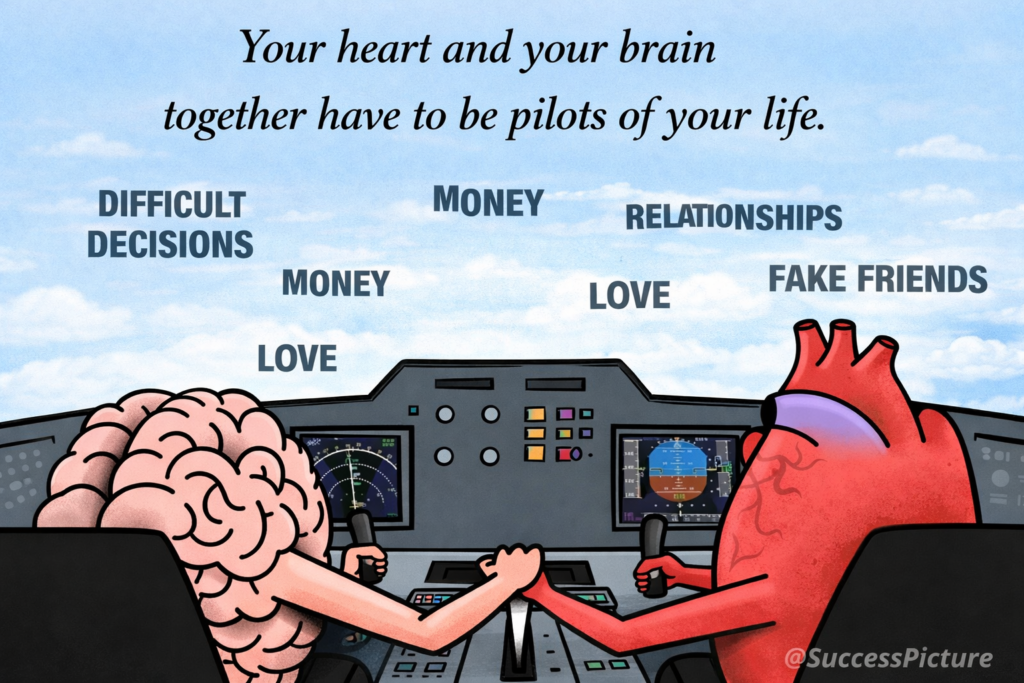
The illustration above perfectly represents this idea. It shows a brain and a heart sitting in the cockpit of a plane, both holding the controls together as they navigate life’s challenges. Outside the cockpit appear various life factors—money, love, relationships, difficult decisions, and even fake friends.
The message is simple but profound: life works best when logic and emotion work together.
In this article, we will explore why balancing the mind and the heart leads to better decisions, how emotions and logic influence our lives, and practical ways to create harmony between the two.
The Meaning Behind the Image
The image depicts a brain and a heart working together like pilots flying an aircraft. The aircraft represents your life, and the pilots represent two powerful forces:
- The brain – logic, analysis, planning, and rational thinking.
- The heart – emotions, empathy, intuition, and passion.
Throughout life, we encounter situations involving:
- Difficult decisions
- Money
- Love
- Relationships
- Fake friends
Each of these areas requires both clear thinking and emotional awareness.
If we rely only on logic, life can become cold and mechanical. If we rely only on emotions, we may make impulsive choices.
But when both work together, we gain clarity and wisdom.
Why Both Logic and Emotion Are Necessary
Many people believe that logic and emotions are opposites. In reality, they complement each other.
Successful decision-making requires both rational thinking and emotional intelligence.
The Brain’s Role
Your brain helps you:
- Analyze situations
- Evaluate risks
- Plan long-term goals
- Solve complex problems
- Make strategic decisions
For example, when making financial choices or career plans, logical thinking helps you understand consequences and outcomes.
The Heart’s Role
Your heart represents:
- Empathy
- Passion
- Compassion
- Intuition
- Emotional connection
These qualities guide decisions involving relationships, values, and purpose.
When combined, these two forces create balanced decision-making.
When People Rely Only on Logic
While logic is essential, relying only on logic can create problems.
People who focus solely on rational thinking may:
- Ignore emotional needs
- Struggle with relationships
- Make decisions that lack compassion
- Prioritize success over happiness
For example, someone may choose a career purely for money, ignoring their passion. Over time, this may lead to dissatisfaction and burnout.
Life is not just about efficiency—it’s also about meaning and fulfillment.
When People Rely Only on Emotion
On the other hand, relying only on emotions can also lead to poor decisions.
Emotional decision-making can cause people to:
- Act impulsively
- Ignore logical consequences
- Trust the wrong people
- Make short-term choices that harm long-term goals
For example, someone might lend money to unreliable friends out of sympathy, even when logic suggests it’s a bad idea.
This is why emotional intelligence must be balanced with rational thinking.
ALSO READ…
- 20 Hard Work Quotes for Career Success to Keep You Motivated Every Day
- 25 Quotes About Success Without Shortcuts That Inspire Real Growth
- The Hidden Truth About Success: Why Self-Respect Matters More Than Blind Approval
- Too Much Trust Might Kill You: The Hidden Danger of Blind Trust in Life and Business
- We Are Too Connected: How Digital Overload Is Quietly Controlling Your Life
The Areas of Life That Require Balance
The image highlights several key aspects of life where balance between heart and brain is essential.
1. Difficult Decisions
Some decisions are straightforward, but others require careful thought.
Examples include:
- Changing careers
- Moving to a new city
- Ending or starting relationships
- Starting a business
In these situations, your brain analyzes the facts, while your heart evaluates personal happiness and fulfillment.
Together, they help you make thoughtful choices.
2. Money and Financial Choices
Money is one of the most common sources of stress in life.
Financial decisions require logic because they involve:
- Budgeting
- Investing
- Risk management
- Long-term planning
However, emotions still play a role. For example:
- Generosity
- Supporting family
- Giving to meaningful causes
Balancing financial intelligence with emotional values creates responsible and fulfilling financial habits.
3. Love and Relationships
Relationships cannot survive on logic alone.
Love requires empathy, understanding, patience, and emotional connection.
But logic still matters.
For example, logic helps you:
- Recognize unhealthy relationships
- Establish boundaries
- Communicate clearly
- Evaluate long-term compatibility
The best relationships grow when both partners use heart and mind together.
4. Identifying Fake Friends
The image also mentions fake friends, a challenge many people face.
Your heart may want to trust and believe the best in others.
But your brain helps you notice patterns such as:
- Lack of loyalty
- Selfish behavior
- Dishonesty
- Manipulation
Balancing compassion with awareness helps you build healthier relationships.
Emotional Intelligence: The Bridge Between Heart and Brain
One concept that connects logic and emotion is emotional intelligence.
Emotional intelligence is the ability to understand and manage emotions while also making rational decisions.
People with strong emotional intelligence can:
- Recognize their feelings
- Understand others’ emotions
- Manage stress
- Communicate effectively
- Make balanced decisions
This skill is essential for leadership, relationships, and personal success.
How Successful People Balance Logic and Emotion
Many successful leaders rely on both analytical thinking and emotional awareness.
For example:
Business Leaders
Successful entrepreneurs combine strategic planning with empathy for customers and employees.
Athletes
Top athletes train their minds with discipline while maintaining passion and motivation.
Great Leaders
Great leaders understand data and logic but also connect emotionally with people.
The most effective individuals understand that success is both intellectual and emotional.
Practical Ways to Balance Your Heart and Brain
Developing balance between logic and emotion requires practice.
Here are some strategies that can help.
1. Pause Before Making Important Decisions
Instead of reacting immediately, take time to think.
Ask yourself:
- What does logic suggest?
- What does my intuition tell me?
This pause creates space for balanced thinking.
2. Write Down Pros and Cons
Writing down advantages and disadvantages helps engage the logical side of your brain.
At the same time, reflect on how each option feels emotionally.
Combining both perspectives improves clarity.
3. Learn to Recognize Emotional Triggers
Strong emotions can cloud judgment.
Recognizing emotional triggers allows you to pause and think before reacting.
This awareness strengthens decision-making.
4. Seek Advice From Trusted People
Sometimes an outside perspective helps balance emotions and logic.
Mentors, friends, or advisors can offer insights that improve decision quality.
5. Trust Your Intuition—But Verify With Logic
Intuition can be powerful because it draws on experience and subconscious knowledge.
However, it works best when supported by rational thinking.
Use intuition as a guide, but confirm decisions with facts.
Why Balanced Decision-Making Leads to a Better Life
People who balance emotion and logic often experience:
- Better relationships
- Less regret
- Improved problem-solving
- Greater self-confidence
- More fulfilling lives
They make decisions that align with both their goals and their values.
Instead of feeling pulled in different directions, they create harmony between mind and heart.
Life Is a Journey That Requires Both Pilots
The cockpit illustration reminds us of an important truth:
Life is like flying an airplane.
If only one pilot controls the aircraft, the journey becomes unstable.
But when both pilots work together, the flight becomes smooth and successful.
Your heart gives your life meaning.
Your brain gives your life direction.
Together, they guide you toward a balanced and fulfilling future.
Final Thoughts: Let Both Guide Your Journey
Life is filled with complex decisions involving love, money, relationships, and personal growth.
Relying solely on logic or emotion can lead to imbalance.
But when the heart and brain work together, they create wisdom.
Remember this simple principle:
Let your brain analyze the path, and let your heart remind you why the journey matters.
When both guide your choices, you gain the ability to navigate life with confidence, clarity, and purpose.
SHARING IS CARING 💖