
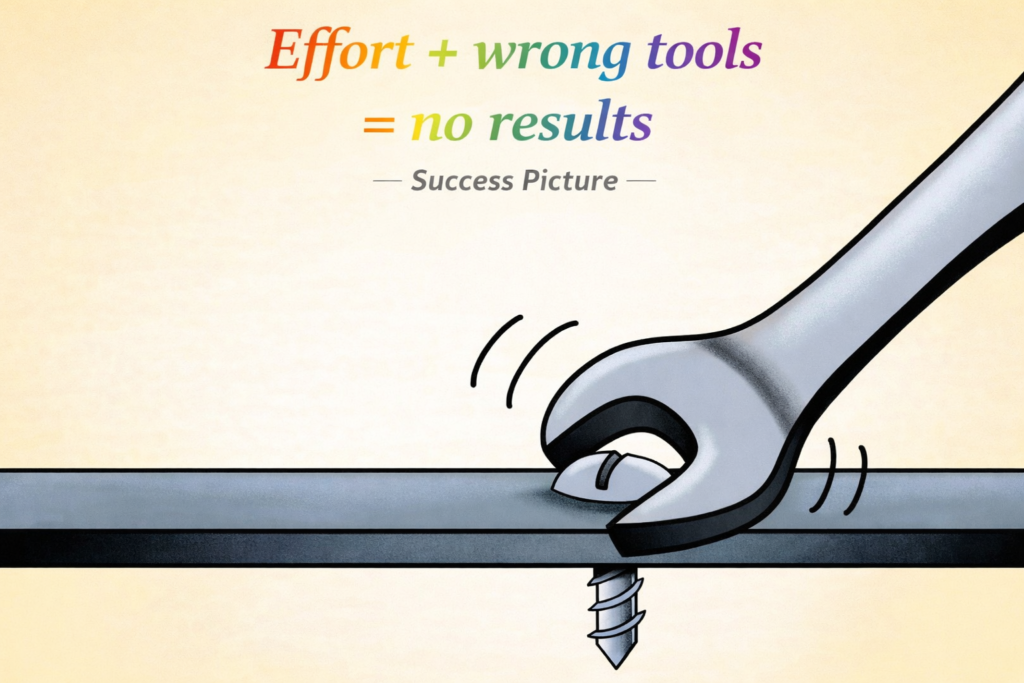
Hard work is often praised as the ultimate key to success. People are taught to stay busy, keep pushing, and never stop trying. But the powerful message in your image reveals a deeper truth: effort without the right tools often leads to little or no results.
The visual of a wrench trying to turn a screw perfectly captures a mistake many people make in life, work, business, and personal growth. The person is clearly putting in effort, but because the tool is wrong for the task, progress does not happen. This simple illustration carries a profound lesson: success depends not only on effort, but also on strategy, systems, and choosing the right methods.
In today’s highly competitive world—especially in the USA where productivity, entrepreneurship, career growth, and smart systems matter more than ever—working harder without working smarter can waste valuable time, money, and energy.
This article explores why hard work alone is not enough, how wrong strategies silently block progress, and practical ways to choose the right tools for faster and more sustainable success.
Why Effort Alone Sometimes Fails
Many people assume that if they just work harder, results will automatically follow.
But in reality, effort without direction can become wasted motion.
This happens when people:
- use outdated methods
- choose the wrong systems
- ignore better strategies
- focus on low-value tasks
- solve the wrong problem
- use poor technology
- apply the wrong mindset
- avoid learning new skills
The image’s wrench-and-screw metaphor shows exactly this.
The energy is real.
The method is wrong.
That is why results stay invisible.
The Hidden Cost of Using the Wrong Tools
Using the wrong tools creates more than failure.
It creates:
- frustration
- burnout
- wasted time
- lower confidence
- slower progress
- repeated mistakes
- financial losses
- emotional exhaustion
This is dangerous because many people mistake lack of results for lack of ability, when the real issue is simply the wrong tool.
The problem is not always the worker.
Often, it is the system.
What “Wrong Tools” Means in Real Life
The “wrong tools” in the image represent much more than physical tools.
In real life, wrong tools can mean:
- poor habits
- outdated software
- weak study methods
- bad marketing strategies
- toxic environments
- incorrect advice
- lack of automation
- ineffective communication
- wrong business models
- poor financial systems
For example:
A person may work 10 hours daily but still use outdated workflows that cut productivity in half.
The effort is high.
The output is low.
Why Smart Strategy Beats Raw Effort
Success today is built on leverage.
Leverage means using systems, tools, and methods that multiply effort.
Examples include:
- automation software
- AI tools
- content scheduling
- productivity apps
- data-driven marketing
- time-blocking systems
- smarter learning methods
- better networking platforms
The right tool can turn one hour of work into the results of ten.
This is especially true in the USA’s fast-moving digital economy.
The Career Lesson: Skill + Systems = Growth
Many professionals work extremely hard but fail to grow because they use outdated career strategies.
Wrong career tools include:
- generic resumes
- weak LinkedIn profiles
- poor networking
- outdated technical skills
- lack of digital literacy
- ineffective communication habits
The modern workplace rewards smarter systems, not just longer hours.
The professionals who grow fastest combine:
- skill
- visibility
- technology
- strategic learning
- smart workflows
That is how effort produces real results.
The Business Lesson: Wrong Tools Kill Momentum
Entrepreneurs often face this exact problem.
Many business owners work tirelessly but use:
- poor sales funnels
- weak SEO strategies
- bad analytics
- low-converting websites
- unclear offers
- wrong audience targeting
- outdated branding
- inefficient processes
The business owner may feel exhausted and assume success is impossible.
But often the truth is simple:
the wrench is on a screw.
The effort is there.
The tool is wrong.
The Productivity Trap: Busy Does Not Mean Effective
A common modern problem is confusing busyness with productivity.
People often spend entire days:
- answering emails
- checking notifications
- multitasking
- attending unnecessary meetings
- switching tasks constantly
- doing repetitive manual work
This creates the illusion of effort.
But real productivity comes from using the right systems.
Examples:
- task managers
- automation
- focus blocks
- templates
- batching work
- AI writing tools
- calendar systems
The right tool saves mental energy.
Why the Right Mindset Is Also a Tool
One overlooked idea is that mindset itself is a tool.
Wrong mental tools include:
- perfectionism
- fear-based thinking
- comparison
- low-value priorities
- avoidance habits
- reactive decision-making
Even with physical resources, the wrong mindset can block results.
The best mental tools include:
- clarity
- prioritization
- resilience
- systems thinking
- adaptability
- continuous learning
Your mind is the first tool behind every action.
How to Identify the Wrong Tool in Your Life
Use these questions:
- Am I working hard but repeating the same outcome?
- Is there a faster method others are using?
- Am I using outdated systems?
- Is this task aligned with the real goal?
- Do I need better software, training, or support?
- Am I solving the correct problem?
Awareness is the first step to changing the tool.
Practical Ways to Use the Right Tools
Here are effective strategies to apply the lesson from the image:
1. Upgrade Your Knowledge
Sometimes the missing tool is simply better information.
Learn:
- better systems
- automation
- AI workflows
- communication frameworks
- new platforms
- advanced strategies
2. Stop Repeating Broken Methods
If something has not worked for months, the answer is rarely “work harder.”
The answer is:
change the tool.
3. Invest in Better Systems
Good tools save time and increase output.
Examples:
- SEO tools
- writing assistants
- CRM software
- design platforms
- analytics dashboards
- project management apps
4. Ask Experts
Often the fastest way to find the right tool is to learn from someone already succeeding.
5. Measure Results, Not Effort
Track:
- outcomes
- conversions
- time saved
- productivity
- revenue
- growth
Results reveal whether the tool is right.
The USA Success Reality: Smarter Wins Faster
In the USA, industries move quickly.
People who succeed long-term usually do not just work harder.
They:
- use better systems
- adopt technology early
- automate repetitive tasks
- leverage digital tools
- learn fast
- pivot strategies quickly
The market rewards smart adaptation.
This makes the image’s lesson highly relevant.
Why Frustration Is Often a Signal
Frustration is not always failure.
Sometimes it is feedback.
It may be telling you:
- wrong tool
- wrong strategy
- wrong environment
- wrong workflow
- wrong audience
- wrong timing
Instead of increasing force, pause and evaluate the method.
The solution may be simple.
Daily Habits for Smarter Results
To avoid the “wrong tool” trap:
- review workflows weekly
- automate repetitive tasks
- learn one new tool monthly
- study high performers
- improve systems
- remove low-value tasks
- track measurable outcomes
- focus on leverage
- simplify processes
- stay adaptable
These habits create smarter progress.
ALSO READ…
- Push Yourself First: The Real Secret to Achieving Your Dreams
- The Reality of Society: Why Hard Work Alone Isn’t Always Enough
- Your Mindset Is Your Strength or Your Weakness: The Hidden Power Within
- Work Today, Win Tomorrow: The Discipline That Builds Extraordinary Success
- Clean Your Mind: Why Leaving a Negative Environment Is the First Step to Success
Final Thoughts: Work Smart Enough for Effort to Matter
The image teaches a timeless truth:
effort is valuable only when matched with the right tool.
Hard work is important.
But effort without the correct system, mindset, or strategy often leads to frustration.
The goal is not to stop working hard.
The goal is to make sure your effort is aligned with the right method.
Choose the right tools.
Upgrade your systems.
Work with precision.
Measure outcomes.
Because when effort meets the right tool, results become inevitable.
SHARING IS CARING 💖