
Do you own a car that stays parked for most of the day? Perhaps you use it only on weekends, work from home, or have purchased another vehicle. If your car spends more time in the parking area than on the road, you may be wondering whether you can rent it out and earn a monthly income.
The good news is that there are potential opportunities to earn money from a vehicle you own. You may be able to work with a fleet operator, a corporate transport contractor, a car rental company, or another business that needs vehicles regularly.
However, finding the right company is only one part of the process. You also need to understand whether your car is eligible, which registration and insurance requirements apply, how payments will work, and who will be responsible for maintenance and damage.
In this guide, we explain how to rent out your private car for monthly income in India, how to approach Uber and Ola fleet partners, where to find corporate transport opportunities, and what to check before signing an agreement.
Important: A privately registered car cannot automatically be used for commercial passenger transport or self-drive rental. The required registration, permit, insurance, and operator approvals depend on the business model and applicable rules. Confirm these requirements before handing over your vehicle.
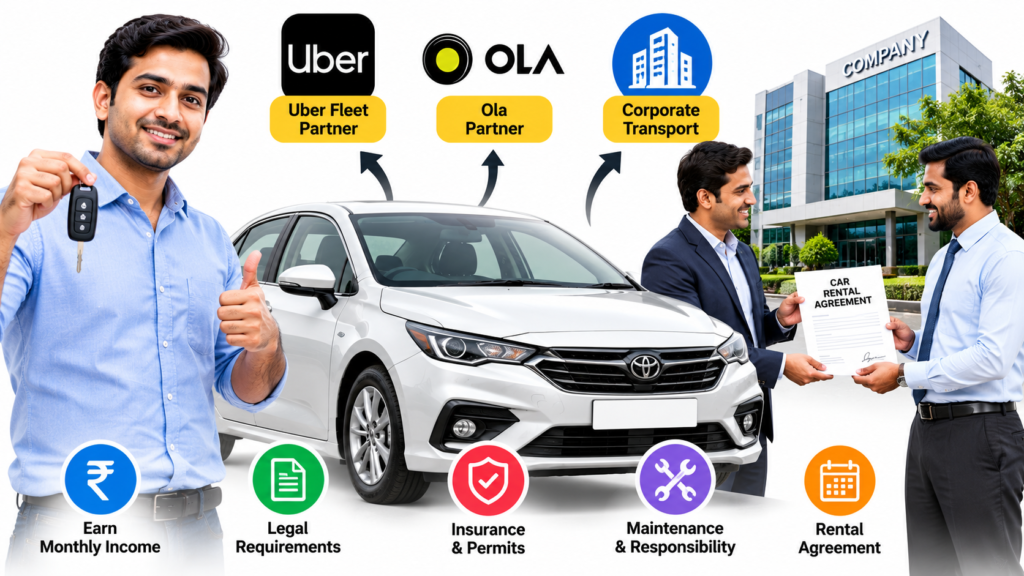
1. Can You Rent Out Your Private Car for Monthly Income in India?
Yes, there may be opportunities to earn income from a car you own, but the arrangement must be legally permitted and commercially suitable.
There are several possible routes:
- App-based taxi fleets: Work with a fleet partner that operates vehicles through a platform such as Uber, subject to eligibility.
- Corporate office transport: Approach companies that arrange daily transportation for employees.
- Employee transportation contractors: Contact vendors that provide cars for office pick-ups, drop-offs, and scheduled travel.
- Car rental companies: Explore companies that operate rental fleets, subject to the relevant rental regulations.
- Business vehicle leasing: Consider a lawful leasing arrangement with a business that needs a vehicle for its operations.
These options are not identical. A taxi fleet may require a commercial passenger vehicle and an approved driver. A self-drive rental business may operate under a different regulatory framework. A corporate transport contractor may have its own vehicle, permit, insurance, and contract requirements.
Before selecting a company, decide whether you want to provide the car with a driver, without a driver, or through a fleet partner that manages the driver.
2. Can You Give Your Car to Uber or Ola Without Driving It Yourself?
This is one of the most important questions for car owners who want to earn from their vehicles without becoming drivers.
Uber fleet partner option
Uber describes a non-driving partner or fleet partner as someone who owns vehicles and manages at least one driver. Its published India guidance lists vehicle registration, insurance, and a vehicle permit among the requirements, and says a commercial car is necessary for its driver-partner arrangements.
You can start by reviewing the official Uber India vehicle requirements and Uber driver requirements.
Contact Uber or an approved fleet partner to ask whether they accept owner-provided vehicles in your city. Ask whether the arrangement involves a fixed monthly lease, a revenue-sharing model, or another payment structure.
Do not assume that Uber will directly accept every privately owned car or offer a guaranteed monthly rental. Acceptance depends on local requirements, vehicle eligibility, and the specific partner arrangement.
Ola option
Ola’s official support information lists documents such as vehicle insurance, the registration certificate, PAN, address proof, and a cancelled cheque for its car-attachment process. It also lists a commercial driving licence and other documents, depending on the arrangement.
You can begin with the Ola Support website and search for the current vehicle attachment process. Ask whether the available programme accepts a non-driving vehicle owner or requires you to join through a fleet operator.
Confirm the current process for your city before spending money on registration changes or vehicle modifications.
3. How to Rent Your Car to a Corporate Office Transport Company
For someone who does not want to drive, corporate transportation may be worth exploring.
Many businesses arrange transport for employees working night shifts, early shifts, or at offices located far from public transport. Some use transport contractors to manage their vehicles and drivers.
Instead of approaching every company individually, you can search for transport vendors that already manage office pick-ups and drop-offs.
Where can you find corporate transport contractors?
Try these methods:
Search Google Maps: Search for phrases such as “corporate employee transport services,” “office cab service,” “employee transportation company,” or “corporate fleet operator” followed by your city.
Contact local business parks: Ask the administration office of nearby IT parks, industrial areas, business centres, and large office complexes whether they can direct you to their authorised transport vendors.
Search job and business directories: Some fleet operators advertise for vehicle owners, driver partners, and vehicle suppliers. Verify the business before sharing documents or paying any fee.
Approach established transport vendors: Contact companies that already provide employee transport to offices, hospitals, hotels, factories, or other organisations.
Ask for the fleet manager: When calling a company, ask to speak with the person responsible for fleet procurement, vehicle attachment, or vendor management.
A simple introduction could be:
“I own a car and am interested in providing it to your company on a monthly contractual basis. Do you accept owner-provided vehicles? Please share your eligibility requirements, expected vehicle specifications, payment terms, and required documents.”
Be clear that you are interested in providing the vehicle without personally driving it.
4. Can You Give Your Car to a Car Rental Company Without a Driver?
Another option is to approach a company that rents vehicles to customers who drive themselves.
This is different from providing a car for an Uber or office taxi service. In a self-drive rental arrangement, the rental business supplies the vehicle to a customer who drives it. Such operations are subject to applicable rental regulations, licensing or operator requirements, and vehicle conditions.
Section 75 of the Motor Vehicles Act, 1988, provides for a scheme regulating the rental of motorcabs and motor vehicles to people who wish to drive them themselves or use them through a driver, as provided under the applicable scheme.
Before agreeing to a self-drive arrangement, ask the company:
- Does it legally operate a self-drive rental service?
- Can it accept a vehicle from an individual owner?
- What registration and insurance are required?
- Who is responsible for the renter’s verification?
- Who handles accidents, fines, damage, and insurance claims?
- Is the monthly payment fixed, or does it depend on bookings?
You can review the Motor Vehicles Act on India Code for the statutory framework.
Never hand over a privately registered car for commercial rental simply because a company promises to manage everything. Verify the arrangement with the relevant transport authority and your insurer first.
5. Can You Rent Out a White-Plate Private Car?
This is a crucial issue.
A private registration generally identifies a vehicle intended for private use. Using that vehicle for commercial passenger transport or a commercial rental operation may require a different registration classification, permits, insurance, or other approvals, depending on the intended use and applicable law.
Uber’s published India vehicle requirements specify a yellow-plated vehicle and relevant documents, including the registration certificate, insurance, and tourist permit.
Therefore, do not assume that your existing white-plate car can be attached to a taxi fleet without changes.
Before signing a contract, contact your local Regional Transport Office (RTO) and ask:
- Can your specific vehicle be used for the proposed commercial arrangement?
- Is a change in registration classification required?
- Which permit and insurance policy are applicable?
- Are there vehicle-age, fitness, tax, or inspection requirements?
- Who is responsible for obtaining and maintaining the necessary approvals?
Requirements can vary according to the state, vehicle category, seating capacity, and business model.
6. Documents You May Need to Rent Out Your Car
The exact paperwork depends on the company and how the vehicle will be used. A prospective partner may request some or all of the following:
- Vehicle Registration Certificate (RC)
- Valid insurance suitable for the intended use
- Owner’s PAN card
- Owner’s identity and address proof
- Bank account details or a cancelled cheque
- Pollution Under Control (PUC) certificate, where required
- Applicable commercial permit and fitness certificate
- Vehicle inspection report
- No Objection Certificate (NOC), where applicable
- Loan or financier approval, if the vehicle is financed and the agreement requires it
- Signed vehicle lease or fleet attachment agreement
Do not share sensitive documents with an unknown person through an unverified link or personal messaging account. Verify the company’s identity and explain how your information will be used.
If your car is financed, read the loan agreement before leasing it to another party. You may need approval from the financier or insurer, depending on the terms.
7. How Much Monthly Income Can You Earn From Your Car?
The amount you can earn depends on the vehicle, location, age, condition, commercial eligibility, usage, and contract terms.
There is no single monthly rental rate that applies to every car in India. A vehicle used for regular corporate transportation may have a different contract from one operated by a taxi fleet or self-drive rental company.
Rather than relying on online advertisements promising a specific income, ask prospective partners for a written offer.
Understand the difference between rent and profit
A company might offer you a fixed monthly payment, but you should calculate what remains after expenses.
For example, suppose a company offers ₹25,000 per month for your car. This is only an illustrative offer, not a market-rate estimate or guaranteed income.
You would need to subtract any costs that remain your responsibility, such as:
- Insurance and registration-related expenses
- Maintenance and tyre replacement
- Repairs and wear and tear
- Loan instalments, if applicable
- Taxes and other applicable charges
- Periods when the vehicle is not earning income
Your actual profit could be substantially lower than the monthly payment.
Before accepting an offer, ask whether the company pays a fixed amount regardless of usage or whether the payment depends on the number of trips, bookings, or working days.
8. Fixed Monthly Rent or Revenue Sharing: Which Is Better?
The right model depends on your financial needs and your willingness to accept risk.
Fixed monthly rental
Under this model, the agreement specifies a monthly amount for the vehicle, subject to the contract’s conditions.
Potential advantage: It can make budgeting easier if the payment terms are reliable and clearly documented.
Potential disadvantage: You may receive less than you could earn under a successful revenue-sharing arrangement. You also need to check who pays for repairs, downtime, and excess usage.
Revenue sharing
Under this model, your payment depends on revenue, bookings, trips, or another agreed formula.
Potential advantage: Earnings may increase when vehicle utilisation is high.
Potential disadvantage: Income may fluctuate, and it can be harder to predict the amount you will receive.
Ask for sample monthly statements and a clear explanation of deductions before signing.
For someone who wants predictable income, a genuine fixed-rent contract may be more suitable. However, a fixed amount is useful only if the agreement defines payment dates, deductions, and responsibilities clearly.
9. What Should You Check Before Handing Over Your Car?
A written contract is essential when another person or company will control your vehicle.
Confirm the monthly payment
The agreement should specify the rental amount, payment date, security deposit, deductions, and conditions for late payment.
Decide who pays for maintenance
Clarify responsibility for routine servicing, tyres, batteries, mechanical repairs, and damage caused during use.
Set limits on vehicle usage
Discuss permitted locations, monthly kilometres, commercial routes, interstate travel, and who may drive the vehicle.
Confirm insurance coverage
Tell your insurer about the intended use. Do not assume that a private-use policy automatically covers commercial transport or self-drive rental.
Protect yourself against misuse
The agreement should address traffic fines, accidents, unauthorised drivers, vehicle theft, and delayed return of the vehicle.
Understand termination conditions
Ask how much notice is required to end the contract, how the vehicle will be returned, and how outstanding payments or damage claims will be settled.
Record the vehicle’s condition
Take dated photographs of the exterior, interior, odometer, tyres, and existing damage before handover. Keep a signed handover report and copies of the relevant documents.
10. Warning Signs to Watch Out For
Unfortunately, vehicle owners can encounter misleading offers when searching for rental income.
Be cautious if someone:
- Promises unusually high guaranteed income without a written contract.
- Demands a large advance fee just to register your car.
- Refuses to disclose the company’s legal identity or office address.
- Asks you to hand over the original RC without a clear, legitimate reason.
- Says commercial permits and insurance are unnecessary.
- Refuses to explain responsibility for accidents or vehicle damage.
- Pressures you to sign blank forms or incomplete agreements.
Verify the business independently. Contact the relevant platform through its official website rather than relying only on a person who claims to be an agent.
Do not hand over the keys until the company’s identity, the legal vehicle arrangement, insurance, and payment terms have been checked.
11. Step-by-Step Plan to Start Renting Out Your Car
If you want to explore this opportunity, follow a practical process.
Step 1: Check your vehicle. Note the make, model, year, fuel type, condition, kilometres driven, and registration details.
Step 2: Choose your preferred model. Decide whether you want a taxi fleet, corporate transport contractor, or lawful self-drive rental operator.
Step 3: Verify commercial eligibility. Contact your RTO and insurer before using the vehicle for commercial purposes.
Step 4: Contact potential partners. Ask companies whether they accept owner-provided vehicles without the owner driving.
Step 5: Compare written offers. Look at monthly payments, deductions, maintenance costs, permitted usage, and contract duration.
Step 6: Verify the company. Check its registration, office details, reputation, and authority to operate the proposed service.
Step 7: Sign a clear agreement. Document payment terms, responsibilities, insurance, accident procedures, and return conditions.
Step 8: Complete the handover. Record the car’s condition and odometer reading, and keep copies of all signed documents.
Taking these steps can help you avoid unsuitable arrangements and choose a contract that matches your expectations.
Frequently Asked Questions (FAQs)
1. Can I rent out my private car to Uber in India?
Potentially, through an eligible fleet or partner arrangement. Uber’s published India requirements specify a yellow-plated vehicle and relevant documents. Confirm whether your car and proposed arrangement qualify before applying.
2. Can I give my car to Ola without becoming a driver?
You can enquire about vehicle attachment and fleet-partner opportunities, but acceptance depends on the current programme, city, vehicle eligibility, and arrangement. Ask Ola or an authorised fleet operator whether they accept non-driving vehicle owners.
3. Can I give my car to a company for monthly rent without a driver?
Some businesses may consider owner-provided vehicles, but the arrangement must meet the relevant registration, permit, insurance, and operating requirements. A company’s willingness to accept the car does not, by itself, establish that the proposed use is legally permitted.
4. Can I earn a fixed monthly income from my car?
A company may offer a fixed monthly lease, but availability and payment amounts vary. Read the agreement carefully and calculate your costs before estimating your net income.
5. Can I rent out a white-plate car for commercial use?
Do not assume that a private registration permits commercial passenger transport or rental. Check the applicable rules with your RTO and insurer before proceeding.
6. Who pays for repairs if the rented car is damaged?
That depends on the agreement, the cause of damage, and the applicable insurance policy. Make sure the contract clearly explains liability, deductibles, repair approval, and claims procedures.
7. Is renting out a car a passive-income opportunity?
It may reduce the time you spend driving, but it is not necessarily completely passive. You may still need to manage documents, maintenance, insurance, payments, inspections, and disputes.
8. Where should I search for companies that rent cars monthly?
Start with official platform websites, established fleet operators, corporate transport contractors, and local business directories. Search using terms such as “corporate car rental,” “employee transport vendor,” and “fleet operator” alongside your city name. Verify every company before entering into an agreement.
Conclusion
Renting out a car that you rarely use may provide an opportunity to earn additional income, especially if you can find a reliable fleet operator, corporate transport contractor, or legally authorised rental business.
The most important step is to choose the right arrangement for your vehicle. A car intended for app-based passenger transport may have different requirements from a vehicle used for self-drive rental or corporate leasing.
Before handing over your keys, confirm the registration and permit requirements, inform your insurer, compare written offers, and sign an agreement that protects your interests.
A good contract and a verified business partner matter just as much as the monthly rental amount. Plan carefully, check the rules, and evaluate the actual profit rather than relying on promised earnings.
SHARING IS CARING 💖