
A car accident can be a stressful experience. Apart from vehicle damage, injuries, medical expenses, and insurance claims, employees may worry about another important question: Can you lose your job after a car accident in India?
The answer depends on the circumstances. A road accident does not automatically mean that an employee will lose their job. However, serious misconduct, drunk driving, reckless driving, violation of workplace rules, or an accident involving a work vehicle may lead to disciplinary action in certain situations.
The rules can also differ between private-sector employees, Central Government employees, State Government employees, and employees working in safety-sensitive roles.
In this guide, we explain when a car accident may affect employment, what legal issues can arise, and what employees should do to protect their rights after an accident in 2026.
Disclaimer: This article provides general information about Indian law. It is not a substitute for advice from a qualified lawyer who can examine the facts of an individual case.
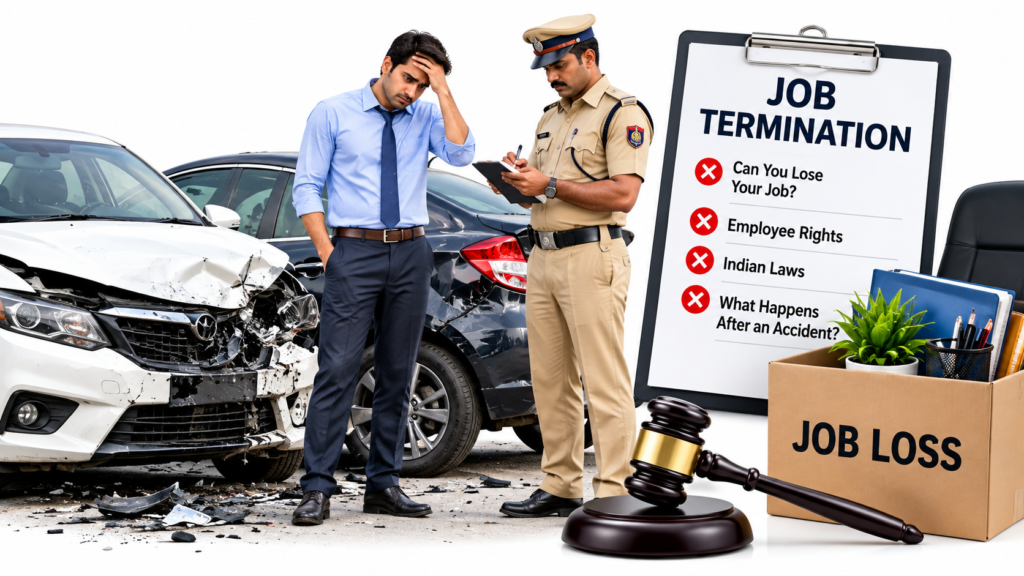
1. Can You Lose Your Job After a Car Accident in India?
In general, an employee does not automatically lose their job simply because they were involved in a car accident.
The employer may consider the circumstances surrounding the accident, including whether the employee was on duty, whether the accident involved a company vehicle, whether traffic laws were violated, and whether the incident breached workplace policies.
For example, an employee who is involved in an ordinary accident while travelling privately may be treated differently from an employee who causes an accident while driving a company vehicle under the influence of alcohol.
Possible outcomes may include:
- No employment action if the incident has no relevant connection to work and no applicable rule has been breached.
- A warning or other disciplinary action where a workplace policy has been violated.
- Temporary suspension where permitted by the applicable rules.
- Dismissal or termination in serious cases, subject to the relevant law and required procedure.
- Separate police or court proceedings if a criminal offence is alleged.
These are possible outcomes, not automatic penalties. An employer should not assume that every accident proves misconduct.
2. Does Every Car Accident Lead to Job Termination?
No. A car accident and workplace misconduct are not the same thing.
An accident may occur because of another driver’s mistake, poor road conditions, mechanical failure, reduced visibility, or circumstances that the employee could not reasonably avoid.
The employer may need to examine the evidence before deciding whether the employee breached any employment obligation.
Consider these examples:
Example 1: An accident caused by another driver
An employee is driving their personal car outside working hours when another vehicle hits it. There is no allegation of unlawful driving or breach of an employment rule.
In such a situation, job loss would not ordinarily follow merely because the employee was involved in the accident. The exact position still depends on the employment contract and any relevant rules.
Example 2: An accident involving drunk driving
An employee drives while intoxicated and causes an accident. The incident may lead to criminal proceedings and may also be treated as serious misconduct, particularly if the employee drives as part of their job.
Disciplinary action may be possible, but the employer must consider the applicable service rules, employment terms, and required procedures.
Example 3: An accident in a company vehicle
An employee causes an accident while using a company vehicle. The employer may investigate whether the employee followed driving policies, safety instructions, and authorised-use requirements.
The outcome depends on the evidence and seriousness of any established violation.
3. Can a Private Company Fire an Employee After a Car Accident?
A private company may take disciplinary action if an accident is connected to misconduct or a breach of a valid workplace policy. However, it does not follow that every accident gives an employer an unrestricted right to dismiss an employee.
The legal position may depend on:
- The employment contract and applicable service rules
- The employee’s actual duties and employment category
- Whether the employee was on duty or using a company vehicle
- Whether serious negligence or unlawful conduct is established
- Applicable state law and labour legislation
- The procedure required for disciplinary action or termination
Some employees may have contractual notice or notice-pay rights. Others may be covered by statutory employment protections, depending on their role and the law that applies.
An employee who believes they were unfairly dismissed should preserve their employment documents and seek advice based on their specific circumstances.
4. Can a Government Employee Lose Their Job After a Car Accident?
Government employees are generally subject to applicable service rules and conduct requirements. A car accident does not automatically mean that a government servant will be dismissed.
For Central Government employees covered by the Central Civil Services (Classification, Control and Appeal) Rules, 1965, disciplinary action and penalties are governed by the applicable service framework. State Government employees and employees in other services may be governed by different rules.
Relevant factors can include:
- Whether the employee was on official duty
- Whether the accident involved an official vehicle
- Whether an offence or serious misconduct is alleged
- Whether the employee was driving under the influence of alcohol
- Whether a departmental or criminal investigation is underway
- Whether the applicable service rules permit disciplinary action and what procedure is required
Depending on the circumstances, a department may consider an investigation or disciplinary proceedings. Suspension, where legally permitted, is not the same as dismissal and does not itself establish guilt.
Employees should consult their department’s administration or disciplinary section and review the rules applicable to their service.
Official reference: Department of Personnel and Training (DoPT).
5. What If a Government Employee Causes an Accident While Drunk Driving?
Drunk driving is a serious matter under Indian traffic law. It can expose a driver to legal consequences and may also have employment consequences.
Under Section 185 of the Motor Vehicles Act, 1988, driving with alcohol exceeding the prescribed limit or under the influence of drugs can attract legal penalties.
If a government employee is accused of drunk driving, the department may examine whether the conduct violates the employee’s service or conduct rules. The consequences may be more serious if the employee was driving an official vehicle or performing a safety-sensitive duty.
However, the exact employment outcome depends on the facts, evidence, applicable service rules, and required disciplinary procedure. An allegation should not be treated as an automatic finding of guilt.
Official reference: India Code — Government of India legislation.
6. Can an Employee Be Suspended After a Road Accident?
Suspension may be possible in certain circumstances, but it is not an automatic consequence of every road accident.
For a government employee, suspension is governed by the applicable service rules. For a private employee, the employment contract, workplace policy, applicable law, and nature of the employment may be relevant.
An employer or department may consider temporary removal from duties where there are serious safety concerns, an investigation, or another legally relevant reason.
Employees should ask for the written order or communication, where applicable, and understand whether the action is an interim measure or a final disciplinary penalty.
Remember: Suspension and dismissal are different. A suspension does not, by itself, mean that the employee has been found guilty or permanently removed from service.
7. What If the Accident Occurs While Travelling for Work?
An accident during official travel or while driving a company vehicle may raise additional questions.
For example, the employer may investigate whether the employee was performing authorised work, following company driving policies, or using the vehicle as permitted.
If an employee is injured while travelling for work, separate questions about workplace injury benefits, insurance, medical support, or compensation may arise. Eligibility depends on the applicable law, employment arrangement, and connection between the accident and employment.
Employees should report the incident through the required workplace procedure and preserve relevant evidence, including:
- Police or accident reports, if available
- Medical records and bills
- Photographs or video of the scene
- Witness details
- Employer incident reports
- Vehicle insurance and registration documents
- Official travel or duty records
These documents may help clarify what happened and support any employment or insurance claim.
8. Can an Employer Terminate an Employee Before a Criminal Case Is Decided?
The answer depends on the nature of the employment, the applicable law, and the circumstances.
A criminal case and an internal disciplinary process are separate processes, although they may involve some of the same facts. An employer may be able to conduct an internal investigation without waiting for the final outcome of a criminal case, where the applicable rules permit it.
However, any disciplinary action must comply with the relevant legal requirements. In some cases, the overlap between criminal proceedings and disciplinary action may require specific legal consideration.
Employees should not assume either that a pending criminal case automatically requires termination or that an employer must always wait until the case concludes.
If dismissal or disciplinary action is threatened, consult a lawyer who can review the allegations, the applicable service rules, and the available evidence.
9. What Are an Employee’s Rights After a Car Accident?
Employees should understand that their rights depend on the applicable employment framework. The following practical steps can help them respond responsibly.
Report the accident accurately
Follow the required reporting procedure if the accident occurred during work, involved a company vehicle, or must be reported under workplace rules. Do not provide false information or conceal relevant facts.
Keep the evidence
Retain photographs, police documents, medical records, insurance details, witness information, and relevant messages or emails.
Read any disciplinary notice carefully
If an employer or department issues a notice, charge sheet, or request for an explanation, read it carefully and respond within the stated deadline.
Ask about the applicable procedure
Government employees should consult the relevant service rules. Private-sector employees should review their contract, workplace policies, and applicable employment law.
Seek independent legal advice
If an employee faces dismissal, a criminal allegation, or a serious disciplinary proceeding, a qualified lawyer can explain the available remedies and deadlines.
10. What Should You Do If You Are Fired After a Car Accident?
If you believe your employer has terminated your employment unfairly after an accident, avoid relying on verbal assurances alone.
Take these steps:
- Obtain and retain the termination letter or written communication.
- Review your employment contract and any applicable disciplinary rules.
- Preserve the accident report, medical documents, witness information, and relevant correspondence.
- Check whether the employer followed the procedure required for your employment category.
- Ask for clarification of the stated reason for termination, where appropriate.
- Consult a qualified employment lawyer or the relevant labour authority to understand your options.
Do not ignore deadlines for responding to notices or pursuing a legal remedy. The correct forum and remedy can depend on the nature of your job, the facts of the case, and the applicable legislation.
Frequently Asked Questions (FAQs)
1. Can I lose my job for a car accident that was not my fault?
Not automatically. If an accident was not your fault and you did not breach a relevant workplace rule, job loss would not ordinarily follow merely from being involved in the accident. The specific facts and applicable employment rules matter.
2. Can a government employee be dismissed after a road accident?
Possible disciplinary action depends on the circumstances and applicable service rules. An ordinary accident does not automatically result in dismissal. Serious misconduct or unlawful conduct may lead to disciplinary proceedings.
3. Can drunk driving lead to job loss in India?
It can have employment consequences, especially when driving is part of the employee’s duties or the conduct violates service rules. The outcome depends on the facts, evidence, and applicable disciplinary procedure.
4. Can a company suspend an employee after an accident?
Suspension may be possible where permitted by the relevant law, contract, or service rules. It is not an automatic result of every accident and is different from permanent dismissal.
5. Can an employee be fired for damaging a company car?
The employer may investigate the circumstances, including negligence, misuse, or breach of vehicle policy. Any disciplinary action should be assessed under the applicable employment rules and facts.
6. Does a pending police case automatically mean job termination?
No universal rule says that every pending police case automatically results in termination. The employment consequences depend on the alleged offence, applicable rules, and the circumstances of the case.
7. Where can a government employee check the applicable rules?
Central Government employees can begin with the DoPT website. State Government employees should consult the conduct and disciplinary rules applicable to their state or service.
Conclusion
A car accident does not automatically mean that you will lose your job in India. The outcome depends on the circumstances of the accident, whether any misconduct or offence is established, the employee’s role, and the employment rules that apply.
An ordinary accident may have no employment consequences, while serious misconduct such as drunk driving or a major breach of workplace safety requirements may lead to disciplinary action.
If you are involved in an accident, report it as required, preserve the evidence, respond carefully to any disciplinary notice, and obtain legal advice if your employment is at risk. Understanding your rights and responsibilities can help you make informed decisions during a difficult situation.
SHARING IS CARING 💖